Hiroshima Peace Declaration on 81st anniversary of atomic bombing [Full
Text]
-
The following is the full text of the Peace Declaration read on Aug. 6 by
Hiroshima Mayor Kazumi Matsui at a ceremony to mark 81 years since the 1945
ato...
Latest Post
Showing posts with label climate crisis. Show all posts
Showing posts with label climate crisis. Show all posts
World's largest and most disastrous project allocated budget
Written By mediavigil on Wednesday, February 02, 2022 | 12:46 AM
The ILR project is contrary to India's commitment under United Nations Framework Convention on Climate and Change, Paris Agreement, Convention on Biological Diversity besides constitutional obligations under Article 48 -A of the Constitution of India which states that “the state shall endeavor to protect and improve the environment and to safeguard the forests and wild life of the country”. According to the Intergovernmental Panel on Climate Change’s 2019 special report on climate change and land, in total, land use is just behind electricity and heat production as the world’s second-largest contributor to greenhouse gas emissions.
World's largest and most disastrous project of diversion of 39 rivers for interlinking is war against rivers. "The expected financial implication as far back as in 2002 was Rs.5,60,000 crores." The source of estimate was never disclosed. The National council of applied economic research (NCAER) study has revealed it to be a flawed estimate.
In the light of insight from Mahabharata, Union Budget 2022-23 is against rivers, which are veins and arteries of nature, according to Mahabharata. Diversion of rivers like Ken-Betwa, Damanganga-Pinjal, Par-Tapi- Narmada, Godavari-Krishna, Krishna-Pennar and Pennar-Cauvery as part of India's ILR project entails massive land use change, contributing to climate crisis irreversible loss of biodiversity. Interlinking of Rivers (ILR) project is anti-oceans and anti-rivers project.
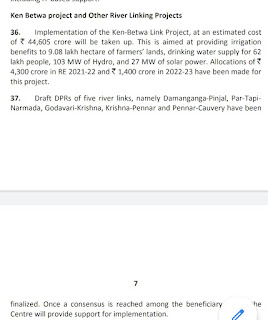
Ken-Betwa is the first link out of 30 links of ILR project which will cost ₹44000 crores. In the 2022-23 budget 1400 crore has been allocated. When union govt realized opposition to national ILR project. Its Plan B is to disaggregate the plan and rope in States, to diffuse united resistance.
The ILR project was rejected in 1999 by National Commission on Integrated Water Resource Management. It was revived by Supreme Court in October 2002 while hearing a petitioner-less case by Chief Justice B. N. Kripal. The same Justice Kripal's observations were repeated by Justice Swatanter Kumar in February 2012.
The unjust verdict of Supreme Court in October 2002 and the one dated February 27, 2012 in petitioner-less Writ Petition (Civil) No. 512 of 2002 by Justice Swatanter Kumar are based on a flawed assumption that there is consensus & unanimity among the states in the matter of ILR project. It is the most disastrous project for ever endorsed by any judge anywhere in the world.
Sometime back in response to my letter to the Union Minister of Water Resources on the subject of "Why several states remain opposed to rewriting of geography through interlinking of rivers", I got a response from Director (Technical), National Water Development Authority (NWDA), Union Ministry of Water Resources. NWDA attempted toe respond to some issues out of several issues I had raised although many of the questions have remained unanswered.
In response to NWDA’s submission about “consensus” among states and Court’s observation on “unanimity” among states on rewriting of geography through interlinking of rivers, I submitted the following:
1. Contrary to NWDA’s submission, Para 29 of Supreme Court’s judgment records: “In the Par-Tapi-Narmada and Damanganga-Pinjal links, residents have shown concern about the extent of land to bes ubmerged on the construction of the proposed dam.” NWDA’s submission “The consensus building amongst the States on river link projects is an ongoing process” does not appear to be valid. It does not stand the test of “consensus building” exercise. The use of the phrase“ consensus building” itself shows that there is going to be an effort to build something which does not pre-exist. The fact is that the whole exercise with regard to rewriting of geography through interlinking of rivers is based on the flawed assumption of “consensus” and “unanimity” although 18 States chose not respond to the notice of Supreme Court of India “despite the grant of repeated opportunities to do so".
2. Consensus is defined by Merriam-Webster Dictionary as, first, general agreement, and second, group solidarity of belief or sentiment. It has its origin in the Latin word cōnsēnsus (agreement), which is from cōnsentiō meaning literally feel together. According to Oxford Dictionary, Consensus means “A general agreement (of opinion, testimony etc)” and “collective opinion”. The contention about “consensus building” is reminiscent of what Prof. Mason Cooley said about use of “vague language and shallow commitments” for achieving it.
At para 28, the Court’s order states: “even comprehensive clearances, from the Uttar Pradesh Government, have not been received.
The State of Rajasthan refuses to consider the MoU for another priority link, Parbati-Kalisindh-Chambal, until the updation of its hydrology project.” Hon’ble Court’s observations and ToR of the government’s Task Force and now its Special Committee constituted on 23.09.2014 reveal that consensus building efforts by government since December 2002 has failed. It also reveals that it Court was misled into assuming consensus and unanimity.
3. There is no agreement between states for implementation of the projects, only an agreement for Detailed Project Report (DPR). More importantly, there is no consensus attempted or achieved with the affected people across the river basins, nor a consensus that this is a optimal, desirable or viable option. There is lack of implementation agreement in case of any of the three projects NWDA is claiming to have consensus for.
4. For Ken Betwa, its EIA is shoddy and the public hearings involved violations. For Details see: https://sandrp.wordpress.com/2014/12/21/why-ken-betwa-eia-by-afcl-is-unacceptable/
and https://sandrp.wordpress.com/2014/12/20/violations-in-ken-betwa-riverlink-public-hearings-in-last-week-of-2014/
Not only that academicians and economists like Prof. Kanchan Chopra have also questioned the rationale of the Ken-Betwa link. Institutions like South Asia Network on Dams, Rivers and People (SANDRP) have provided irrefutable critique of this link.
5. For Par Tapi Narmada, the fact is that there is a strong opposition in Maharashtra. For Details: see:
https://sandrp.wordpress.com/2015/01/08/interlinking-conflicts-maharashtra-se-gujarat-tak/
and https://sandrp.wordpress.com/2015/04/30/par-tapi-narmada-link-divided-states-united-tribals/
The diversion of water to Gujarat Par Tapi Narmada link has created a political turmoil in Maharashtra. Notably, a special meeting was held between Maharashtra Water Resources Minister Girish Mahajan and MLAs from the Par, Nar, Ambika and Tapi regions, which include Baglan, Chanwad, Devala, Malegaon, Surgana-Kalvan etc to discuss strategy before interstate meeting between officials from Maharashtra and Gujarat on the interlinking projects in March 2015. It was urgently decided that the government will come up with a master plan for using waters of these rivers for Maharashtra itself rather than diverting it to Gujarat through the Par-Tapi Narmada link. In a meeting in Vadodara organized by the NWDA, there was an appeal to give immediate permission for the Par-Tapi Narmada Link project, but officials of the Tapi Irrigation Development Corporation from Maharashtra opposed this.
Locals have organized fasts and protests opposing this move, and the tremendous opposition to these plans in the affected regions and the proposed beneficiary region.
6. The fact is how can there be consensus and unanimity to undertake delinking of rivers from their basins. Sanity prevents emergence of dangerous consensus and unanimity for mutilating rivers from their basins.
7. NWDA seems to suffer from a gross materialist and technocentric bias wherein water flow is deemed material flow alone and not the flow of life that sustains life. NWDA must appreciate the pearls of wisdom from Mahabharata that describes the Divine Being saying, “The mountains are his bones. The earth is his fat and flesh. The oceans are his blood. Space is his stomach. The Wind is his breath. Fire is his energy. The rivers are his arteries and veins. Agni and Soma, otherwise called the Sun and the Moon, are called his eyes. The firmament above is his head. The earth is his two feet. The cardinal and subsidiary points of the horizon are his arms,” the new government should reject the idea of “inter-linking of rivers based on feasibility”. This is narrated by Bhishma in conversation with Yudhishthira while referring to the reply of sage Bhrigu to sage Bharadwaja. This verse occurs in the Shanti Parva of Mahabharata. NWDA fails to recognize that Interlinking of rivers project is an exercise in delinking because it entails mutilation of the veins and arteries of the divine nature. Rivers shape the terrain and lives of people by its waters which are always in a dynamic state. Breaking this dynamic would unleash forces of uncontrolled change and invite the ‘law of unintended consequences’.
In response to NWDA’s submission “As regard to the environment and forest clearances these are being pursued for individual link Project vigorously and hoped that the same will become available”, we submitted the following:
1. Given the fact that ILR project is a cumulative project, isn’t it logically compelling to undertake cumulative environment and forest impact assessment prior to seeking clearances? The practice of seeking “environment and forest clearances” admittedly “for in dividuallink Project” shows deep insensitivity towards environment and forests. Thus, it is deeply flawed.
2. NWDA appears to be pursuing the colonial legacy of viewing land, water and virtual water separately. It must review, revise and reverse its approach for conserving the very substratum of existence.
3. It is noteworthy that National Bureau of Soil Survey and Land Use Planning and Indian Council of Agricultural Research note that about 146.82 million hectare area of country's total geographical area of 328.60 million hectares is hit by various kinds of soil erosion and land degradation. This is about 45 per cent of the country's total geographical area. This land degradation is due to soil erosion at an average rate of 16.4 tonnes per hectare per annum although the permissible limit (of erosion) is 10 tonnes per hectare per annum. Land degradation of about 9.48 million hectare happens by wind erosion.
4. NWDA and other concerned planners and law makers are yet to take cognizance of the fact that about 93.68 million hectare soil of the total degraded area of 146.82 million hectare has eroded due to water.
This constitutes about 63 per cent of the total degraded area. About 16.03 million hectare land has been degraded by soil acidity and about 14.30 million hectare by water logging.
5. NWDA must adopt river basin approach because it strikes a balance between the existing natural functions of the river system and societal expectations for livelihoods, industry, recreation, nature management, and agriculture. This approach maximizes the economic and social benefits derived from water resources in an equitable manner while conserving and, where necessary, restoring freshwater ecosystems. It factors in doctrine of riparian rights that emphasizes recognition of equal rights of water use by all owners of land subject to non-interference with rights of other riparian owners and the territorial integrity theory or theory of natural water flow wherein every lower riparian is entitled to natural flow of river without interference from upper riparian. It adopts the doctrine of community of interest implying that a river passed through states is deemed to be one unit and should be developed as such. The approach of seeking “environment and forest clearances” admittedly “for individual link Project” is quite parochial, dated and is caught in a time warp.
6. NWDA cannot even attempt to defend the indefensible without the cumulative impact assessment of the ILR project. So far it has completely failed to do so. It is relevant to recall that a partial, unsuccessful and biased attempt was made to undertake cumulative impact of assessment of hydropower projects in Alaknanda and Bhagirathi Basins. For the ILR project, cumulative impacts must assess changes in sedimentation at various points within project, at various points within a day, season, year, over the years and cumulatively across the basin and impacts thereof. It should assess cumulative impact on aquatic and terrestrial flora and fauna across the basin due to ILR project. It should assess cumulative impact on hydrological flows, at various points within project, at various points within a day, season, year, over the years and cumulatively across the basin and impacts thereof. This should include impacts on various hydrological elements including springs, tributaries, groundwater aquifers, etc. This assessment must provide a picture of what is the situation before undertaking the ILR project and what would be the situation. After the implementation of the project. It should account for cumulative green house gas emissions. It should assess the cumulative impact of mining of sand, boulders, coarse and fine granules etc required for the ILR project. It should assess the cumulative impact of blasting of so many tunnels. It should assess cumulative impact of improper and proper muck dumping into rivers. Its hould assess cumulative impact of silt laden water into the river channel downstream from the dam, and how this gets accumulated across the non monsoon months and what are its implications. It should assess cumulative impact of release of silt free water into the river downstream from the power house and impact thereof on the geomorphology, erosion, stability of structures etc. It should assess cumulative impact of differential water flow downstream from powerhouse in non monsoon months, with sudden release of heavy flows during peaking/ power generation hours and no releases during other times. It should assess cumulative impact of all the project components (dam, tunnels, blasting, power house, muck dumping, mining, road building, township building, deforestation, transmission lines, submergence etc) for the ILR project. This should be done for the periods during construction, operation and decommissioning phases of the projects.
As to NWDA’s submission regarding the formation of special committee and task force, the fact is that there has been no transparency and credible participation. I wish to know on what basis and how the earlier expert committee was dissolved, even without informing the members.
NWDA’s contention “the ILR projects are green projects and these link projects under ILR Programme have been formulated by exercising all caution and considering all engineering parameters required for the project” ignores the glaring fact of South Asia’s biggest ecological crisis due to construction of embankments in Kosi basin in Bihar and Nepal. These misplaced engineering interventions have created unprecedented drainage congestion crisis even as NWDA and its sister organizations keep claiming that it was “formulated by exercising all caution and considering all engineering parameters required for the project.” NWDA’S contention ignores the lessons from the drying up of Aral Sea, the world biggest ecological catastrophe because of diversion of Siberian rivers in former USSR.
We submit that some 60 years ago Aral Sea basin was a richly forested eco-system fed by two of the longest rivers in Asia. It stretched 266 miles from its northern port, Aral'sk, to the port on its southern delta, Muynak. The lake was fed in the north by the Syr-Dar'ya River, flowing from its headwaters in Kyrgyzstan through Uzbekistan and Tajikistan, then north through Kazakhstan into the lake. The Amu-Dar'ya River begins near Khyber Pass in Afghanistan, flowing along the border between Turkmenistan and Uzbekistan before forming a delta at the southern end of the Aral Sea. After the collapse of USSR, Kazakhstan borders the Aral Sea in the north, while Uzbekistan lies on the south shore. After the collapse USSR, scientists discovered that the Aral Sea was missing. At present the Aral Sea has lost three-fourths of its former volume and two-thirds of its former surface area. The water level has dropped by almost seventy feet, and the salinity of the lake is triple the level of forty years ago. The former sea has split into two parts with a diminishing trickle of water between them. There are projections about its complete disappearance in near future.
We submit that quite like the proposed ILR project, Soviet government had launched a massive irrigation project. In 1ate 1930s when it was decided to drain the rivers of the Aral basin to irrigate wide expanses of desert disregarding the advice and prediction of Soviet scientists about its adverse consequences for the Aral Sea and its ecosystem if the Amu-Dar'ya and Syr-Dar'ya were exploited as planned, but their advice was ignored. As a result, water from the two rivers stopped reaching the sea much of the time, and not at all in dry years. The Amu-Dar'ya stopped reaching the sea due to drought, and water from the Syr-Dar'ya did not reach the sea during the summer when needed for irrigation, coming instead in the winter and causing floods, exacerbating the ecological situation. The sea began drying up within years after introduction of the plan, but the USSR government argued that "the disappearance of the sea would be good, because then more cotton fields could be planted on the seabed." The desertification of the Aral Sea was not a natural process; it was deliberate process akin to the proposed ILR project.
We wish to point out what Shri Mikhail Gorbachev, formerly President of the USSR said in this regard. He said, “After the extent of the Aral Sea tragedy became known, we stabilized the unsustainable irrigation schemes which were cutting off the water supply to the Aral Sea, and halted a project which had been planned by engineers to divert two major Siberian rivers.” He added, “The most important lesson is that the developments in science and technology of the past century bring with them not only huge benefits, but also great responsibility, as human mistakes or mismanagement can now cause irreversible damage to the environment, immeasurable human suffering and threaten the very habitability of large parts of our precious planet.”
NWDA’s claim, “The ILR projects will provide boost in every sphere of life including job creation, greenery, tourism and ultimately helps in food production and thus increase food security of the nation” is an exercise in empty posturing. It does not provide any figures for such claims. It does not disclose the quantum of agricultural land that will be submerged and how much of such land will be put to non-agricultural purposes while making unsubstantiated claims about “food production” and “food security”. Unless NWDA provides figures for how food production will suffer and impact food security due to submergence and diversion of agricultural land such claims are manifestly misleading.
We submit that the proposed Interlinking of Rivers (ILR) project will kill the rivers and their basins. It will destroy groundwater recharge system. The fact is that surface water projects are not delivering, they only seem to involve scandals.
We wish to draw your attention towards a book ‘Free the CBI’ by Late Shri B R Lall, former Joint Director, Central Bureau of Investigation (CBI) wherein there is a reference author’s letter to Shri K VijayaRama Rao, the then Director, CBI in August 1995. In this letter he mentions that he strove for complete investigation into the power sector, which is draining the country. In the book it is mentioned that kickbacks may be 3 to 10 % of the project cost, but up-valuation is anything between 40 to 100 % of the real project cost. He had sent a report on Chamera project to Director, CBI where against an estimated cost of Rs 1393 crores in 1992, the negotiations for allotment are on for Rs 3300 to 3600 crores i.e.@ Rs 12 crores per MW whereas world over rate of only around Rs 6 crores per MW is considered reasonable for hydro electric projects. In the letter it is reasoned that even if this figure were to be Rs 2000 crores for 300 MW Chamera project, shouldn’t it be examined when Rs 1000 to 1500 crore of the nation is being squandered for kickbacks of Rs 100 crore. The Director CBI never permitted this probe.
We demand a high level probe in the hydro power sector before pursuing the ILR project which entails such projects as well.
We submit that as per the Planning Commission’s Tenth Plan document, there are 383 ongoing major and medium projects awaiting completion, 111 of which are pending since pre-fifth Plan period i.e. more than 26 years. All these can be completed within five to eight years, yielding an additional potential of about 14 million hectares at a cost of Rs 77,000crore as estimated by the plan task force, now raised to Rs 100,000 crore.
The second component listed in the Plan is development of minor irrigation, mostly in the eastern and northeastern regions. The total potential assessed is 24.5 million hectares with a total investment of Rs 54,000 crore, of which the government is expected to provide only Rs 13,500 crore, the balance coming from beneficiary farmers and institutional loans. The cost per hectare is only Rs 20,000 and gestation period almost nil, against a cost of Rs 100,00
0 and 12 years' gestation in case of major and medium projects.
The third equally beneficial scheme mentioned in the Plan is the groundwater recharge master plan prepared by the Central Ground Water Board needing Rs 24,500 crore to trap 36 billion cubic metres of water annually.
We submit that these measures are quite clearly better than the project of networking of rivers. The concerned judges would serve the ecological interest of the subcontinent better if they could pay heed to these proposals of the Plan document. Judges at all levels have, by and large, justified the confidence reposed in them. But there is scope for improvement in several spheres and it is up to the judiciary itself to rectify the defects in its role and prove to the public that as long as there is an efficient, impartial, independent and incorruptible judiciary, democracy in India will be safe from the tyranny of the executive and also the judiciary.
We submit that the proposal of networking Peninsular and Himalayan rivers emerges from a lack of rigorous evaluation of the ecological impacts which would prove disastrous not only to the fishery, but also to the biodiversity and biotic processes that have evolved over the past hundred of millions of years.
We must remember if water scarcity is the perennial question, there better answers like the groundwater recharge master plan available with the government. Water can be made to “Reach to All Homes, Farms and Factories” by adopting this plan as well at a minimal cost.
It submitted that whenever there is conflict between financial gains and rivers, the latter must get priority over monetary benefits because by any yard stick economic value of a free flowing river is bigger than dammed and mutilated rivers. The capitalist, communist and colonial legacy of treating rivers as material flow that flow through pipelines must be abandoned and rivers must be treated as living beings that nourished our civilization for centuries and can nourish all the coming generations if cannibalistic tendency of diverting waters in bottles, dams and banks is stopped.
We submit that NWDA is under structural compulsion to push these ecologically destructive projects envisaged in 1970s to justify their continued existence. NCAER, NWDA and their promoters remain trapped in pre-climate crisis era wherein “taming of rivers”, dams were temples and not outcome of disease of gigantism and conquest over nature was considered part of scientific temper with which rivers could be murdered with impunity.
We submit that in 1715 India accounted for 25 % of world industrial output. India’s share in the world’s industrial output became possible without engineering the landscape and replumbing the river valleys of the sub continent which is already demonstrably earth quake prone.
In view of the recent earth quakes, unpredictable rainfall andchanging weather pattern, our submission dated 10th June, 2015 and the above submissions, we are under logical compulsion to reiterate that for the sake of sanity and humanity, Interlinking of Rivers project should be abandoned.
-----
Gopal Krishna
-------------------
The author is an environmental lawyer who has been working on the subject of diversion of rivers project (officially called Interlinking of Rivers project) since 2002.
-----------------------------------
Response of NWDA
--------------------------------------
With reference to your email on the subject cited above as regards to the Judgement given by the Hon’ble Supreme Court on writ petition (Civil) No.512 of 2002 “In RE: Networking of Rivers”, it is to statet hat the Ministry of Water Resources, River Development and Ganga Rejuvenation has constituted the Special Committee vide Gazette notification dated 23.09.2014. The Special Committee for Interlinking of Rivers is taking decision as appropriate.
The consensus building amongst the States on river link projects is an ongoing process. At present consensus have been reached on three links i.e. Ken-Betwa link Project, Damanganga-Pinjal link Project and Par-Tapi-Narmada link Project.
As regard to the environment and forest clearances these are being pursued for individual link Project vigorously and hoped that the same will become available.
With regard to the issue of cost of resettlement of displaced people due to ILR project it is to state that while preparing Detailed Project Report (DPR) these issues are considered in details and adequate provisions are being kept.
With regard to abandon the Interlinking of River project for the sake of sanity and humanity, it is imperative to mention here that the ILR projects are green projects and these link projects under ILR Programme have been formulated by exercising all caution and considering all engineering parameters required for the project. The ILR projects will provide boost in every sphere of life including job creation, greenery, tourism and ultimately helps in food production and thus increase food security of the nation.
Energy Conservation (Amendment) Bill for combating climate crisis
Written By mediavigil on Sunday, November 28, 2021 | 9:34 PM
The Energy Conservation (Amendment) Bill, 2021, to provide for enhanced new and additional financial, technological and capacity-building support, is listed for introduction to meet India's Paris Agreement commitments and to implement the Nationally Determined Contributions (NDCs).
Government of India has identified new areas to achieve higher levels of penetration of Renewable energy by proposing certain Amendments to Energy Conservation Act, 2001. The objective is to enhance demand for renewable energy at the end- use sectors such as Industry, buildings, transport.
The proposal includes defining minimum share of renewable energy in the overall consumption by the industrial units or any establishment. There is a provision to incentivise efforts on using clean energy sources by means of carbon saving certificate.
R.K. Singh, Union Power Minister reviewed the proposed amendments. He had sought suggestions from concerned Line ministries/departments and State Governments. A meeting was held by Secretary (Power) with the stakeholders ministries and organizations on 28th October, 2021 to give a final shape to the proposed amendments in the EC Act.
The amendments have been proposed to strengthen the institutions originally envisaged under the Act. It is claimed that the proposed amendments will facilitate development of carbon market in India and prescribe minimum consumption of renewable energy either as direct consumption or indirect use through grid. It is claimed that it will help in reduction of fossil fuel based energy consumption and carbon emission to the atmosphere.
It is inexplicable as to how carbon trade and market can combat climate crisis. The past experience reveals that most carbon trade projects are business as usual projects. For instance, even judicially determined polluting waste based thermal power plants are earning carbon credits. India's proposed 100 waste to energy projects are all set to contribute to climate crisis. It distorts waste management by promoting waste incineration which emits green house gases, heavy metals like Mercury and persistent organic pollutants like Dioxins.
India has committed to an ambitious Nationally Determined Contributions (NDCs) of reducing emission intensity by 33-35% in 2030 against the levels of 2005. India is committed to achieve more than 40 percent cumulative electric power installed capacity from non-fossil-fuel energy resources by 2030.
It is claimed that by adopting energy efficiency measures, India holds a potential to reduce about 550 MtCO2 by 2030. It is also claimed that the proposed changes to the EC Act will boost the adoption of clean technologies in various sectors of economy. The provisions would facilitate promotion of green Hydrogen as an alternate to the existing fossil fuels used by the Industries.
The claim about additional incentives in the form of carbon credits against deployment of clean technologies resulting in private sector involvement in climate actions is suspect. The proposal also includes expanding the scope of Act to include larger residential
 buildings, with an aim to promote sustainable habitat.
It is claimed that the amendment to EC Act, 2001 will empower institutions to contribute for India's Paris commitments and in the implementation of our NDCs.
Testimony at "The People’s Health Hearing: Health Justice means Climate Justice"
Written By mediavigil on Saturday, November 06, 2021 | 6:00 AM
ToxicsWatch gave it's testimony at "The People’s Health Hearing: Health Justice means Climate Justice". The hearing is part of People's Summit for Climate Justice organised by UK based #COP26 Coalition on 7th November. There was testimony by Patricia Miranda, Celestine, Paul Belisario, Raki,  Baijayanta Mukhopadhyay and Rhiannon Osborne moderated the public hearing.
Mafel and Minda as well. Ben Eder, Abi Deivanayagam and his colleagues from the coalition co-organised it.

Gopal Krishna of ToxicsWatch observed that deafening silence on fake solutions for climate "crisis" is indefensible, inexcusable, unpardonable, unethical and immoral. The carbon trade is fraudulent. It is a fake solution to the crisis. The public hearing was held in the backdrop of UK hosting the 26th UN Climate Change Conference of the Parties to UNFCCC (COP26) in Glasgow. The conference commenced on 31 October and concludes on 12 November.
Having failed in complying with commitments under Kyoto Protocol 2005-2020, the 26th Conference of Parties (COP-26) of UN Framework Convention on Climate Change (UNFCCC), effective from 1994 has brought parties to UNFCCC together to accelerate action towards the goals of the Paris Agreement effective from 2016 under the UNFCCC in order to combat climate crisis. UNFCCC adopted in 1992 has 197 parties but 165 signatories.
The Paris Agreement was adopted by 196 Parties at COP 21 in Paris, on 12 December 2015. It entered into force on 4 November 2016. The fact remains that it commenced in 2021 only after the end of the second commitment period under the Kyoto Protocol in 2020. At present, there are 193 parties to the Paris Agreement.
The Agreement's goal is to limit global warming to well below 2, preferably to 1.5 degrees Celsius, compared to pre-industrial levels.
To achieve the long-term temperature goal, countries aim to reach global peaking of greenhouse gas emissions to achieve a climate neutral world by 2050. These aims are akin to aiming for the sky but not reaching even the mountains.
Given the fact that Paris Agreement works on a 5- year cycle of climate action carried out by countries, the countries were supposed to submit their plans for climate action known as nationally determined contributions (NDCs) by 2020. 194 parties have submitted their first NDCs. Eritrea is not a party to Paris Agreement but has submitted its first NDC. Only 13 parties have submitted their second NDCs. India submitted its first NDC in October 2016 but it is yet to submit it's updated 2030 targets. It missed the deadline of October 12, 2021.
In their NDCs, countries communicate actions they will take to reduce their Greenhouse Gas emissions in order to reach the goals of the Paris Agreement. Countries also communicate in the NDCs actions they will take to build resilience to adapt to the impacts of rising temperatures. Unless NDCs are made legally binding and makes body corporates directly liable, NDCs will meet the fate of promises made under Kyoto Protocol.
The invitation of the Paris Agreement to formulate and submit by 2020 long-term low greenhouse gas emission development strategies (LT-LEDS) is just a charitable public relations exercise.
LT-LEDS provide the long-term horizon to the NDCs. Unlike NDCs, they are not mandatory. Some jurists have pointed out for long that international law is no law, the experience with mandatory Kyoto Protocol vindicates their stance. Paris Agreement and NDCs under it are weaker than commitments under Kyoto Protocol.
The Paris Agreement provides a framework for financial, technical and capacity building support to those countries who need it. The Agreement being voluntary in nature, the framework remains an empty shell.
The Paris Agreement reaffirms that developed countries must take the lead in providing financial assistance to countries that are less endowed and more vulnerable. Climate finance is needed for mitigation, because large-scale investments are required to significantly reduce emissions. Climate finance is equally important for adaptation, as significant financial resources are needed to adapt to the adverse effects and reduce the impacts of a changing climate. Unmindful of climate injustice by rich nations at least since 1750, these countries remain trapped in a business as usual mode.
The Paris Agreement has vision for technology development and transfer for both improving resilience to climate change and reducing GHG emissions. It is akin to verbal assurance.
With the Paris Agreement, countries established an enhanced transparency framework (ETF). Under ETF, from 2024, countries are supposed to report transparently on actions taken and progress in climate change mitigation, adaptation measures and support provided or received. It is a post dated cheque.
To achieve the goals of the Paris Agreement, the years since its entry into force countries, regions, and cities are establishing carbon neutrality targets. The firms are doing so as part of their corporate social responsibility and for ethical positioning of their brands. Zero-carbon solutions has entered the imagination of economic sectors. But ground reality reveals gulf between fertile imagination, pious intention and implementation.
The poverty of imagination displayed by heads of nation states and corporations in the aftermath of the publication of study of first working group as part of Sixth Assessment Report (AR6) of the UN's Intergovernmental Panel on Climate Change (IPCC) that has provided assessment of scientific, technical, and socio-economic information concerning climate crisis, is disconcerting. The study titled "Climate Change 2021: The Physical Science Basis" released on 9 August 2021 states that the only way to avoid warming of 1.5 °C or 2 °C is to undertake radical cuts (of upto 50 ℅ by 2030 and 100 ℅ by 2050) in greenhouse gas emissions to prevent irreversible climate disruption. Global temperature is expected to peak at 1.6°C during 2041-2060.
The public hearing engaged with the memory of communities, and nature to confront inequality and injustice.
Why India must ratify Doha Amendment to Kyoto Protocol for pre-2020 period before ratifying Paris Agreement for post-2020 period
Written By mediavigil on Monday, September 26, 2016 | 5:54 AM
 To
To
Hon’ble President of India
Republic of India
New Delhi
Date: September 26, 2016
Subject- Why India must ratify Doha Amendment to Kyoto Protocol for pre-2020 period before ratifying Paris Agreement for post-2020 period
Sir,
This is to draw your attention towards Hon’ble Prime Minister’s announcement on September 25, 2016 that India will ratify the climate treaty on October 2, 2016 on the birth day of Mahatma Gandhi. Hon’ble Prime Minister made a reference to deliberations in Paris. The twenty-first session of the Conference of the Parties (COP) and the eleventh session of the Conference of the Parties serving as the meeting of the Parties to the Kyoto Protocol (CMP) took place from 30 November to 11 December 2015, in Paris, France. While media appears to have erred in interpreting his statement as reference to Paris climate Agreement for post 2020 period, the correct interpretation which is chronologically apposite is that he referred to ratification of Doha Amendment to Kyoto Protocol, which has been ratified by China and some 70 countries. Indian climate negotiators have consistently and rightly been taking this position.
I submit that the Kyoto Protocol which is the only international treaty on climate till 2020 attempts to implement the objective of the UNFCCC to fight global warming by reducing greenhouse gas concentrations in the atmosphere to "a level that would prevent dangerous anthropogenic interference with the climate system" (Art. 2). The Protocol is based on the principle of common but differentiated responsibilities: it puts the obligation to reduce current emissions on developed countries on the basis that they are historically responsible for the current levels of greenhouse gases in the atmosphere. The Protocol’s first commitment period started in 2008 and ended in 2012. A second commitment period was agreed on in 2012, known as the Doha Amendment to the protocol, in which 37 countries have binding targets. It is noteworthy that submit that USA has neither ratified the first commitment period nor the second commitment period of the Protocol.
As of September 2016, some 70 states have accepted the Doha Amendment, while entry into force requires the acceptances of 144 states. Of the 37 countries with binding commitments, only 7 have ratified. This reveals the true nature of the commitment of development countries towards climate crisis.
I submit that the issues before CoP 22, which will be held in Marrakesh, Morocco in November, 2016 entry into force of Doha Amendment besides include the implementation of the Paris Agreement and the CoP 21 Decision text. Some of the issues are precautionary principle and common but differentiated responsibilities, status of pre 2020 actions by countries, particularly those committed to the second period of the Kyoto Protocol and progress on climate finance and technology transfer discussions ahead of CoP 22. Neither Doha Amendment to the Kyoto Protocol or Paris Agreement guarantee the safety of the world's most vulnerable but former is better than the latter for it makes provision for binding commitments and unlike the latter.
I submit that Kyoto Protocol succeeded in adopting precautionary approach but the Paris Agreement fails because it does not satisfy the provisions of Article 3.3 of UNFCCC. It reads: “The Parties should take precautionary measures to anticipate, prevent or minimize the causes of climate change and mitigate its adverse effects. Where there are threats of serious or irreversible damage, lack of full scientific certainty should not be used as a reason for postponing such measures, taking into account that policies and measures to deal with climate change should be cost-effective so as to ensure global benefits at the lowest possible cost. To achieve this, such policies and measures should take into account different socio-economic contexts, be comprehensive, cover all relevant sources, sinks and reservoirs of greenhouse gases and adaptation, and comprise all economic sectors. Efforts to address climate change may be carried out cooperatively by interested Parties.”
I submit that India and civil society groups failed to support a small country like Nicaragua in the Paris Climate Conference which raised its flag questioning the autocratic change introduced in the final draft at the last moment (from ‘shall’ to ‘should’) while adopting the 12 page long Paris Agreement dated 12th December, 2015. The Agreement being a legal text required application of basic legal knowledge by negotiators from India. In law schools across the globe students are taught that “shall” is “mandatory”. The drafters of legal documents are trained into the use of “shall” as it conveys “a duty to” be performed. It conveys obligation.
Had “shall” been not important 76 pages of Words and Phrases, a multi volume work of legal definitions would not have been devoted to case laws around it. The word “should” does not express a legal obligation, the word “shall” expresses a legal requirement.
Initially, Article 4.4 of the Draft Agreement read: “Developed country Parties shall continue taking the lead by undertaking economy-wide absolute emission reduction targets. Developing country Parties should continue enhancing their mitigation efforts…” This formulation aptly captured the historic responsibilities of rich countries and differentiated responsibilities of poorer countries. But disregarding the voice of a Central American country like Nicaragua which is a member of Group of 77, succumbing to the USA’s demand shall was substituted with should. India’s decision to maintain a deafening silence when the voice of a fellow member from G77 was disregarded is contrary to its stature. India should revise its position at CoP-22.
There was a total failure in comprehending that States have a fundamental responsibility to preserve resources like the land, water, and air, which belongs to the future generations. Its responsibility “predates statutory law”. So far most civil society groups have failed to highlight it.
What Indian environment minister, Shri Prakash Javadekar did not disclose to the Parliament was admitted by Shri Nozipho Joyce Mxakato-Diseko, chairperson of the Group of 134 developing countries (G77 and China Group). India is a member of this Group. Diseko has revealed that Intended Nationally Determined Contribution (INDC) for mitigating climate change is “a perversion of the principle of common but differentiated responsibilities” because it undermines the “legal obligation in accordance with historical responsibilities for finance” accepted under the bullying influence of USA and its allies.
It is quite outrageous that INDCs are not legally enforceable. The paragraph 52 of the Decision of CoP 21 makes a categorical declaration that Article 8 of the Paris Agreement which deals with the issue of addressing loss and damage associated with the adverse effects of climate change “does not involve or provide a basis for any liability or compensation.”
Although such announcement sets a regressive precedent in international negotiations, given the fact Paris Agreement is not legally binding by implication, this attempt to escape liability for loss and damage appears unsuccessful. The 12 page long Paris Agreement dated 12th December, 2015 adopted by the countries that are Parties to United Nations Framework Convention on Climate Change (UNFCCC) which was adopted on 9th May, 1992, is an articulation of how ‘climate-inequality’ shapes the text of an international treaty supposedly aimed at climate justice and for the protection of Mother Earth.
It may be recalled that the false solution of carbon trade and off setting was introduced in the Kyoto Protocol at the behest of USA which had made it a pre-condition to sign the Protocol. Notably, after diluting the Protocol USA unsigned the Protocol. Unmindful of the fraud and corruption ridden carbon trade projects, instead of discarding this fake remedy the Paris Agreement makes way for global carbon market through Article 6 of the Agreement. It makes space for “voluntary contribution” among countries in the implementation of their emission reduction targets and “to allow for higher ambition in their mitigation and adaptation actions”.
It creates a new class of carbon assets namely, “internationally transferred mitigation outcomes” (ITMOs) for trading and “support for results- based payments to implement policy approaches”. This new mechanism of UNFCCC has been incarnated as Sustainable Development Mechanism (SDM) as main mitigation tool in place of pre-existing Clean Development Mechanism (CDM) and Joint Implementation post-2020.
I submit that what is charitably referred to as “dangerous anthropogenic interference with the climate system” in the text of the UNFCCC is in reality an act of industrial warfare against climate and its allied ecosystem whose impact has become glaring. It is quite surprising that green house gas emissions from the war industry which is reaping unprecedented profits amidst conflicts around natural resources has not been included as one of the key sources of climate crisis.
It is apparent that world governments have adopted Ostrich policy with regard to climate crisis under the influence of undemocratic economic organizations. Richer countries became prosperous and dominant due to carbon emission since 1750. Between 1850 and 2011, USA, European Union, Russian Federation, Japan and others contributed over 2/3rd of total global emissions. Notably, developed countries have been outsourcing their carbon-intensive industries to developing countries like India.
Admittedly, the estimated aggregate greenhouse gas emission levels in 2025 and 2030 resulting from INDCs do not fall within least –cost 2 degree C but rather lead to a projected level of 55 gigatons in 2030. The Decision underlines that in order to hold the increase in global average temperature to below 2 degree C above pre-industrial levels there is a need for reduction of emissions to 40 gigatons.
It is quite bizarre that while almost all the countries have stated their commitments to reduce emissions from 1990 levels, USA has decided to count its reduction in emission using 2005 as the base year. Thus, its commitment of reduction is only 14% instead of 28% as has been claimed quite deceptively.
It has been estimated that India’s current per capita income is close US’s per capita income in the 1890s. Like most developed countries where coal remains unavoidable, India continues to argue that it will continue to use coal as its primary source in its energy mix. Meanwhile, in a remarkable move, the share of renewables in India has increased over 6 times between 2002 and 2015. India has also announced that it will add 175 GW of renewable energy capacity (almost equal to the total installed power generation of Germany) by 2022. This will lead to avoidance of burning over 300 million tonnes of coal.
I submit that India cannot afford to be complacent citing emissions by top polluters given the fact emissions of top 10 % of urban Indians is about 27 times the emissions of the bottom 10 % of rural India that the carbon footprint of 1 % of the India’s wealthy class is being veiled by 823 million poor class of the country. Saving climate from poisonous market interference
I submit that Paris Agreement panders to the whims and fancies of commercial czars who are obstinately commodifying and monetizing nature and interfering with climate and allied ecosystems. The natural resource dependent communities are facing unprecedented deprivation. This has created an episteme that blindly bulldozes technical and market solutions as “real” solutions. Meanwhile, World Bank Group feigned surprise on 17th December “to see the extent and detail on carbon markets” included in the Paris Agreement that paves the way for “Carbon Markets 2.0”.
I submit that a new, non-market, climate finance mechanism is needed to support the formalization and expansion of mitigation and technology transfer as a genuine solution to combat the propensity of promoting free trade in carbon at the cost of climate system. Climate talks remain relevant because fate of the communities and global order is linked to the decision by the richest countries to undergo mandatory fossil fuel de-addiction. But the Agreement fails to make top polluters liable for “dangerous anthropogenic interference” and for endangering human ecosystem which is the substratum for the existence of living beings.
In effect, despite the brave effort of a G77 country, Paris conference failed to save climate and intra-generational and inter-generational equity from the banks and markets that threaten our planet by integrating carbon pricing policies in all sectors of economy. It failed to make ratification of Doha amendment 2012 to Kyoto Protocol, 1997 developed under the UNFCCC’s charter covering 2012-2020 time span a priority.
In such a scenario, even at this late stage India should take ethical leadership by declaring carbon trading as a fake solution and by choosing not “to pursue the reckless and environmentally harmful path to development” that the developed countries have taken so far. It should have sought early ratification of the Doha Amendment to the Protocol which is the international law till 2020. But this law has not entered into force as yet. This exposes the hollowness of the claims about leading “nearly 200 nations to the most ambitious agreement in history to fight climate change” made by President Barack Obama in his last State of the Union address in front of the US Congress. The failure to apply “public trust doctrine” for safeguarding climate system is quite evident.
Ahead of 22nd Conference of Parties to United Nations Framework Convention on Climate Change (UNFCCC)-CoP 22, which will be held in Marrakesh, Morocco from 7-18 November 2016, at a Round Table on “From Kyoto, Doha to Paris: Issues before Marrakesh Climate Conference”, in September academicians, researchers, journalists and activists dwelt on issues like Doha amendment to the Kyoto Protocol, Paris Agreement and role of state and non-state actors in dealing implications of climate crisis. It dwelt on the compliance with a second commitment period which has commenced from 1st January 2013 in the 11th year of the Protocol. The Round Table was organised by ToxicsWatch Alliance (TWA).
It must be noted that UNFCC’s website was altered in an effort to bury the reference to Doha Amendment. Its reference was removed from the homepage of UNFCCC during September 12-17, 2016, when it became apparent to the Presidencies of CoP-21 and CoP-22 that Indian climate negotiators will continue to insist on ratification of Doha Amendment especially because chronologically it comes first. It has reliably been learnt from the sources in the Ministry of External Affairs and Ministry of Environment, Forests & Climate Change that developed countries have written the obituary of Doha Amendment. They have decided to engineer the global agenda in such a way as to ensure that the entire focus is on Paris Agreement, which is a post dated cheque of questionable efficacy. India must combat the propaganda of developed countries which have unleashed an information war to submerge the primacy of Doha Amendment, the only existing international climate treaty at least till 2020.
I submit that there is a logical compulsion to undertake climate action to prevent irreversible global changes in the pre-2020 and post-2020 period. India must explore the remedial nature of the proposed solutions for combating climate crisis instead of falling into the tarp of false solutions in the 22nd year of UNFCCC’s entry into force.
Ahead of the next conference which is planned in November 2016 in Marrakech, Morocco, India should take recourse to “long memories” to mobilize G-77 countries to put limits on ungovernable national and transnational business enterprises by adopting principles that account for the imminent danger to the very substratum of human existence.
It is evident that the dominant economic and political ideology has constrained the actions needed to strengthen the provisions on mitigation and in dealing with the impacts of climate crisis. Most donor driven civil society groups appear complicit with this ideology. As a consequence almost all visible activities end up being hand in glove with status quo.
In view of the above mentioned facts your intervention is required to ensure that India ratifies mandatory Doha Amendment before ratifying voluntary Paris Agreement for the post 2020 period.
Thanking You
Yours faithfully
Gopal Krishna
ToxicsWatch Alliance (TWA)
Mb: 9818089660, 08227816731
E-mail: 1715krishna@gmail.com
Web: www.toxicswatch.org
Cc
Smt Sushma Swaraj, Union Minister of External Affairs
Shri Anil Madhav Dave, Union Minister of State (Independent Charge) Environment, Forest and Climate Change
Dr. S. Jaishankar, Foreign Secretary, Union Ministry of External Affairs
Shri Pradeep Kumar Sinha, Cabinet Secretary, Government of India
Shri Ajay Narayan Jha, Secretary, Union Ministry of Environment, Forest and Climate Change
Shri Rajani Ranjan Rashmi, Special Secretary, Union Ministry of Environment, Forest and Climate Change
P.S.: Word version of TWA's letter is attached.
Draft Paris Agreement, CLIMATE JUSTICE & historical debt
Written By mediavigil on Tuesday, December 08, 2015 | 11:55 PM
Draft Paris Agreement and the submissions by top polluters who also happen to be top profit makers reveal that arrangements have not been made to make top polluters pay the “ecological debt” that global north owes to the south.
Some 23 years after the United Nations Framework Convention
on Climate Change Convention (UNFCCC) and 18 years after the Kyoto Protocol,
over 160 countries have communicated voluntary Intended Nationally Determined Contribution
(INDC) for the period 2021 to 2030 for combating climate crisis. Demanding
‘fair share’ of world’s resources, insisting on common but differentiated
responsibilities (CBDR) to end climate inequality, Indian Government too has
communicated its 38 page long INDC. Its INDC is “contingent upon an ambitious
global agreement including additional means of implementation to be provided by
developed country parties, technology transfer and capacity building following
Article 3.1 and 4.7” of the UNFCCC.
While it is true that “both in terms of cumulative global
emissions (only 3%) and per capita emission (1.56 tCO 2 e in 2010), India’s
contribution to the problem of climate change is limited”, the fact is that
‘Make in India’ kind of initiative paves the for transfer of hazardous and
polluting industries to India. Although it has officially taken note of
“consumption-based or imported emissions”, India’s INDC fails to stop transfer
of industries that emit Green House Gases (GHGs). Amit Narang, Counsellor, Permanent
Mission of India to UN noted it in New York while delivering his remarks on
“The rich are from Mars, the poor are from Venus: Tackling climate inequality
for a sustainable world” on 21st November, 2015.
The ultimate objective of UNFCCC and any related legal
instruments is that the Conference of the Parties (COP) may adopt is to
achieve, in accordance with the relevant provisions of the Convention,
stabilization of greenhouse gas concentrations in the atmosphere at a level
that would prevent dangerous anthropogenic interference with the climate
system. UNFCCC’s text refers to “dangerous anthropogenic interference with the
climate system” which in reality is an act of industrial warfare against
climate and its allied ecosystem whose impact has become glaring. Its continued
relevance for the communities of shared fate and global order is linked to the
decision by the richest countries to undergo mandatory de-addiction.
Notably, industrialized countries have committed to
implementing quantified economy-wide emissions targets for 2020. But the INDCs
of the top polluters- China, USA and EU including India aren’t significant enough
to deal with climate crisis from 2020 onwards. Such announcements by the top
polluters are far from what is required based on scientific evidence in order
to limit global temperature rise by 2°C.
There was a need to cut emissions to the tune of 70 %
below 2010 levels by 2050 to be on the path of limiting 2°C temperature
increase.
The 21st Conference of the Parties to the
UNFCCC (COP21) aims to achieve a new international agreement on the climate,
applicable to all countries, with the aim of keeping global warming below 2°C. But by now it is quite clear that INDCs submitted by the key countries
aren’t sufficient to meet the 2OC target.
The 2015 agreement will only come into effect and be
implemented from 2020. The Doha Amendment covers the pre - 2020 period, which
is critical in the overall mitigation effort to hold the increase in global
average temperature below 2° C above pre- industrial levels. The agreement will have any purposeful meaning only if it can subordinate commercial contracts to international law, the Paris