


Hiroshima Peace Declaration on 81st anniversary of atomic bombing [Full
Text]
-
The following is the full text of the Peace Declaration read on Aug. 6 by
Hiroshima Mayor Kazumi Matsui at a ceremony to mark 81 years since the 1945
ato...
Latest Post
Showing posts with label CIDR. Show all posts
Showing posts with label CIDR. Show all posts
Why Aadhaar Act is a Black Law -Part III
Written By mediavigil on Friday, June 15, 2018 | 8:50 AM
Citizens
would face an unprecedented onslaught from the provisions of Aadhaar Act and
Human DNA Profiling Bill and other related surveillance measures being bulldozed by unregulated
and ungovernable technology. Aadhaar Act paves the way for the manufacturing
legitimacy of the proposed Human DNA Profiling Act. Biometric profiling of every
sort is dehumanizing.
The
dangers of trusting identification technologies for determining social policies
is bound to be consequential in a situation where “[A] warrant requirement will
not make much difference to a society that, under the sway of a naive and
discredited theory of genetic determinism, is willing to lock people away on
the basis of their genes.”
The
21st century ideology of genetic determinism is being promoted
through biometric identification. Such identification includes DNA profiling.
DNA profiling is ‘undesirable particularly as forensic DNA
developments are intertwined with significant changes in legislation and
contentious issues of privacy, civil liberty and social justice.’ The argument
which is often mouthed in defence of biometric National Population Register
(NPR) and unique identification (UID)/Aadhaar number is that it is meant for
social security akin to social security number in the US, which incidentally is
not based on biometric data. This must be seen along with a similar argument
being advanced for a DNA profile. They say such profiling is required because
it “is very much like a social security number—though it is longer and is
assigned by chance, not by the federal government”. Clearly, the ramifications
of automatic profiling, tracking and surveillance is
unfolding and trapping unsuspecting citizens in its ambit.
The
Draft Human DNA Profiling Bill, 2018 (listed for introduction) is linked to the
emergence of a surveillance and database state using Union Surface Transport
Ministry’s Radio Frequency Identification (RFID), Union Finance Ministry’s
National Information Utility, Unique Identification (UID)/Aadhaar, Union Rural
Development Ministry’s Land Titling Bill, World Bank’s e-Transform Initiative,
North Atlantic Treaty Organisation (NATO)’s identification policy and Public Information
Infrastructure and Innovations etc. Notably, Lokniti Foundation, an entity of
questionable integrity which unsuccessfully tried to get UID/Aadhaar linked to
mobile phones had also filed a writ petition in the Supreme Court seeking DNA
Profiling. l
Having
initiated collection of biometric data like fingerprints and iris scan for NPR
and UID number, the Draft Human DNA Profiling Bill
takes the next step and provides for procurement of “intimate body sample”
which means a sample of blood, semen or any other tissue, fluid, urine, or
pubic hair, a dental impression; or a swab taken from a person’s body orifice
other than mouth obtained through “intimate forensic procedure”.
A
paper ‘Prelude to a Miss: A Cautionary Note against Expanding DNA Databanks in
the Face of Scientific Uncertainty’ by Jennifer Sue Deck wherein a text of
Office of Technology Assessment, US Congress, ‘Genetic Witness: Forensic Uses
of DNA Tests’ reads: “DNA
fingerprinting is all but foolproof, but some fool is going to use it”.
This is apt about all kinds of biometric identification.
Profiling
based on Deoxyribose Nucleic Acid (DNA) is aimed at examination of human
biological material acquired through intimate forensic procedure. This
biological material is coded with "the past history and thus dictate the
future of an individual's racial and genealogical makeup, and influence an
individual's medical and psychological makeup."
The
intimate forensic procedure means the following forensic procedures, namely:-
(a)An
external examination of the genital or anal area, the buttocks and also breasts
in the case of a female breast;
(b)
Taking of a sample of blood;
(c)
Taking of a sample of pubic hair;
(d)
Taking of a sample by swab or washing from the external genital or anal area,
the buttocks and also breasts in the case of a female;
(e)
Taking of a sample by vacuum suction, by scraping or by lifting by tape from
the external genital or anal area, the buttocks and also breasts in the case of
a female;
(f)
Taking of a dental impression;
(g) Taking
of a photograph or video recording of, or an impression or cast of a wound
from, the genital or anal area, the buttocks and also breasts in the case
of a female.
DNA
Profiling is aimed at regulating the use of DNA analysis of body substance
profiles and making provision for establishment of DNA Profiling Board
consisting of eminent scientists, administrators and law enforcement officers
to lay down standards for laboratories, collection of body substances, custody trail from collection to reporting and establishment
of a databank and to create policies for use and access to information from
such data bank, appointment of a DNA Databank Manager to supervise, execute and
maintain the databank and for matters connected therewith.
A
decision of the European Court of Human Rights (ECHR) about violation of the
right to privacy and family life by DNA profile retention in criminal justice
databanks is relevant here. The case was heard publicly on 27 February
2008, and the unanimous decision of 17 judges was delivered on 4 December 2008.
The court found that the “blanket and indiscriminate nature” of the power of
retention of the fingerprints, cellular samples, and DNA profiles of persons
suspected but not convicted of offenses, failed to strike a fair balance between competing public and private interests and
ruled that the United Kingdom had “overstepped any acceptable margin of
appreciation” in this regard. This was before David Cameron became the Prime
Minister in May 2011 defeating Tony Blair's Labour Party which had introduced
identity card legislation and compulsory DNA recording.
The technique of DNA profiling
was pioneered in the UK and it was the first nation to establish a criminal
justice DNA databank. The decision is non-appealable. Unmindful of this, in
India National DNA databank is being proposed.
Once
the DNA databank is in place the enlargement of scope for its new predictive
uses cannot be ruled out given scientific advancements underway. In such a
situation a readymade DNA based inferences adversely impacts impartiality
of the criminal justice system and other systems become questionable. Contrary
to the existing legal provisions under Census Act and Citizenship Act, the Bill
states that the DNA data will also be used for the "creation and maintenance"
of population statistics that can be used for "identification, research,
protocol development or quality control".
The
Bill once it becomes a law will grant the authority to collect vast amount of
sensitive DNA data of citizens merely on the ground of suspicion in a criminal case. The data will be held till the person is
cleared by court. Under the Identification of Prisoner Act, there is a
reference of collection of sensitive biometric data like fingerprints wherein
biometric data of prisoners can be collected that too with the permission of a Magistrate but on acquittal the biometric
data is required to be destroyed. The Draft Human DNA Profiling Bill is far
more regressive than the colonial law. The provision of collection of citizens
DNA data in the Draft Bill for DNA Database in effect treats the citizens worse
than prisoners. UID/Aadhaar database (CIDR) and DNA database can turn citizens’ body itself into a prison.
It
has been admitted that "DNA analysis offers sensitive information which,
if misused, can cause harm to a person or society". It proposes the
creation of a National DNA Data Bank which will be headed by an officer in the
rank of a Joint Secretary to the Government of India. Similar provisions exist
in Aadhaar Act. There is a section in the Draft DNA Bill that allows for
"volunteers" to give their DNA profiles. It is quite strange that
"volunteers" are expected to share their sensitive data with the
government. It is noteworthy that Unique Identification Authority of India
(UIDAI) too had initially claimed that enrolment based on biometric data is
voluntary. Subsequent events and official documents reveal that it is
explicitly mandatory by implication.
In
all likelihood DNA Data Bank, CIDR and criminal database will get converged in
furtherance of World Bank’s e-Transform Initiative unfolding in partnership
with six transnational companies namely, Gemalto, IBM, L-1 Identity Solutions,
Microsoft and Pfizer and two national governments of France and South Korea.
Such convergence poses a threat to minorities and political opponents whose
targeting is imminent.
It
may be noted that US Genetic Information Non-discrimination Act (GINA), 2008
prohibits US insurance companies and employers from discriminating on the basis
of information derived from genetic tests. The necessity of such law underlines
that biometric and genetic information like DNA facilitates discrimination.
In
all likelihood the manifesto of biometric identification promoters of CIDR of
UID/Aadhaar numbers and Human DNA Profiling Bill will read like the 1,500 page
regressive manifesto titled “2083: A European Declaration of Independence”
brought out by Norwegian gunman and neo-Crusader, Anders Behring Breivik who
carried out the heinous attacks on his fellow citizens. It refers to the word
“identity” over 100 times, “unique” over 40 times and “identification” over 10
times. There is reference to “state-issued identity cards”, “converts’ identity
cards”, “identification card”, “fingerprints”, “DNA” etc as well in this
manifesto. Biometric profiling of every
sort is an invitation to deeper, structural and physical violence.
These
words and their imports merit attention in order to safeguard human rights of
present and future generation of citizens which faces an unprecedented
onslaught from the provisions of Aadhaar Act and Human DNA Profiling Bill and other
related surveillance measures. These are being pushed down citizens’ throats by
unregulated and ungovernable technology vendors at the behest of their
beneficial owners. A joint reading of Aadhaar
Act, Collection of Statistics Act, Human DNA Profiling Bill and manifesto
titled “2083: A European Declaration of Independence” reveals that profiling of human body is
being done in such a manner that it has genocidal implications.
Why Aadhaar Act is a Black Law -Part II
Written By mediavigil on Thursday, June 14, 2018 | 2:40 AM
The Database State is an exercise in outsourcing of
government through technologies that make individuals subservient to admittedly
undemocratic entities wherein biometric identification is being made a
pre-condition for citizens to have any rights.
Database
State, a report from
the UK revealed how the old maxim, 'If
you have nothing to hide, you have nothing to fear' has been given
a very public burial. The report states, ”In October 2007, Her Majesty's Revenue
and Customs lost two discs containing a copy of the entire child benefit
database. Suddenly issues of privacy and data security
were on the front page of most newspapers and leading the TV news bulletins.
The millions of people affected by this data loss, who may have thought they
had nothing to hide, were shown that they do have much to fear from the
failures of the database state.” Likewise, creating database containing
biometrics is a giant leap towards authoritarian control by data mining companies.
It turns citizens into subjects and suspected criminals, who can be kept under
leash by control over sensitive data. Through convergence each data can be
transformed into sensitive data.
If
consent for it is granted by uninformed citizens then citizens become a number
on a computer of a state actor or non–state actor engaged in ‘welfare’
services. This would automatically create a file on each citizen. In an effort
to appear harmless, the claims are that the file would contain very little
information like but as has now come to light it is being linked to ‘preventing
terrorism’, ‘stopping crime’ or ‘protecting children’ etc. This in turn creates
logic for profiling and tracking citizens based on
their financial transactions, mobility, religion, caste,
region, orientations, health records and driving record.
Right
to privacy and freedom belong to citizens by right. It is not granted by
government. A government is the servant of the citizens, not its master.
Governments are supposed to seek the permission to
limit these rights in certain circumstances. It signals a break-down of a democratic government if it chooses to engage in
indiscriminate surveillance of citizens or to impose a
system of compulsory identification or to open a file on each citizen or to
criminalise citizens who refuse to comply.
When
political candidates of the ruling party and its allies stood up for elections
and sought votes did they seek the mandate to put the voters under
surveillance?
The
'database state' is the tendency of the state and non-state actors to use
computers and biometrics to manage society by putting people under watch by
mouthing benevolent schemes and excuses.
Databasing
people is akin to modern day enslavement by those who are wedded to the faith
in property-based democracy. Slavery by whatever name is wrong on principle.
Non-state
actors have prevailed on state agencies to adopt "Transformational
Government" initiative. It might sound good unless one comprehends that
what is being transformed is not government but it is power over citizens under
the dictates of non-state actors.
This
was attempted by UK’s Tony Blair government, which misled the world and its own
citizens about Iraq having nuclear, chemical, and biological weapons programme
although it knew that it was not true. Not surprisingly, the British citizens
could see through the fraudulent misrepresentation and voted for the coalition
of David Cameron-Nick Clegg. As UK's Deputy Prime Minister Nick Clegg said,
“This government will end the culture of spying on its citizens. It is
outrageous that decent, law-abiding people are regularly treated as if they
have something to hide. It has to stop. So there will be no ID card scheme. No
national identity register, a halt to second generation biometric passports” in
the British House of Commons.
Clegg
added, “We won't hold your internet and email records when there is just no
reason to do so. Britain must not be a country where our children grow up so
used to their liberty being infringed that they accept it without question.
Schools will not take children's fingerprints without even asking their
parent's consent. This will be a government that is proud when British citizens
stand up against illegitimate advances of the state.”
But
like Sonia Gandhi-led coalition government, Narendra Modi-led coalition
government in India chooses to follow the discredited path of Tony Blair and
his UK's Identity Cards Act, 2006. Both, Blair and UKID
Act have been abandoned by voters in UK.
Given
the fact that ‘radical restructuring of the security architecture at the
national level’ is underway, when Nandan Nilekani, as the chairman of Unique
Identification Authority of India (UIDAI) was asked as to how tracking of
citizens can get facilitated once different databases
like National Population Register (NPR), National Intelligence Grid (NATGRID),
National Technical Research Organisation (NTRO), Crime and Criminal Tracking
Network System (CCTNS), Multi-Agency Centre (MAC), central monitoring system
(CMS) , Socio Economic and Caste Census (SECC), National Investigation Agency
(NIA), national cyber coordination centre (NCCC), national critical information
infrastructure protection centre (NCIIPC), telecom security directorate, Public
Information Infrastructure and Innovations and UID are converged, you can
actually track all the information. He responded saying, “I don't want to talk
about that.” His silence remains deafening. But intelligence agencies be it
UIDAI or any or any of it incarnations are known for adopting such stances.
Under
NATGRID, 21 sets of databases is being networked to achieve quick, seamless and
secure access to desired information for intelligence/enforcement agencies, it
is quite clear that the biometric databases under creation are meant for such
agencies in India and elsewhere. The Rules made under the Information
Technology Act, 2000 in April 2011 provide access to any data held by any
"body corporate" in India. This does not seem to apply
to body corporate of foreign origin.
In
such a backdrop, there is a compelling logic in resisting attempts “to merge
the Election ID cards with UID”. Such an exercise would mean rewriting and
engineering the electoral ecosystem with the unconstitutional and illegal use
of biometric technology in a context where electoral finance has become source
of corruption and black money in the country. This would lead to linking of
biometric UID/Aadhaar, election ID and electronic voting machines (EVMs), which
are not as innocent and as politically neutral as it has been made out to be.
It is noteworthy that all EVMs have a UID number as well. This will amount to
electoral surveillance. Aadhaar Act paves the way for merger of UID/Aadhaar
with Voter ID.
Surveillance
is a “shameful act” of supervising and imposing discipline on a subject through
a hierarchy system of policing. Michel Foucault, the author of 'Discipline and
Punish: The Birth of the Prison' examined the systems of social power through
the lens of the 18th century philosopher Jeremy Bentham, the originator of the
now iconic Panopticon. This Panopticon was/is a design for a prison in which
the inmate's cells are arranged in a circular fashion around a central guard
tower. The architectural configuration allows for a single guard's gaze to view
all inmates, but prevents those inmates from knowing exactly when they are
being watched.
It
was aptly observed, “The major effect of the Panopticon: to induce in the
inmate a state of conscious and permanent visibility that assures the automatic
functioning of power.” This design is a “generalised model of functioning and a
way of defining power relations in terms of the everyday lives of men.”
In
initiatives like biometric identification the subject, the citizen is seen but
he/she does not see. He/she is the object of information, but never a subject
in communication. Foucault's Panoptic model is quite valid for biometric
database because these databases are meant to ensure real time tracking and
profiling of citizens and turns them into subjects and in a slave like
situation. Tumultuous colonial history of the technologies associated with
surveillance reveal that the origins of surveillance happened during free trade
of slaves.
Biometric
identification treats Indian citizens worse than slaves. It is an act of
identification prior to any act of omission and commission. It is a case
of a deepening of everyday surveillance. It is similar to what was done under
the Britain's Habitual Criminals Act of 1869 required police to keep an
“Alphabetical Registry” and cross-referenced “Distinctive Marks Registry. The
first held names and the latter descriptions of scars, tattoos, birthmarks,
balding, pockmarks, and other distinguishing features. This registry of marks
was systematically disaggregated into nine general categories pertaining to
regions of the body. Therefore there were files for the head and face; throat
and neck; chest; belly and groin; back and loins; arms; hands and fingers;
thighs and legs; feet and ankles.
The
proposed convergence of biometric information with financial and personal data
such as residence, employment, and medical history heralds the beginning of the
demolition of one of the most important firewalls in the structure of privacy.
Such convergence of databases poses a threat to minorities and political
opponents as they can be targeted in a situation where government is led by any
Nazi party like political formations.
Late Roger Needham, a British computer scientist aptly said, “If you think IT is the solution to your problem, then you don’t understand IT, and you don’t understand your problem either.” It sounds like he was addressing this observation to gullible citizens, political class and the proponents of UID/Aadhaar and Human DNA Profiling.

(Photo: Section 2 (g) of Aaadhaar Act 2016 defines "biometric information)
Safeguarding
of citizens' privacy and their civil liberties in the face of an unprecedented
onslaught from collection of biometric data and other related surveillance
measures that are being bulldozed by unregulated and ungovernable technology
companies by overawing the Governments through its marketing blitzkrieg is
emerging as fight between the David and the Goliath. Database State cannot be
the aim of any democratically healthy government. It is an exercise in
outsourcing of government through technologies that make individuals subservient
to admittedly undemocratic entities wherein biometric identification is being
made a pre-condition for citizens to have any rights.
In
effect, Aadhaar Act makes right to have rights dependent on being biometrically
profiled and not on constitutional guarantees and Universal Declaration of
Human Rights. This is a regressive step that takes citizens to pre-Magna Carta
days (1215 AD) or even earlier to the days prior to the declaration of Cyrus,
the Persian King (539 BC) that willed freedom for slaves. Should it not be
resisted?
The author had appeared before the Parliamentary Standing Committee on Finance that examined the Aadhaar Bill and the Parliamentary Standing Committee on Food, Consumer Affairs and Public Distribution that examined the Consumer Protection Bill. He is editor of www.toxicswatch.org and is the convener of Citizens Forum for Civil Liberties which have been working on UID/Aadhaar issue since 2010.
Why Aadhaar Act is a Black law? Part I
Written By mediavigil on Tuesday, June 12, 2018 | 3:12 AM
Ever wondered as
to why bankers are immensely interested in biometric identification and
verification of citizens? Biometric identification implies that movements of present
and future generations of citizensare tracked like those of bacteria under a
microscope. This exercise of creating a centralized ‘online database’ of
biometric information of Indians is unfolding under the gaze of all the public
institutions in general and the Supreme Court in particular. The core issue
here is: will efforts to undermine the fundamental right of Indians to move and
transact freely around the country and to live without constantly having to
prove who they are, succeed or fail.
What is ironical is
that while it is inevitable that no centralized electronic database of
biometric information can be made leak proof in the post Wikileaks and Edward
Snowden world, the bankers, biometric technology companies and their
collaborators are marketing it as an answer to increasing demand for identity
proof and identity protection from citizens.
In 1998, National
Biometric Test Center, San Jose State University set up by the Biometric
Consortium, which is the U.S. government interest group on biometric
authentication was asked to testify to the USA’s House Committee on Banking and
Financial Services hearing on “Biometrics and the Future of Money”. This
testimony of May 20, 1998 was reprinted under the title, “Biometric
Identification and the Financial Services Industry. This centre emerged from a
meeting of Biometric Consortium held in 1995 at the FBI training facility. This
Test Centre has defined biometric authentication as “the automatic
identification or identity verification of an individual based on physiological
and behavioral characteristics”.
Whatever is happening
in India is an exercise in imitation of what was attempted in USA through the REAL ID Act of 2005 amidst bitter opposition.
As of 2018, half of all the 50 states have taken extensions. One state,
American Samoa has chosen not to comply with the REAL ID Act. It has been 13
years since the REAL ID Act was passed. The current round of extensions expires
October 10, 2018 but the extensions are renewable.
The US Senate never discussed or voted on the REAL ID Act specifically
and no Senate committee hearings were conducted on the Real ID Act prior to its
passage exposing its undemocratic character and the bill's proponents avoided a
substantive debate on a far-reaching piece of legislation by attaching it to a
"must-pass" bill. Barack Obama had categorically opposed it during
the 2008 presidential election campaign.
A significant number of US states are not participating in the program. Among
other concerns they have argued is that it infringes upon states’
rights. Bills have been introduced into
US Congress to amend or repeal it. The controversial, $4 billion Real ID
initiative is meant to provide secure licenses in the hands of 245 million
Americans. It is surprising as to why unlike in US, States in India are yet to
argue on how Aadhaar Act for Centralized Identities Data Repository (CIDR) of
Unique Identification (UID)/Aadhaar numbers infringes upon states’
rights.
In India, when one
looks at the definition of the “Biometrics” which “means the technologies that
measure and analyse human body characteristics, such as ‘fingerprints’, ‘eye
retinas and irises’, ‘voice patterns’, “facial patterns’, ‘hand measurements’
and ‘DNA’ for authentication purposes” as per Information Technology
(Reasonable security practices and procedures and sensitive personal data or
information) Rules, 2011 under section 87 read with section 43A of Information
Technology Act, 2000, it becomes clear that the plan of data collection does
not end with collection of finger prints and iris scan it goes quite beyond it.
As per Section 2 (g) of Aadhaar (Targeted Delivery of Financial and Other
Subsidies, Benefits and Services) Act, 2016, “‘biometric information’ means
photograph, fingerprint, iris scan, or such other biological attributes of an
individual as may be specified by regulations.”
The fact remains
biometric data like finger print, voice print, iris scan and DNA do not reveal
citizenship or residentship. While use of biometric technology, an advanced
technique for the identification of humans, based on their characteristics or
traits is unfolding there is agency within India to. These traits can be face,
fingerprint, iris, voice, signature, palm, vein, and DNA. DNA recognition and
vein recognition are the latest and most advanced types of biometric
authentication. Biometric technology is being deployed in the application areas
like government, travel and immigration, banking and finance, and defense.
Government applications cover voting, personal ID, license, building access,
etc.; whereas travel and immigration use biometric authentication for border
access control, immigration, detection of explosives at the airports, etc.
Banking and finance sector use biometric authentication for account access, ATM
security, etc.
The International
Biometric Industry Association has listed potential applications for including
voter registration, access to healthcare records, banking transactions,
national identification systems and parental control. Indeed “Biometrics are
turning the human body into the universal ID card of the future”. Unmindful of
dangerous ramifications of such applications, if citizens and political parties
concerned about civil liberties do not act quickly enough biometric ID’s are
all set to be made as common as email addresses without any legal and
legitimate mandate. Biometric information includes DNA profiling wherein
biological traits are taken from a person because by their very nature are
unique to the individual and positively identifies that person within an ever
larger population as the technology improves.
In its report titled
‘Regional Economic Outlook, Asia and Pacific Shifting Risks, New Foundations
for Growth’ as part of World Economic and Financial Surveys, the International
Monetary Fund (IMF) notes that “India is planning to enhance its existing cash
transfer program and identification system in connection with the ongoing
subsidy reform”.
Elaborating it further
it reports how “This program will also present large opportunities for savings.
A nationally uniform, biometric database would cut down on leakages from
outdated biographical information, ghost identification, double registration,
and other losses, which have been estimated in the range of 15–20 percent of
total spending.”
Underlining the
convergence underway, it says, “The integration of these two programs, aadhaar
and direct cash transfers, promises further savings but will involve many
challenges: the timeframe for bringing India’s population of 1.2 billion into
the aadhar program could extend beyond 2014, and integrating this database with
information on individuals eligible for subsidized fuel will take time.
Shifting the fertilizer subsidy from companies to individual farmers and
building up the capacity to deliver payments electronically could also be
challenging in such a large country. But the total savings could be
substantial: if the combination of direct cash transfer and aadhaar eliminates
the estimated 15 percent leakage cited above for the programs being integrated,
savings could total ½ percent of GDP in addition to the gains from the better
targeting of spending on the poor.”
Such claims are
figments of IMF’s imagination unless the total estimated budget of the
UID/Aadhaar project is disclosed. It is irrational for anyone to reach
inference about benefits from any project without factoring in the costs but
World Bank Group is doing it and endorsing similar acts by UIDAI.
Not surprisingly,
having applauded both biometric identification and cash transfer, Jim Yong Kim as
the World Bank Group President underlined the importance of the subject to the
World Bank Group in his opening remarks at the Bank's Development Economics
Lecture series on April 24, 2013 in Washington where Chairman, Unique
Identification Authority of India (UIDAI), Nandan Manohar Nilekani spoke about
the unique system for the biometric identification of Indian residents. It may
be recalled that Robert B. Zoellick, as the then World Bank Chief had met
Chairman of the UIDAI on December 4, 2009. What transpired at these meetings is
not in public domain.
In the aftermath of
these meetings what is least talked about is that the E-identity and
UID/aadhaar related projects are part of World Bank’s eTransform Initiative
formally launched on April 23, 2010 for converging private sector, citizen
sector and public sector and Interpol’s e-identity database project. This along
with the then Union Finance Minister, Pranab Mukherjee’s announcement in
January 2011 voluntarily seeking full-fledged Financial Sector Assessment
Programmee by IMF and the World Bank merits attention of the legislatures and
concerned citizens.
In April, 2010 L-1
Identity Solutions Inc. (which has now been purchased by biometric technology
company Safran group, a French corporation signed a Memorandum of Understanding
(MOU) between L-1 and the World Bank was signed as part of the launch of the
initiative at a World Bank Spring Meeting event attended by many developing
country Ministers of Finance and Communications. It claimed that this
collaborative relationship with the World Bank is meant to improve the way
governments in developing countries deliver services to citizens as part of the
launch of the World Bank eTransform Initiative (ETI).
The World Bank's ETI
seeks to leverage Information and Communication Technology (ICT) to build a
knowledge sharing network that helps governments of developing nations to
leverage the best practices of practitioners like L-1 and others to improve the
delivery of social and economic services. The knowledge sharing network will
focus on areas such as electronic Identification (eID), e-Procurement, e-Health
and e-Education; areas vital to promoting the participation of citizens in
democratic processes, such as voting, and helping undocumented citizens get
access to health and welfare programs. The World Bank is currently funding 14
projects related to e-government and e-ID around the world. Are citizens
supposed to believe that the World Bank Group is working to ensure that India's
national interest and its citizens’ rights are protected?
"The speed and
precision with which developing countries administer services is dependent upon
many factors, not the least of which is the ability to verify the identities of
those receiving services," said Mohsen Khalil, as Director of the World
Bank's Global Information and Communication Technologies Department in a
statement.
Robert V. LaPenta, as Chairman,
President and CEO of L-1 Identity Solutions had said, "We believe that
identity management solutions and services can make a significant contribution
to society and undocumented citizens in developing countries, bringing them out
of anonymity and helping establish their place and participation in society and
affirming their rights to benefits they are entitled to receive as
citizens."
It has been underlined
that the “game-changing UID applications in payments, savings, and other tools
for driving efficiency and transparency” using “already created one of the
world's largest platforms (that is) transforming
not only authentication but also everything from government payments to
financial inclusion”. In effect, it is a case biometric profiling by the IFIs
who have vested interest in surveillance of financial transactions.
In his book Imagining
India, Nilekani refers to Bank’s economist, Hernando de Soto's book 'The
Mystery of Capital: Why Capitalism Triumphs in the West and Fails Everywhere
Else' to argue that national ID system would be a big step for land markets
to facilitate right to property and undoing of abolition of right to property
in 1978 in order to bring down poverty! In the post capitalist and post
socialist era, such assumptions of triumph have been found to be deeply
flawed. In fact even the title of the
books sounds weird in the post financial crisis era.
It does not appear to
be a coincidence that Lyon, France based Ronald K Noble, as Secretary General,
INTERPOL, and world’s largest police organisation too has called for global
electronic e-ID identity card system. When Nilekani was asked about the
relationship of UID/Aadhaar with the National Intelligence Grid (NATGRID) in an
interview by Hard News magazine, his reply was ‘No Comments’. Isn’t global electronic e-ID identity card
system proposed by INTERPOL, e-Identity project of World Bank Group and
UID/aadhaar related databases linked? Is ‘No Comments’ a convincing answer?
Biometric documentation
of undocumented citizens in developing countries which is underway in some 14
developing countries under ETI is aimed at bringing them out of anonymity
without any legal mandate. Such documentation of sensitive data of citizens
facilitates bullying and invasiveness by the state and international financial
institutions.
Identifying citizens
biometrically is an exercise in empire building by ‘commercial czars’ and
turning citizens in to serfs. Modern day Jaichands, Mir Zafars, JeewanLals and
Mirza Ilahi Bakshis seem to be collaborating to help empire builders to earn
myopic rewards through attempts to compromise citizens’ sovereignty for good.
The journey of
biometric identification and numbering of Indians commenced a year after the
first war of India’s independence was brutally suppressed by the army of
British East India Company with the help of collaborators like Jeevan Lal,
Mirza Ilahi Baksh and Rajab Ali. The first systematic capture of hand images
for identification purposes initiated by William Herschel, a civil servant in
colonial India in 1858. It is noteworthy that in 1898, Edward Henry, Inspector
General of the Bengal Police established the first British fingerprint files in
London.
Referring to the
British victory over Indians in 1857, William Howard Russell of London Times
wrote: “Our siege of Delhi would have been impossible, if the Rajas of Patiala
and Jhind (Jind) had not been our friends”. The seize of the database of
personal sensitive biometric information of all the Indians would have been
impossible but for the help of ‘commercial czars’ and the complicity of civil
servants.
Occupy Wall Street
Movement has a pithy slogan ‘Empire is on the Wall Street’. The exercise of
biometric identification of citizens is a comprehensive intelligence initiative
with financial surveillance at its core. The personal sensitive information
like biometric data that is collected in myriad disguises and through numerous
tempting claims about its benefits is going to be purchased by banks and other
financial institutions to be correlated with other data, and used for purposes
that was neither agreed nor foreseen. This data is bound to be stolen or illegitimately
released, exposing citizens to risks of profiling, tracking and grievous
embarrassments as has happened in the case of Greece, Egypt, Pakistan and UK.
So far legislators and
citizens have failed to make bring World Bank Group and other international
financial institutions under legislative oversight. A situation is emerging
where if the pre-existing databases like electoral database, census and other
databases which are under preparation is converged, these unaccountable and
undemocratic financial institutions will never come under parliamentary
scrutiny. The identification and surveillance technology providers are appear
to be aiding an empire of a kind where every nano activity is under the
vigilance of the Big Brother.
Aadhaar Act is based on
the flawed assumption of Government of India that the benefits of biometric
systems are sufficient to warrant use of biometric technology for financial
transactions. This presumption is misplaced. States and citizens have succumbed
to such presumption because they have not been informed about potential risks
of biometric and electronic determinism. The blatant use of financial rewards
akin to bribes to promote citizen’s participation in biometric identification
programs sets a very harmful precedent as it violates the principle of free and
informed consent. Informed citizens and democratic legislatures can respond to
it only through non-cooperation, civil disobedience and voting against parties
which support the banker-biometric technology vendor nexus.
The author is a public policy and law
researcher, convener Citizens Forum for Civil Liberties (CFCL) and editor of www.toxicswatch.org. He had
appeared before the Parliamentary Standing Committee on Finance that examined
and trashed the Aadhaar Bill, 2010. He has been working on the subject of UID/Aadhaar
and surveillance technologies since 2010. The author had also appeared before the Parliamentary Standing Committee on Food, Consumer Affairs and Public
Distribution that examined the Consumer Protection Bill.
Right to privacy, How important is it: Rajya Sabha TV
Written By mediavigil on Tuesday, July 25, 2017 | 2:05 AM
Anchor: Qurban Ali, Rajya Sabha TV
Panelists: Sanjay Hegde Satya Prakash KTS Tulsi Dr Gopal Krishna
Centralised Identities Data Repository (CIDR) of Unique Identification (UID)/Aadhaar numbers initiative is a privacy invasion project. It has ramifications for all the democratic countries of the world. In UK, the British Parliament has repealed its Identity Cards Act 2006 even as Government of India has chosen to give approval to cyber-biometric UID numbers project that threatens citizens’ privacy. Germany has stopped doing its census because it has not been able to regulate private and foreign biometric and digital technology companies. Clearly, what is poisonous for civil liberties in US, UK, Australia, China, France, Germany and other countries which have abandoned UID like projects cannot become non-poisonous in India. Supreme Court's 9-Judge Bench is all set to pronounce its verdict on whether Right to Privacy is a fundamental right.


UIDAI authenticates Aadhaar No. of key UID/Aadhaar opponent who never applied for it
Written By krishna on Monday, June 26, 2017 | 6:15 AM

Supreme Court to hear biometric UID/Aadhaar Number case on June 27
Aadhaar Act does not provide any recourse to victims

Ahead
of the upcoming hearing in the Supreme Court on 12 digit biometric
Unique Identification (UID)/Aadhaar Number, on June 27, this is to draw
your attention towards the message below from UIDAI and the attached
screenshots of the message. UIDAI wishes to have my contact details
and email via "private message". This is after UIDAI blundered into
authenticating my UID/Aadhaar Number and communicating it to me. The
screenshot of their authentication message to me is attached. I have
been authenticated thrice so far. I never enrolled for it. This
is a blatant example of the endless chicanery implicit in the unholy
and questionable biometric identification scheme being foisted on
unsuspecting citizens. The Division Bench of Justices A.M. Khanwilkar and Navin Sinha will the case on Tuesday.
Notably, this case was to be taken up on 17 May 2017 by the vacation
bench of Justices L. Nageswara Rao and Navin Sinha but Justice Rao
recused himself on account of him appearing as ASG in the matter
earlier.
On
behalf of Citizens Forum for Civil Liberties (CFCL), I had appeared
before the Parliamentary Standing on Finance that examined and trashed
the Aadhaar Bill, 2010. CFCL has been undertaking research and advocacy
on ramifications of Big Data and surveillance technologies since 2010.
CFCL had formally briefed the Chairman, Parliamentary Committee on
Subordinate Legislation on the subject of "Constitutional, Legal, Historical, & Technological Reasons Against UID//Aadhaar Scheme".
The case of UIDAI authenticating the UID/Aadhaar No. of a key UID/Aadhaar opponent who never applied for it is not an isolated case wherein despite never having been registered, he got the message that he has been authenticated.
It is noteworthy that Aadhaar Act, 2016
provides no recourse to protect citizens from such fraud or to seek
justice. The question is if this is the plight of someone who has an
email and cell phone but what of the hundreds of millions who do not and
have most likely have never enrolled either, but someone has enrolled
them and is drawing their benefits?
The Central Identities Data Repository (CIDR) of UID/Aadhaar Numbers of residents of India is one of
the most vulnerable databases. The making of CIDR is contrary to the
principle of decentralisation in cybersecurity.
Notably, Aadhaar Act 2016 lists breaking into CIDR as an offence but
this law criminalises a technological impossibility. In a bizarre act,
it provides that only UIDAI can file a complaint when the data of a
resident of India is misused or abused instead of the victim of abuse.
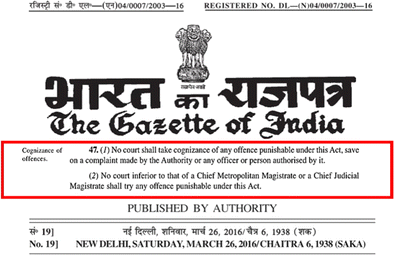
As per Section 47 of the Act, “Courts will take cognizance of offences
under this Act only upon complaint being made by the UIDAI or any
officer authorised by it.” This deprives the victim of a right to file
complaint although Section 34 of the Act provides that “Impersonating or
attempting to impersonate another person by providing false
demographic or biometric information will punishable by imprisonment
of up to three years, and/or fine of up to ten thousand rupees.”
Victims cannot file complaint even when someone changes or attempts to
change any demographic or biometric information of an Aadhaar number
holder by impersonating another person (or attempting to do so), with
the intent of i) causing harm or mischief to an Aadhaar number holder,
or ii) appropriating the identity of an Aadhaar number holder although
it is punishable under Section 35.
Victims of abuse cannot file complaint in cases wherein collection of
identity information is done by one not authorised by this Act, by
way of pretending otherwise despite the fact that the Act makes it
punishable under Section 36.
Unless authorized by UIDAI or any officer authorised by it, victims
cannot file complaint even when there is “Intentional disclosure
or dissemination of identity information, to any person not authorised
under this Act, or in violation of any agreement entered into under this
Act” under Section 37 although it is punishable.
Unless authorised by the UIDAI, the intentional acts like accessing or
securing access to the CIDR; downloading, copying or extracting any data
from the CIDR; introducing or causing any virus or other
contaminant into the CIDR; damaging or causing damage to the data in the
CIDR; disrupting or causing disruption to access to CIDR; causing
denial of access to an authorised to the CIDR; revealing information in
breach of (D) in Section 28, or Section 29; destruction, deletion or
alteration of any files in the CIDR; stealing, destruction, concealment
or alteration of any source code used by the UIDAI , will be
punishable under Section 38. Even in such cases victims cannot file
complaint without authorization by UIDAI.
Section 39 reads, “Tampering of data in the CIDR or removable storage
medium, with the intention to modify or discover information relating to
Aadhaar number holder will be punishable”. Thus, it admits that such
acts are possible and imminent but the Act does not empower the victims
of such tampering or removal instead it empowers UIDAI.
While Section 40 makes “Use of identity information in violation of
Section 8 (3) by a requesting entity will be punishable with
imprisonment up to three years and/or a fine up to ten thousand rupees
(in case of an individual), and fine up to one lakh rupees (in case of a
company)”, it is incomprehensible as to how a company or an individual
feel deterred by such meager punishment when they can harvest big
database of personal sensitive information which is admittedly a
“national asset” and “rich asset”.
Section 43 visualize a situation wherein offences can be committed by a
Company but they can be excused “if they can prove lack of knowledge of
the offense or that they had exercised all due diligence to prevent it.”
It also underlines the possibility of an offence committed by a Company
with the consent, connivance or neglect of a director, manager,
secretary or other officer of a company but they too can be
excused if they can prove their ignorance, inability and inevitability.
In a stark admission of the involvement of foreign locations and
persons, Section 44 states that the Act “will also apply to offences
committed outside of India by any person, irrespective of their
nationality, if the offence involves any data in the CIDR.”
The authentication of a non-existent UID/Aadhaar Number holder like me
demonstrates for the umpteenth time that UID/Aadhaar is a tried, tested
and failed project. This failure was apprehended and indicated by the Parliamentary Standing on Finance in its report to both the Houses of Parliament.
In such a backdrop there is a compelling reason for the Court to apply the doctrine of prohibition of “unconstitutional
condition” which means any stipulation imposed upon the grant of a
governmental privilege which in effect requires the recipient of the
privilege to relinquish some constitutional right. The submission
demonstrates that it is unreasonable in a special sense that Aadhaar
takes away or abridges the exercise of a right protected by the
Constitution. In Ahmedabad St. Xavier's College Society v. State of
Gujarat, (1974), the Court has drawn on a verdict from US Supreme Court
in Frost and Frost Trucking Co. v. Railroad Comm to hold that State does
not have the right to impose conditions
which require the relinquishment of constitutional rights. If the state
succeeds in compelling the surrender of one constitutional right as a
condition of its favour, it may, in like manner, compel a surrender of
all. It is inconceivable
that guarantees embedded in the Constitution be manipulated out of existence.
In the light of this verdict, it is quite evident that
the implementation of UID/Aadhaar is an exercise which is forbidden by
our Constitution. If this could be done, constitutional guarantees,
so carefully safeguarded against direct assault, are open to
destruction by the indirect, but no less effective, process of requiring
a surrender, which, though in form voluntary, in fact lacks none of
the elements of compulsion. State does not have the constitutional
power to discontinue benefits due to citizens. State’s power to
withhold recognition or affiliation altogether does not carry with it
unlimited power to impose conditions
which have the effect of restraining the exercise of fundamental
rights. Infringement of a fundamental right is nonetheless infringement
because it is accomplished through the conditioning of a privilege. If a
Legislature attaches to a public benefit or privilege restraining the
exercise of a fundamental right,
the restraint can draw no constitutional strength whatsoever from
its being attached to benefit or privilege. This is applicable to
the Aadhaar Act, 2016.
Notably, Re Kerala Education Bill (1958) was the first case in India to lay down the doctrine of the prohibition of “unconstitutional conditions“. The doctrine of unconstitutional conditions
prohibits the State from denying citizens a benefit by making access to
that benefit conditional upon citizens’ abstaining from exercising any
or all of their fundamental rights. This is despite the fact that there
is no antecedent right to that benefit in the first place. It emerges
that no Central or State Government can coerce citizens to access
subsidies by sacrificing their private data by enrolling for UID/Aadhaar
given the fact that they have a right to subsidy. No Government has
the constitutional power to make right to have rights condition
precedent.
Apparently, under some external influence, Central Government’s
stance has been insincere from the every outset. The total estimated
budget of the biometric UID/Aadhaar number project has not been
disclosed till date. In any case unless total estimated budget of the
project is revealed all claims of benefits are suspect and
untrustworthy.
After the trashing of UID/Aadhaar by Lok Sabh a’s Parliamentary Standing
Committee on Finance and later by Rajya Sabha, the Division Bench of
Supreme Court too will now have the opportunity to see through the
coercive and unconstitutional nature of UID/Aaadhaar Number project when it decides the case filed by Shanta Sinha and Kalyani Menon Sen.
For Details: Dr Gopal Krishna, Citizens Forum for Civil Liberties (CFCL), Mb: 9818089660, 08227816731, E-mail: 1715krishna@gmail.com, Twitter
On Wed, Jun 21, 2017 at 3:26 PM, Aadhaar (via Twitter) <notify@twitter.com> wrote:
@UIDAI: @krishna1715 Please share your contact details and email ID via private message. 


Aadhaar replied to your Tweet.
Reply

Jun 21
@UIDAI Plz find attached screenshot of my UID authentication @AnupamSaraph @no2uid @NirAadCollectiv @sunil_abraham @anivar @Rita_Banerji #Aadhaar pic.twitter.com/ZDRDYuEz04

Aadhaar 
@UIDAI
Jun 21 @krishna1715 Please share your contact details and email ID via private message.
View conversation
Twitter, Inc. 1355 Market Street, Suite 900 San Francisco, CA 94103
For further details kindly refer to the following:
Supreme Court Says Aadhaar Act Keeps UID/Aadhaar Voluntary As Well
Defying Fundamental Rights with Impunity
Database State to Surveillance State
The terrible truth about surveillance, 'bio-political tattooing' and
e-identity projects
What SC’s Distrust Of Private Companies’ Role In Collection Of
Bio-Metric Data Signifies
UID/Aadhaar Enabled Bio-Metric Attendance System (AEBAS) Violates
Supreme Court’s Orders
Enemy At The Aadhaar Gates
Digital Racism; ‘Aadhaar’ Promotes US Interests-II
http://www.frontierweekly.com/
Be very afraid of the biometric regime
Citizen’s Public Statement on Biometric Profiling through aadhaar & DNA Bill
11 August 2015
Statement of Concern on UID Number
28 September 2010
Hyderabad Declaration for Boycott of UID/Adhaar.
July 30, 2011
Patna Declaration: Citizens’ groups call for scrapping of UID/Aadhaar Project
January 10, 2012
‘People of South Asian countries are subjected to slavery by mass
biometric surveillance like Aadhaar’
India - Other countries - Biometrics - Constitutional Alliance
Moneylife Series on Biometric Identification
The Statesman Series:
Repository of aadhaar related articles: aadhararticles.blogspot.com