

Hiroshima Peace Declaration on 81st anniversary of atomic bombing [Full
Text]
-
The following is the full text of the Peace Declaration read on Aug. 6 by
Hiroshima Mayor Kazumi Matsui at a ceremony to mark 81 years since the 1945
ato...
Latest Post
Showing posts with label Environment and Occupational Health. Show all posts
Showing posts with label Environment and Occupational Health. Show all posts
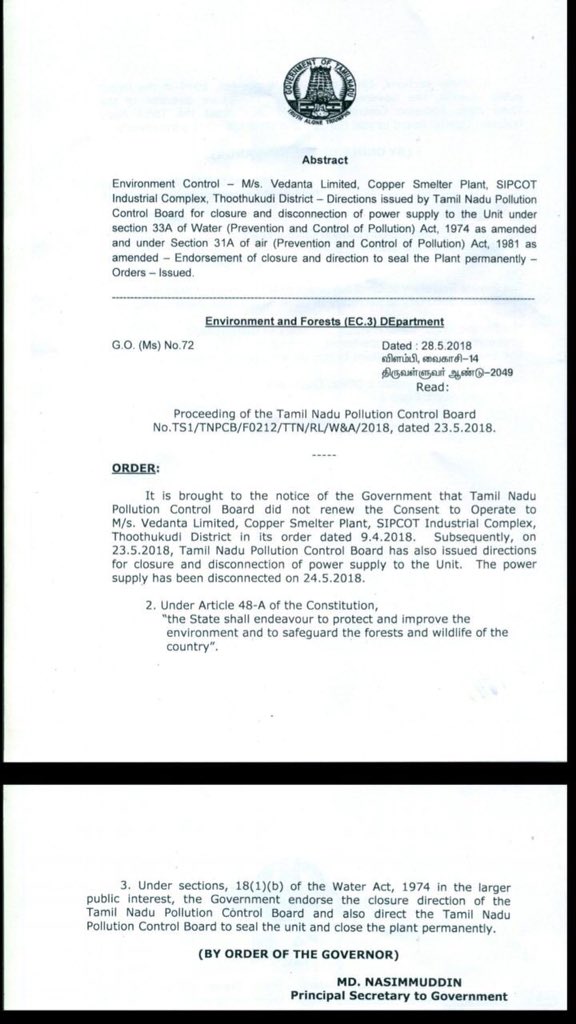
Permanent Closure of Vedanta group's copper plant after Madras High Court's interim order
Written By Unknown on Tuesday, May 29, 2018 | 2:19 AM
Ahead of the commencement of the session of Tamil Nadu Legislative Assembly, the State Government has ordered "permanent closure" of Vedanta group's copper plant in Tuticorin.
The decision has come in the aftermath of 23 May, 2018 interim order of a Division Bench of Justices M. Sundar and Dr Anita Sumanth of Madras High Court in a case filed by Ms. Fatima, an academic activist challenging the environmental clearance given to Vedanta Limited (formerly Sterlite Industries Limited).
The petition is based on the information gathered under Right to Information Act from the Public Information Officer. The information contains 600 pages of documents including notices to show cause issued by the Tamil Nadu Pollution Control Board (TNPCB) to the State Industries Promotion Corporation of Tamil Nadu (SIPCOT). The information has been furnished under cover of letter dated 30 April, 2018.
This company has been carrying on construction activities on the site for the proposed Copper Smelter Unit II at SIPCOT, Tuticorin. According to the petitioner, the environmental clearance (EC) was obtained by Vedanta company without the conduct of a public hearing because the requirement for such hearing had been waived on the incorrect representation of the company. The matter was mentioned before the Vacation Bench on 16 May, 2018 requesting listing for urgent hearing.
This Vacation Bench heard the matter and issued the following directions on 23rd May: "(i) The application for renewal of EC submitted by Vedanta shall be processed expeditiously after conduct of mandatory public hearing. In any event, the application shall be decided by the appropriate authorities within a period of four months from today i.e. on or before 23.09.2018."
(ii) In the meanwhile, Vedanta shall cease construction and all other activities on-site proposed Unit-II of the Copper Smelting Plant at Tuticorin with immediate effect."
 The order was delivered by Justice Dr Anita Sumanth.
The order reads" "In issuing the above directions, we believe that we have taken into account and balanced the interests of all parties before us, the public as well as Vedanta. While, on the one hand, the economic benefits of encouraging industries cannot be ignored, the toll extracted on available resources, water and soil regimes by such industries, cannot also be lost sight of. There is thus yet another stakeholder before us, one that is invisible in the array of parties, the environment in itself. In balancing the interests of all parties to this Public Interest Litigation, we believe that the interests of this hapless party be treated on par, if not paramount."
 It is must be noted that Phase I of SIPCOT is stated to cover 1083 hectares and Phase II is stated to be proposed to cover a total of 1616 hectares of which it is proposed that Unit II of Vedanta will occupy 300 hectares. An EC was granted to Vedanta dispensing with the requirement of mandatory public hearing as set out in terms of clause 7(c) of Environmental Impact Notification dated 14.09.2006 based on its representation that the proposed unit was to be located inside a notified area of the SIPCOT Industrial park. This aspect is recorded in the High Court's order. This order has come to the rescue of the "hapless party" which has been a victim of corporate crimes.
In a related development, Tamil Nadu Governor Banwarilal Purohit has appointed retired
judge Aruna Jagadeesan to head the probe into the Thoothukudi violence
in which 13 people died in police action during anti-Sterlite protests.
Implementation of Stockholm Convention on Persistent Organic Pollutants (POPs) in India & outcome of triple CoP
Written By Krishna on Friday, August 18, 2017 | 7:02 AM

India has prepared its
National Implementation Plan and submitted the same to the Stockholm Convention
Secretariat. As per Article 7 of the treaty development of the National
Implementation Plan (NIP) of the Stockholm Convention on Persistent Organic
Pollutants (POPs) is required by all the parties. It is to demonstrate how the
obligations under the Convention would be implemented and discusses how Parties
aim to meet their obligations under the treaty. The Convention entered into force on May 17, 2004. India signed it
on May 14, 2002. It ratified it on January 13, 2006. It came into force for
India on April 13, 2006.
The treaty can ban
chemicals currently in use, not only the obsolete and redundant ones. The
chemical industry has expressed concern about the listing of its persistent organic
pollutant (POP) products.
The objective of the
Stockholm Convention on Persistent Organic Pollutants is to protect human
health and the environment from POPs. The treaty requests parties to protect
the citizens and the environment from POPs through activities stipulated in the
articles of the treaty.
Governments have agreed
to list all the chemicals recommended by the POPs Review Committee (POPRC)
because the evaluation process is comprehensive and meet convention obligations
under Article 8. The main problem with the decision-making process at
Conferences of the Parties (COPs) is not that chemicals in use are listed but
that the POPRC’s work and its recommendations limiting the scope of exemptions
are often ignored. The COP8 meeting illustrates it. Short-chain chlorinated
paraffins (SCCPs) form a class of industrial chemicals primarily used in
metalworking but also as flame retardants and softeners in plastics, including
children’s products. SCCPs adversely affect
the kidney, liver and thyroid, disrupt endocrine function and are anticipated
to be human carcinogens. The POPRC recommended listing them in the treaty
without exemptions, due to the availability of feasible alternatives.
Governments at COP8
proposed a wide-ranging series of exemptions that effectively cover all known
uses of SCCPs. The treaty listing does represent an important five-year global
phase-out of a very harmful chemical, but there was a clear disconnect between
POPRC evidence that vegetable oil is a key substitute for the substances in
metalworking and granting an exemption for this use, along with many others.
DecaBDE is a serious
example of a listing process getting sidetracked by unjustified exemptions. For
example, an exemption was granted for the use of decaBDE in polyurethane foam
for building insulation, but the POPRC had no evidence that the substance is
used for this purpose.
The exemptions for the
automotive and aviation industries shows how conventional phase-out period of
five years has been expanded to 2036.
Such extensive
exemptions will result in the continued production and use of decaBDE, a
substance that strongly resembles polychlorinated biphenyls.
The aviation industry’s
decaBDE exemption shows what happens when companies that have already phased
out POPs ignore the Stockholm Convention.
COP 8 agreed that
governments that seek exemption for decaBDE or SCCPs should justify their need
for it by December 2019.
Two countries have
withdrawn a proposal to permit the recycling of materials containing
decaBDE. Recycling plastic products
containing POPs also contaminates new products.
The treaty prohibits
POP recycling and the POPRC warned against the practice, noting continuing
human and environmental exposure and the loss of the credibility of recycling.
The current toxic recycling exemption for commercial pentaBDE and octaBDE
allows this bad practice to continue until 2030.
In countries like India
decision making on exemptions bring POPs across borders legally amidst a flood
of products, causing ongoing exposure.
It will create
difficulty in complying with the treaty’s waste provisions, since it cannot
identify which products contain POPs. Even if they could identify them, many do
not have the capacity to destroy them as per law's requirements. India remains
caught in such vicious circle of poison.
India’s NIP development
includes conducting POPs inventory preparation, establishment of required
national infrastructure and the capacities for its realization.
While
decisions on exemptions appear abstract and intangible the fact is that such
exemptions pose harm to human health through food chain.
The joint Conferences of the Parties of the Basel,
Rotterdam, and Stockholm Conventions took place in Geneva from 24 April to 5
May, 2017. The note below draws on information shared
on IPEN list serve. It explains a few key points that emerged from the separate
meetings of the three treaties in general and Basel Convention and Ban Amendment
to it in particular.
Triple
COP 2017 outcomes:
- Governments added short-chain chlorinated paraffins (Short-chain
chlorinated paraffins-SCCPs) to the treaty for global elimination along
with a variety of five-year exemptions. SCCPs are toxic industrial
chemicals used in metal cutting and also in PVC consumer products.
- Governments added DecaBDE to the treaty for global
elimination along with a variety of five-year exemptions and longer
exemptions for new and old vehicle parts and aircraft. A proposal for a
recycling exemption was defeated. DecaBDE is flame retardant and prominent
component of e-waste.
- Governments added hexachlorobutadiene, a chemical
formed unintentionally, including during chlorinated solvent production
and incineration, to Annex C of the treaty to reduce releases with the
goal of elimination.
- The meeting adopted weak waste limits, but kept alive
more protective limits as an option for HBCD and the commercial mixtures
of PentaBDE and OctaBDE.
- Stockholm COP8 encouraged regional centers to work on
the impact of plastic waste, marine plastic litter,
microplastic, and measures for prevention and environmentally sound
management.
- Stockholm Convention COP8 admitted that the recycling
exemption likely contaminates children’s toys and urged governments to
ensure that flame retardants are not introduced into products that would
pose a risk of human exposure such as children’s toys.
- Basel Convention COP13 established a household waste
working group which will develop a guidance document on the
environmentally sound management of household waste including best
practices; mechanical biological
treatment, energy recovery, management of sanitary landfills and
compartmentalization to deal with various waste streams.
- The Basel Convention e-waste guidelines will go to a newly formed working group led by China for further work including distinguishing waste from non-waste and the repair loophole.€
- The Basel Convention extended the mandate of the group
working on environmentally sound management of waste to develop manuals on
extended producer responsibility, financing systems, insurance
and liability; conduct five pilot projects
on the topic; and develop a guidance document on efficient strategies for the
recycling and recovery of hazardous and other wastes and how to address
the environmentally sound management of wastes in the informal sector.
- Carbofuran, trichlorfon, SCCPs, and tributyl tin were
all listed in Annex III of the Rotterdam Convention, making them subject
to the treaty’s prior informed consent procedure.
- Chrysotile asbestos, fenthion, paraquat, and carbosulfan were all blocked from listing in the Rotterdam Convention even though there was consensus agreement that they met all criteria for addition to the treaty. Rotterdam Convention came into force on February 24, 2004. India signed the accession on May 24, 2005. It entered into force for India on August 22, 2005.
- The
Basel Convention adopted a guidance document focusing on waste prevention,
minimization and reuse. The document includes measures such as information
on chemicals in products, green procurement, and extended producer
responsibility. The expert working group will continue and gather good
practices and examples with regard to waste prevention and minimization.
- It is noteworthy
that Ban Amendment to Basel Convention has not come into force as yet
although it was adopted on September 22, 1995. As per 17
(5) of the Convention which reads as follows: "Instruments of
ratification, approval, formal confirmation or acceptance of amendments
shall be deposited with the Depositary. Amendments adopted in accordance
with paragraphs 3 or 4 [of article 17 of the Convention] shall enter into force
between Parties having accepted them on the ninetieth day after the
receipt by the Depositary of their instrument of ratification, approval,
formal confirmation or acceptance by at least three-fourths of the Parties
who accepted them or by at least two thirds of the Parties to the protocol
concerned who accepted them, except as may otherwise be provided in such
protocol. The amendments shall enter into force for any other Party on the
ninetieth day after that Party deposits its instrument of ratification,
approval, formal confirmation or acceptance of the amendments.” In
accordance with paragraph 3 of Article 25 of the Basel Convention,
applicable mutatis mutandis to amendments of the Convention, for the
purpose of entry into force, any instrument deposited by a political
and/or economic integration organization shall not be counted as
additional to those deposited by member States of such organization.
Accordingly, as a regional economic integration organization, ratification
by the European Union does not count in addition to the ratifications by
Member States of the Union for the purposes of entry into force of this
instrument. By
decision III/1, of 22 September 1995, the Third meeting of the Conference
of the Contracting Parties to the above Convention, which took place in
Geneva from 18 to 22 September 1995, adopted an Amendment to the
Convention (including the adoption of Annex VII).
- Basel Protocol on Liability and Compensation for Damage
Resulting from Transboundary Movements of Hazardous Wastes and their
Disposal Basel adopted on December 10, 1999 also awaits ratification for
it come into force. As
per Article 29, "1.The Protocol shall enter into force on the
ninetieth day after the date of deposit of the twentieth instrument of
ratification, acceptance, formal confirmation, approval or accession. 2.
For each State or regional economic integration organization which
ratifies, accepts, approves or formally confirms the Protocol or accedes
thereto after the date of the deposit of the twentieth instrument of
ratification, acceptance, approval, formal confirmation or accession, it
shall enter into force on the ninetieth day after the date of deposit by
such State or regional economic integration organization of its instrument
of ratification, acceptance, approval, formal confirmation or accession.
3. For the purpose of paragraphs 1 and 2 of this Article, any instrument
deposited by a regional economic integration organization shall not be
counted as additional to those deposited by member States of such
organization".
- Although the parent treaty Basel Convention came into force
on May, 1992. It is being undermined by bilateral free trade agreements of the parties.
Govt betrays consumers, public health, workers, environment & human rights by opposing listing of white chrysotile asbestos as hazardous substance at the UN Meet
Written By mediavigil on Sunday, May 07, 2017 | 11:00 PM
Public Statement
Indian Govt betrays consumers, public health, workers, environment & human rights by opposing listing of white chrysotile asbestos as hazardous substance at the UN Meet
Government’s position contrary to domestic laws
Cabinet Committee on Economic Affairs deciding position on Asbestos does not include Ministers of Consumer Affairs, Health, Labour, and Environment
Govt ignored views expressed by environment minister, Health Minister & States on hazards of asbestos and incurable asbestos related diseases
Govt must take action against white chrysotile asbestos to protect public health and human rights instead of waiting for outcome of next meeting of UN’s Rotterdam Convention in 2019
Taking an inconsistent position disregarding public health and human rights of Indians, India joined Russia, Kazakhstan, Kyrgyzstan, Zimbabwe and Syria to block listing of hazardous white chrysotile asbestos, the killer fiber in the UN list at the UN Meet that concluded on 5 May in Geneva. The 8th Conference of the Parties to the UN’s Rotterdam Convention on the prior informed consent procedure for certain hazardous chemicals and pesticides in international trade (COP8) failed to make any progress on democratic right of people to be protected from hazardous substances. The listing of white chrysotile asbestos in the UN list of hazardous substances helps in better protection of public health and environment. In an act of betrayal of gnawing public interest cause, India took a position which is contrary to its own domestic law on hazardous white chrysotile asbestos at the UN Meet. The next UN meeting on the issue will happen in 2019.
Given the fact that Cabinet Committee on Economic Affairs, Government of India does not include Ministers of Consumer Affairs, Health, Labour, and Environment, it was apprehended that concerns related to consumers, public health, workers, and environment is likely to be disregarded. This apprension has turned out to be true. Government failed to pay heed to the opinion expressed by Union environment minister and Union Health Minister.
Asbestos diseases have a very long incubation period. So if you are exposed today to an asbestos fibre, you are likely to get the disease in next 10-35 years. Asbestos is like a time bomb to the lungs and Indians will suffer the most. If it is banned today that does not mean people will not suffer. Because of past usage people will continue to suffer from these diseases. It is clear that lack of documentation and lack of environmental and occupational health infrastructure does not mean lack of victims of asbestos related diseases.
Union Environment Minister has said, “Since the use of asbestos is affecting human health, its use should gradually be minimised and eventually end. As far as I know, its use is declining. But it must end.”
In a written reply Union Minister of Health and Family Welfare has informed the Parliament on the subject of Asbestos Related Diseases saying: “The Indian Council of Medical Research (ICMR) has informed that major health hazards of asbestos include cancer of lung, mesothelioma of pleura and peritoneum and specific fibrous disease of lung known as asbestosis. All types of asbestos fibers are responsible for human mortality and morbidity. Studies have been carried out at National Institute of Occupational Research, an Institute of ICMR, Ahmedabad which show that workers when exposed to higher workplace concentration of asbestos fiber have higher incidence of interstitial lung disease and pulmonary function impairment. Directorate General Factory Advice Service and Labour Institutes, (DGFASLI) under Ministry of Labour & Employment has intimated data of workers suffering from Asbestosis in factories registered under the Factories Act, 1948.As per the information provided by DGFASLI, it is informed that 21 no. of Asbestosis cases were reported in Gujarat in 2010 and 2 cases in Maharashtra in the year 2012.”
The reply of the Union Minister of Health and Family Welfare further reads: “As per the provisions of the Factories Act, 1948 and rules framed thereunder, manufacture, handling and processing of Asbestos and its products is declared as Hazardous Process. Further, Govt. of India has prepared Schedule XIV- ‘’Handling and Processing of Asbestos, Manufacture of any Article or Substance of Asbestos and any other Process of Manufacture or otherwise in which Asbestos is used in any Form’’ as a Dangerous Operation under section 87 of the Factories Act,1948. The Ministry of Mines has informed that the Grant of fresh mining leases and renewal of existing mining leases for Asbestos are presently banned in the country on Health Grounds.” This was stated by the Union Minister for Health and Family Welfare in a reply to the Lok Sabha.
This reply is consistent with the observation of World Health Organisation (WHO) saying, " All types of asbestos cause lung cancer, mesothelioma, cancer of the larynx and ovary, and asbestosis (fibrosis of the lungs). Exposure to asbestos occurs through inhalation of fibres in air in the working environment, ambient air in the vicinity of point sources such as factories handling asbestos, or indoor air in housing and buildings containing friable (crumbly) asbestos materials." It underlines that several thousands of deaths can be attributed to other asbestos-related diseases, as well as to non-occupational exposures to asbestos.
It is quite shameful that Indian delegation disregarded the views of Health and Environment Ministry and ignored the 105 page long Indian Government’s Environmental Impact Assessment Guidance Manual for Asbestos Based Industries. The relevant part of the Manual reads: “All workplaces where asbestos dust may cause a hazard is to be clearly indicated as an asbestos dust exposure area through the use of a well-displayed sign, which identifies the hazard and the associated health effects” for workers’s education. It also states, “Pictorial warning signs and precautionary notices for asbestos and products containing asbestos are to be made” for the protection of consumers from “hazard and the associated health effects.”
Government allowed itself to be overwhelmed by the influence of the four asbetsos producers of the world who produced 1,799,700 metric tons of chrysotile asbestos in 2015 (Russia - 1,100,000 tons, Brazil- 310,000 tons, China-210,000 tons and Kazakhstan 179,700 tons) who seem to have given themselves the power to determine whether or not Indians have the right of Prior Informed Consent. In a bizzare situation, it is being implied by them this right exists only if the hazardous white chrysotile asbestos industry allows it to be exercised.
Government failed to protect itself from the unhealthy influence of Asbestos Cement Products Manufacturers Association (ACPMA) and the asbestos producing countries which are patrons of ACPMA.
Government failed to note that Asbestos is listed as a hazardous substance under Part II of Schedule-I of the Manufacture, Storage and import of Hazardous Chemical Rules under the Environment (Protection) Act, 1986 provides the List of Hazardous and Toxic Chemicals. This list has 429 chemicals. Asbestos is at the serial no. 28 in the list. This Rule and the list are available on the website of Union Ministry of Environment & Forests. Indian position should have been in keeping with government’s “Inventory of Hazardous Chemicals Import in India” that lists ‘asbestos’ at serial no. 26 as one of the 180 hazardous chemicals in international trade which is imported in India. It would be scandalous if Indian delegation took a position inconsistent with the Manufacture, Storage, and Import of Hazardous Chemicals (MSIHC) Rules.
Notably, even under Factories Act, 1948, the List of 29 industries involving hazardous processes is given under Section 2 (cb), Schedule First, asbestos is mentioned at serial no. 24. The Act defines "hazardous process" as “any process or activity in relation to an industry specified in the First Schedule where, unless special care is taken, raw materials used therein or the intermediate or finished products, bye-products, wastes or effluents thereof would--(i) cause material impairment to the health of the persons engaged in or connected therewith, or (ii) result in the pollution of the general environment”. This leaves no doubt that asbestos is a hazardous substance.
It has been observed that promoters of white chrysotile asbestos like ACPMA manage to get themselves planted in the Indian delegation and seem to prevail on the government representatives take a position against human health and the environment and to put profit of the asbestos industry before gnawing public health concerns.
It must be recalled that on June 22, 2011 Indian delegation led by Ms. Mira Mehrishi, Additional Secretary, had supported the listing of Chrysotile asbestos as a hazardous chemical substance at the fifth meeting on Rotterdam Convention amidst standing ovation. Ban Asbestos Network of India (BANI) and ToxicsWatch Alliance (TWA) had taken the opportunity of congratulating the government but the about turn on later occasions under the corrupting influence ACPMA was a sad let down. The same deleterious forces have prevailed at the COP 8 too.
Government should pay heed to a precedent-setting decision dated April 2, 2013 delivered by the Israel's High Court of Justice that rejected a petition on against a law placing substantial financial responsibility on a company to clean up asbestos waste. The order observed, “In recent years, countries throughout the world have been required to deal with different dilemmas related to protecting the quality of the environmental. A substantial portion of these dilemmas involve, among other things, legal, economic and ethical considerations. Amongst these dilemmas, the removal of hazardous waste – the matter at the heart of the present appeal – is a subject that demands significant attention. Asbestos, in particular, has proved itself to be efficient and strong, suitable for many uses. However, it has become clear with time that its ability to cause damage immeasurably outweighs its potential benefits. Since the 20th century, different states have dealt with this matter of how to clean up the environment from asbestos, and onthe questions of who to impose the responsibility and who to require to pay for the implementation. Consequently, I have found it appropriate to first turn our perspective on the relevant legal regimes in a few key countries beyond our borders.” It ruled that "To conclude, the survey presented (of various international legal perspectives) indicates various and complimentary components. In all instances it appears a consensus has been established, certainly so with regards to materials hazardous by their very nature such as asbestos, that substantial responsibility is to be imposed on the pollutant."
Government must pay attention to the verdict of five judges of Japan’s Supreme Court dated February 17, 2015 that has upheld a ruling that found asbestos used at a plant of Kubota Corporation caused fatal mesothelioma in a man who lived near the plant and ordered the company to pay ¥31.9 million in damages to his relatives. The petitioners were relatives of Kojiro Yamauchi, who died at age 80 after working for two decades about 200 meters from the Kubota plant in Amagasaki, Hyogo Prefecture. His relatives and those of Ayako Yasui, who died at age 85 having lived about 1 km from the plant, sought damages from both Kubota and the government. In October, 2014 this Supreme Court ruled that the government was responsible for failing to protect workers from exposure at asbestos factories in Sennan, Osaka Prefecture.
Government should examine that the official record which shows that three cases of asbestos related diseases i.e. Mesothelioma have been reported from among the workers of employed in the factory of Hyderabad Industries Limited, Sanathnagara, Hyderabad in Andhra Pradesh. These workers have died due to the disease. These workers were: 1) N Chandra Mouli, 2) Sher Khan and 3) ama Chandraiah. This was revealed in an affidavit filed by T Narayana Reddy, Special Officer Office of Advocate-on-record, Andhra Pradesh Legal Cell, New Delhi in the Supreme Court. This company in question may be asked to file a report on total number of workers employed by it and their health status including a report about the three above mentioned workers.
It is also a matter of official record that National Institute of Occupational Health (NIOH), Ahmedabad, Gujarat recommended compensation for two workers employed in Gujarat Composites Limited who were certified to be suffering from asbestosis. This has been revealed in a reply given by Government of Gujarat. A letter of Chief Inspector of Factories, Gujarat State dated December 24, 2002 in the matter of execution of the order of Supreme Court in Writ Petition (Civil) No. 206 of 1986 categorically reveals that two workers of Gujarat Composites Ltd were confirmed for Asbestosis, an incurable lung disease by NIOH. The workers were (1) Hazarilal Manraj and (2) Sahejram B Yadav. The letter recommended compensation of Rs 1 lakh as per the Court order but till date the same has not been given. This and many such cases conclusively establish the hazards from asbestos. Influence of the asbestos industry becomes quite obvious when Government turns a blind eye to such glaring official facts. This is also a clear case of contempt of court by the asbestos based company. It may be noted that Gujarat Composite Ltd (formerly named Digvijay Cement Company) appears to be attempting to hide behind myriad corporate veils by changing names and by outsourcing its work. The official letter demonstrates that white chrysotile asbestos is a hazardous substance which causes asbestos related incurable diseases.
It is noteworthy that Secretary, Medical Education & Research, Chandigarh Administration which has categorically informed National Human Rights Commission (NHRC) that “a. White Asbestos (Chrysotile Asbestos) is implicated in so many studies with the following diseases:-Mesothelioma (Cancer of Pleura), Lung Cancer, Peritoneal Cancer, Asbestosis, And also consider as cause of following cancers:- Ovarian Cancer, Laryngeal Cancer, Other Cancer b. Diseases are produced in the person involved in Asbestos Industry.” It states that “No. of cancer deaths due to asbestos requires further large scale study from India”. It informs, “It is definitely harmful material, causing cancer and other related diseases.”
It quotes from Pulmonary Medicine journal saying, “Asbestos is a set of six naturally occurring silicate minerals exploited commercially for their desirable physical properties. However, it has been proved beyond doubt that Asbestos is hazardous to humans. White asbestos has been found to have causal relationship with various diseases like pulmonary asbestosis, lung cancer and mesothelioma leading to deaths of thousands of people every year.”
The communication of Chandigarh Administration concludes saying, “Hence, use of white asbestos should be completely banned in India also and the same may be replaced by some safe alternative material.” Chandigarh Administration has realized the public health consequences of exposure to fibers of asbestos.
The Assistant Labour Commissioner, Union Territory, Chandigarh has referred to para 16 of the judgment of Supreme Court dated January 21, 2011 passed in Writ Petition (Civil) No.260 of 2004 wherein directions of January 27, 1995 in the Writ Petition (Civil) No. 206 of 1986 is required to be strictly adhered to. It further states, “In terms of the above judgement of this Court as well as reasons stated in this judgement, we hereby direct the Union of India and States to review safeguards in relation to primary as well as secondary exposure to asbestos keeping in mind the information supplied by the respective States in furtherance to the earlier judgement as well as fresh resolution passed by the ILO. Upon such review, further directions, consistent with law, shall be issued within a period of six months from the date of passing of this order.” As to ‘fresh resolution passed by the ILO’, it is noteworthy that “A Resolution concerning asbestos was adopted by the International Labour Conference at its 95th Session in 2006. Noting that all forms of asbestos, including chrysotile, are classified as human carcinogens by the International Agency for Research on Cancer (IARC), and expressing its concern that workers continue to face serious risks from asbestos exposure, particularly in asbestos removal, demolition, building maintenance, ship breaking and waste handling activities, it calls for: – the elimination of the future use of asbestos and the identification and proper management of asbestos currently in place as the most effective means to protect workers from asbestos exposure and to prevent future asbestos-related diseases and deaths.”
In a letter dated May 29, 2012, Joint Secretary, Government of Uttarakhand has referred to a document Medline Plus Trusted Health Information for You, U.S. National Library of Medicine and the prescription of National Institutes of Health (NIH) highlighting the Treatment stating: “There is no cure. Stopping exposure to asbestos is essential.”
It is not surprising that Union Ministry of Labour’s concept paper declares, "The Government of India is considering the ban on use of chrysotile asbestos in India to protect the workers and the general population against primary and secondary exposure to Chrysotile form of Asbestos. The Concept paper of the Central Government notes, "Asbestosis is yet another occupational disease of the Lungs which is on an increase under similar circumstances warranting concerted efforts of all stake holders to evolve strategies to curb this menace".
It has been estimated that one person dies from mesothelioma for every 170 tons of asbestos consumed. WHO estimates we have107,000 deaths worldwide per year from occupational exposure to asbestos. If non occupational exposure is added it reaches a figure of about 120,000 deaths. Average world consumption/year 30-60 years ago was -- looks like3/2 of what it is now (2 million metric tons/year). Give India its share of that based on its share of global consumption. At 300,000 tons in 2013, that's about 18,000 deaths (15% of 120,000).
Government failed to insulate Indian delegation from undue and motivated industry influence to ensure that they are not made to act like parrots of commercial interests. In matters like exposure from carcinogenic fibers of asbestos these officials must be made to factor in far reaching implications for public health before defending the indefensible hazardous asbestos industry. The day is not far when officials who are members of the Indian delegation too will be held liable for their acts of omission and commission as is happening in more than 50 countries that have banned all kinds of asbestos. The representatives of asbestos industry association has been undermining India’s stature among the global scientific community for long.
It is now clear that Government failed to resist the influence of foreign interests. It failed to ensure that public health interest triumphs over immoral, unethical and myopic commercial considerations of foreign asbestos producers to defend India’s supreme interest. The manufacturers in India can easily shift to non-asbestos materials for manufacturing and some of them have started to move in that direction in South India.
Government should recognize that Environmental Impact Assessment Guidance Manual for Asbestos Based Industries, the Terms of Reference (TOR) that is awarded by the Experts Appraisal Committee (EAC), Industrial Project, Union Ministry of Environment & Forests for Chrysotile asbestos based roofing factory asks the project proponent to prepare a “Health Management Plan for Mesothelmia, Lung cancer and Asbestosis related problems in asbestos industries” revealing its hazardous nature.
COP 8 demonstrated that for the time being in this conflict between Truth Versus Profit, the latter has prevailed. It does not behove the stature of India to take untruthful and unscientific position displaying unpardonable callousness towards concerns of consumers, public health, workers, environment and human rights. India should learn from countries that have banned asbestos of all kinds including white chrysotile asbestos. These countries are: 1) Algeria, 2) Argentina, 3) Australia, 4) Austria, 5) Bahrain, 6) Belgium, 7) Brunei, 8) Bulgaria, 9) Chile, 10) Croatia, 11) Cyprus, 12) Czech Republic, 13) Denmark, 14) Egypt, 15) Estonia, 16) Finland, 17) France, 18) Gabon, 19) Greece, 20) Germany, 21) Gibraltar, 22) Hungary, 23) Honduras, 24) Iceland, 25) Iraq, 26) Ireland, 27) Israel, 28) Italy, 29) Japan, 30) Jordan, 31) Kuwait, 32) Latvia, 33) Luxembourg, 34) Lithuania, 35) Mauritius, 36) Mozambique, 37) Malta, 38) Netherlands, 39) New Caledonia, 40) New Zealand, 41) Norway, 42) Oman, 43) Portugal, 44) Poland, 45) Qatar, 46) Romania, 47) Saudi Arabia, 48) Sweden, 49) Switzerland, 50) Serbia, 51) Seychelles, 52) Slovakia, 53) Slovenia, 54) South Africa, 55) South Korea, 56) Spain, 57) Turkey, 58) Uruguay and 59) United Kingdom.
 Given the fact that Indian domestic laws recognize white chrysotile asbestos as hazardous, the Government need await the outcome of next meeting of UN’s Rotterdam Convention in 2019 in this regard to take actions to make India asbestos free. Indian laws include asbestos in the list of hazardous substances but tremendous influence of commercial interests has forced the Indian delegation to take a position which is diametrically opposite of domestic laws.
Government should take steps to rectify the blunder it has committed by immorally and illegitimately denying right to know about hazardous substances to present and future Indians. It should factor in views of health and environment ministers to pave the way for creating a future which is free of incurable hazardous asbestos related diseases.
For Details: Dr Gopal Krishna, Ban Asbestos Network of India (BANI)-ToxicsWatch Alliance (TWA), Mb: 08227816731, 09818089660, E-mail-1715krishna@gmail.com, Web: www.asbestosfreeindia.org, toxicswatch.org
Why India should support Ban Amendment to UN’s Basel Convention on Transboundary Movement of Hazardous Wastes and Their Disposal to prevent dumping of toxic waste
Written By krishna on Sunday, April 30, 2017 | 7:40 PM

To
Shri Bishwanath
Sinha
Joint Secretary
Union Ministry
of Environment, Forests & Climate Change
Government of India
Subject: Why India should support Ban Amendment to UN’s Basel
Convention on Transboundary Movement of Hazardous Wastes and Their
Disposal to prevent dumping of toxic waste
Sir,
With reference to the invitation from Union Ministry of Environment, Forests & Climate Change seeking comments and suggestions on matters of the Basel Convention (BC), Rotterdam Convention (RC) and Stockholm Convention (RC) and with regard to an inconsistent position taken by one of the Indian delegates at the thirteenth meeting of the Conference of the Parties (COP) to the UN’s Basel Convention (BC COP13) on Transboundary Movement of Hazardous Wastes and Their Disposal, we submit the following:
1. We are distressed to learn that on the opening
day of the BC COP13 India’s official delegation shocked the UN Meeting with its statement
in opposition
to UN accord
to stop the flow of hazardous wastes from developed to
developing countries like India. This is akin to
opposing Hon’ble Prime
Minister’s Clean India Mission and is in violation of Hon’ble Supreme Court’s
verdict in Writ
Petition (Civil) No.657 of 1995;
2. We have learnt that Dr Sonu Singh, one of the official delegates from our country gave a speech crticising the
Ban Amendment to Basel Convention on Transboundary Movement of Hazardous Wastes and Their
Disposal. He lowered the stature
of India and its scientific community by claiming
that the Ban Amendment is contrary to sustainable consumption and the circular
economy as well as the Sustainable Development Goals. He made a bizaare claim that India
allows imports of hazardous waste under careful conditions and this is part of its national strategy. India
was the ONLY country which made
such a statement. How can he make claims about non-existent services and infrastructure to
deal with their hazardous waste and other wastes in the absence of required
infrastructure like laboratories, treatment facilities and land in the country
which can be used for testing samples of imported waste and treatment and
landfills? Our India cannot be turned into a land of
landfills for foreign hazardous wastes. Unless all the
waste that is generated in our own country has been
treated and disposed of in an environmentally sound manner how can hazardous waste
import be permitted?;
3. This is an admission that trade in
hazardous waste will happen in a business as usual manner
unmindful of Hon’ble Prime Minister’s Clean India Mission
and Hon’ble Court’s verdict. This position is inconsistent with National Environment Policy that includes strategies for cleanup of
toxic and hazardous waste dump legacies, developing a national inventory of
such dumps, an online monitoring system for movement of hazardous wastes and
taking legal measures for addressing emergencies arising out of transportation,
handling, and disposal of hazardous wastes. All other
Parties who spoke at CoP 13 voiced their very
strong support for the Ban Amendment. This delegates’s position
is inconsistent with our Hon’ble Prime Minister’s Clean India Mission as well;
4. According to the verdict
of Hon’ble Court, “Hazardous Wastes are highly toxic in nature.
The industrialization has had the effect of generation of huge quantities of
hazardous wastes. These and other side effects of development gave birth
to principles of sustainable development so as to sustain industrial growth.
The hazardous waste required adequate and proper control and handling.
Efforts are required to be made to minimise it. In developing nations,
there are additional problems including that of dumping of hazardous waste on
their lands by some of the nations where cost of destruction of such waste is
felt very heavy. These and other allied problems gave birth to Basel
Convention.” This verdict has been given in Writ Petition
(Civil) No.657 of 1995. The Convention was made part of its
order by the Hon’ble Court due to alarming situation
created by dumping of hazardous waste, its generation and serious and
irreversible damage, as a result thereof, to the environment, flora and fauna,
health of animals and human beings. Hon’ble Court took
cognizance of dumping of hazardous wastes in Indian waters as violation
of Article 14 and 21 of the Constitution of India. It is evident from it that the position of this Indian
delegate betrays his ignorance about the issue;
5. We wish inform
you that such motivated
attempts have attracted widespread criticism from
environment, public health groups and even the Confederation of Indian Industry
(CII) when hazardous wastes and hazardous materials and
recyclable materials was being made synonymous. by redefining "hazardous waste"
as "hazardous material" in a manifest act of linguistic
corruption. It is noteworthy that in a study, Associated Chambers of Commerce & Industry (ASSOCHAM) also recommended ban on trade in hazardous wastes. Two members of Hon’ble Court's own
monitoring committee on hazardous wastes have also raised
objections They who are complicit in promoting hazardous waste
dumping in our country are doing so at the behest of hazardous waste
traders. Their role needs to be probed;
6. We wish to draw your attention towards the fact that European Union has fully implemented the Basel Ban in
its Waste Shipment Regulation, making it legally binding in all EU member
states. Norway and Switzerland have similarly fully implemented the Basel Ban
in their legislation. In the light of
the blockage concerning the entry into force of the Ban amendment, a
“Country-led Initiative” (CLI) was launched which
was adopted at
COP10 of the Basel Convention on Transboundary Movement of Hazardous Wastes and Their
Disposal, the opponents of the Ban Amendment agreed to stand down and not to publicly
fight against it
anymore. Such
statement from the Indian delegate in question is quite at variance with India’s Clean India Mission which
is so dear to our Hon’ble Prime Minister;
7. We are quite disgusted to
hear this delegate making an unscientific claim saying
that the Basel Ban Amendment works against Sustainable Development Goals. How can he be allowed to make baseless claims to the
effect that India’s
technology is infallible to import of hazardous wastes. Such statements are contrary to India’s public health and exposes India’s
insensitivity towards environmental health. It is unbecoming of India’s statuture to take such a position
at a UN meeting. This is not the way to make Clean India Mission sucessful as desired by
our Hon’ble Prime Minister;
8. We wish to draw
your attention towards Basel
Convention’s very clear and simple definition of waste:
wastes are materials which are disposed of, or intended to be disposed of, or
required to be disposed of, to the environment”. Hon’ble Court’s verdict has directed the Union of India
to incorporate the Basel list in the existing Rules and had actively argued for
expanding the list of prohibited items for import;
9. We submit that
the position ariculated by our delegate is in complete contrast to the
revised EU Waste Shipment Regulations, to which all EU member nations need to
comply. The new EU rules now require a tracking document to accompany shipments
of non-hazardous materials designated as waste, including recyclables. But the
scrap industry feels that the complexity of information required by the new EU
rules was totally illogical, complaining that it did not offer clear
environment benefit. If senior officials endorse this anti-India
position of Dr Singh then it amounts to a formal announcement that India is welcoming globalisation of the toxic hazardous waste and it arrival in Indian waters. India
should call for the development of guidance to aid countries to help prohibit efforts to reclassify hazardous waste as non-waste in an exercise of circuitous
defintition. Hazardous waste exporters from rich
countries have been consistently seeking to export toxic scrap to India and
likewise, there has been a similar trend amongst businesses in the India to
import such waste. This is being done despite the fact that National
Environment Policy acknowledges how "Environmental factors are estimated
as being responsible in some cases for nearly 20 percent of the burden of
disease in India";
10. We urge you to
review the position taken by Dr Sonu Singh and articulate Government of India’s intention to
ratify the Ban Amendment to Basel Convention on the Control of Transboundary
Movements of Hazardous Wastes and Their Disposal. India missed the opportunity
of ratifying it before the Twelfth Conference of the Parties held in Geneva
during 4-15 May, 2015.
11. We submit that
India must take a principled stand in tune with the main principles of this UN treaty which are: transboundary movements of hazardous wastes should be
reduced to a minimum consistent with their environmentally sound management;
hazardous wastes should be treated and disposed of as close as possible to
their source of generation; and hazardous waste generation should be reduced
and minimized at source. This position of Dr
Singh is contrary to these principles and stands in manifest contrast
with its position in 1992.
12. You may
recollect that by decision
III/1, of September 22, 1995, at COP-3, the Third meeting of the Conference of
the Contracting Parties to the above Convention that took place in Geneva in
September 1995, adopted an Amendment to the Convention. This bans the export of
hazardous wastes for final disposal and recycling from rich countries to poorer
countries. This Article reads as follows: “Instruments of ratification,
approval, formal confirmation or acceptance of amendments shall be deposited
with the Depositary. Amendments adopted in accordance with paragraphs 3 or 4
[of article 17 of the Convention] shall enter into force between Parties having
accepted them on the ninetieth day after the receipt by the Depositary of their
instrument of ratification, approval, formal confirmation or acceptance by at
least three-fourths of the Parties who accepted them or by at least two thirds
of the Parties to the protocol concerned who accepted them, except as may
otherwise be provided in such protocol. The amendments shall enter into force for
any other Party on the ninetieth day after that Party deposits its instrument
of ratification, approval, formal confirmation or acceptance of the
amendments.” The Ban Amendment has not entered into force
despite the fact that 89 parties have accepted
it becasue that requires ratification by 3/4 of the
member states to the Convention as per Article 17.5. So far, the
Parties of the Basel Convention have not been able to agree as to whether
this would be three fourth of the Parties that were Party to the Basel
Convention when the Ban was adopted, or three fourth of the current Parties of
the Convention. This amendment
was to enter into force following ratification by 62 parties as per Article 17
(5) of the Convention. Ban Amendment needs ratification of only 12 more members for it to come into
force. We submit that the parent
treaty, the Basel Convention has been ratified by 183 countries;
13. Under the influence of countries like
USA, Germany, United Kingdom, Australia, Canada, South Korea and Japan in
general and U.S. Chamber of Commerce, the world’s largest business federation
representing the interests of more than 3 million businesses, International
Chamber of Commerce, US Institute of Scrap Recycling Industries and Bureau of
International Recycling (BIR), the international trade federation representing
the world’s recycling industry, India’s position have faced continued dilution. These countries
and interests never wished Convention, Ban Amendment and
compliant Rules to come into force;
14.
As part of Clean
India Mission, our Government should try to
regain its original stance of being a strong opponent of the international
waste trade and an ardent supporter ban on toxic waste exports from the world’s
richest countries to less industrialized ones. Government of India should
recollect its position at the First Conference of Parties to the Basel
Convention in Piriapolis, Uruguay, from 3-4 December, 1992. Shri A.
Bhattacharja, Head of the Indian delegation who pleaded with industrialized
countries to stop exporting hazardous waste. “You industrial countries have
been asking us to do many things for the global good — to stop cutting down our
forests, to stop using your CFCs. Now we are asking you to do something for the
global good: keep your own waste.” Government of India was
firm even at the Second Basel Convention Conference of Parties, in March 1994
and advocated ban on all hazardous waste exports from the world’s most
industrialized countries, the members of the Organization of Economic Cooperation
and Development (OECD) to non-industrialized countries like India. It was only in 1995 that Government of India revised its
position at the Third Basel Conference of Parties in September 1995 under the
harmful influence of representatives of the US and Australia. This led to an Indian delegate announcing that it was
reconsidering its position on the Basel Ban as a consequence of the
regressive statement of Shri Kamal Nath, the then Union Minister of Environment
& Forests who averred, “We are against environmentally unfriendly
recycling. We are not against the movement of waste, provided the recipient has
adequate equipment, facility and the proper process to deal with it.” This was
a direct assault on intent of Basel Convention. It was the first nail in the
coffin. Consequently, India did not ratify the ‘Ban Amendment’ to the Basel
Convention, which could have stopped the import of hazardous waste and stopped
India from becoming a leading dumping ground;
15.
We submit that US
Government and ICC have been instrumental in outwitting the UN ban on hazardous
waste trade through bilateral Free Trade Agreements between countries. In one
of its position paper on the Basel Convention, ICC has even called for the ban
on hazardous waste to be stopped by the World Trade Organization (WTO) because
it is trade disruptive. This undermines the customary environmental law
principles. It is noeowrthy that Wikileaks has revealed
how the US Government ensured that the same Shri Kamal Nath was not made the
Commerce Minister again for his position in WTO negotiations in a different
context;
16.
To safeguard our country’s environmental security and
maritime security, India
should not allow itself to be misled by hazardous
waste traders who are blinded by their lust for profit at any human and
environmental cost. In any case the truth about who all were immorally,
unethically and unpatriotically complicit with merchants of death, the
hazardous waste traders and who all defended public health will not remain
hidden for long. It is high time
the present Government disassociated itself from the regressive legacy and adopted
its glorious legacy to safeguard India’s supreme national interest and the
health of present and future generations;
In view of the above facts, before the UN meeting ends on May 5, Government should
articulate its support for Ban
Amendment and ratify it in order to save
India from becoming the dumping ground of rich countries which are transferring
harm becasue they want to protect their own environment and public health.
The review of Dr Sonu Singh’s position provides a chance
to recover the lost ground and re-adopt our 1992 position
and ask the rich countries to “keep your own waste” for global common good. We earnestly appeal to you to ensure that foreign toxic waste
does not flow in the veins and arteries of present and future Indians.
Thanking you in anticipation
Warm
Regards
Dr Gopal Krishna
ToxicsWatch Alliance (TWA)
Mb: 08227816731, 09818089660
E-mail-1715krishna@gmail.com
Web: www.toxicswatch.org
Dr Gopal Krishna
ToxicsWatch Alliance (TWA)
Mb: 08227816731, 09818089660
E-mail-1715krishna@gmail.com
Web: www.toxicswatch.org
Cc
Shri Anil Madhav Dave, Union Ministry
of Environment, Forests & Climate Change
Shri Nripendra Misra, Principal
Secretary to Prime Minister
Shri Pradeep Kumar Sinha, Cabinet Secretary
Shri Ajit Doval, National Security
Advisor
Shri Arvind Panagariya,
Vice Chairman, Vice-Chairman, Niti Aayog
Shri Ajay Narayan Jha, Secretary, Union Ministry of Environment, Forests & Climate Change
We
may admire what he does, but we despise what he is."-referring to humans
who act mechanically on instructions -------Wilhelm von Humboldt, 1792