

An Ordinary Insanity: A Must-Watch Documentary on the Banalized Threats of
Nuclear Weapons
-
Courtsey: An Ordinary Insanity “In this 29-minute documentary, renowned
whistleblower Daniel Ellsberg provides a powerful wakeup call about the
globa...
Latest Post
Showing posts with label Paris Agreement. Show all posts
Showing posts with label Paris Agreement. Show all posts
Seventh meeting of Paris Agreement, COP 29 of UNFCCC fail to deliver, solution for climate crisis to wait till COP 30 in November 2025
Written By mediavigil on Monday, November 25, 2024 | 7:18 AM
The Thirteenth Conference of Parties to the UN Framework Convention on Climate Change (UNFCCC COP-30) will convene in November 2025 in Belém, Brazil. It will serve as the 20th meeting of the COP serving as the Meeting of the Parties to the Kyoto Protocol (CMP 20), and the Seventh meeting of the COP serving as the Meeting of the Parties to the Paris Agreement (CMA 7). UNFCCC was voluntary. Kyoto Protocol was mandatory. Paris Agreement is voluntary. The distressing outcome of Twenty Ninth Conference of Parties to the UN Framework Convention on Climate Change (UNFCCC COP-29) was more disappointing than the outcome of the COP 28 held in Dubai, the United Arab Emirates, during 30 November-13 December 2023. These outcomes reveal that the adoption of Paris Agreement instead of adopting third commitment period of the Kyoto Protocol was/is a misleading initiative. CMP 20 of Kyoto Protocol should be used to re-negotiate its third commitment period. COP29 decision text has come under unprecedented criticism.
India became the first Global South nation to reject the UN climate deal, which offers $300 billion annually to developing countries to address the consequences of climate crisis they did not cause. India rejected the climate spending goal adopted at the COP29 in the Azerbaijani capital of Baku. Chandni Raina, an advisor at India’s Finance Ministry and COP29 negotiator for India, severely criticised the deal saying, "In continuation of several such incidents of not following inclusivity, not respecting country positions...We had informed the presidency, we had informed the secretariat that we wanted to make a statement prior to any decision. However, this is for everyone to see, this has been stage-managed. We are extremely disappointed." She said that India was not allowed to speak before the adoption of the deal. She added: "USD 300 billion does not address the needs and priorities of developing countries. It is incompatible with the principle of CBDR (Common but Differentiated Responsibilities) and equity, regardless of the battle with the impact of climate change". She underlined her sadness: "We are very unhappy, disappointed with the process, and object to the adoption of this agenda". She asserted: “I regret to say that this document is nothing more than an optical illusion. This, in our opinion, will not address the enormity of the challenge we all face. Therefore, we oppose the adoption of this document.”
Prior to this India had expressed disappointment at the shifting of focus from enablement of adequate Climate Finance to emphasis only on mitigation, at the Plenary Session at the CoP29 of the UN Climate Change Summit in Baku, Azerbaijan. India aligned its stance with the statement made by Bolivia on behalf of Like-Minded Developing Countries (LMDCs) and reiterated that the process of the fight against Climate Change has to be guided by the UNFCCC and its Paris Agreement, as the Global South continues to face the intense impacts of Climate Change.
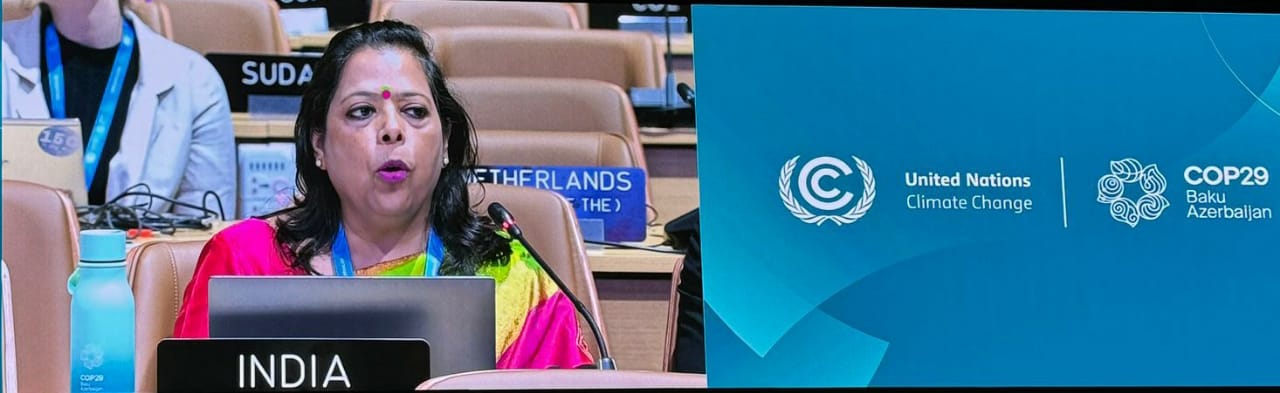
Delivering India’s statement, Secretary (MoEFCC) and Deputy Leader of the Delegation, Leena Nandan had said, “We feel disappointed by the fact that we continue to shift focus when the time has come to ensure that the mitigation actions are fully supported through provisions of adequate Finances as per CBDR-RC and equity considerations. COP after COP, we keep talking about mitigation ambitions - what is to be done, without talking about how it is to be done - in other words, the enablement of mitigation ambitions. This COP started with Focus on enablement through New Collective Quantitative Goals (NCQG), but as we move towards the end, we see shifting of the focus to mitigation.”
India firmly asserted that any attempts to deflect the focus again from Finance to repeated emphasis on mitigation cannot be accepted. The statement read, “All countries have submitted their NDCs and will be submitting the next round of Nationally Determined Contributions (NDCs) being informed by the various decisions we have taken together in the past as well as on the basis of our national circumstances and in the context of sustainable development goals and poverty eradication. What we decide here on climate finance will certainly influence what we submit next year. The attempt by some parties to further talk about mitigation is primarily a shift in focus from their own responsibilities of providing finance.” The statement called for a ‘Balance in the Climate Discourse’, and added, “If not so ensured, we may have continuous talk of mitigation that has no meaning, unless supported by enablement that is needed to make climate actions happen on the ground.”
India put forth its stance on the following issues that are critical in the fight against Climate Change. They are:
NCQG
India highlighted that as grant-based concessional Climate Finance is the most critical enabler to formulate and implement the new NDCs, action will get severely impacted in the absence of adequate means of implementation. The statement read, “The document needs to be specific on the structure, quantum, quality, timeframe, access, transparency, and review. The goal for mobilisation needs to be USD 1.3 trillion, with USD 600 billion of this coming through grants and grants equivalent resources. Expansion of the contributor base, reflection of conditional elements such as macroeconomic and fiscal measures, suggestion for carbon pricing, focus on private sector actors for scaling up resource flows as investments – is contrary to the mandate for the goal. NCQG is not an investment goal. We must accept that climate actions by Developing countries will have to be country driven, in line with their circumstances and in the manner best suited to country priorities.”
Mitigation
India strongly protested against changing the scope of the Mitigation Work Programme (MWP) in the draft text. India further cautioned against shifting of temperature goals, which need to be as per the exact language in the Paris Agreement. India called the introduction to the targets for 2030, 2035 and 2050 in the preamble as purely prescriptive.
India urged to add to the text certain elements like noting the pre-2020 mitigation gap by Annex-I Parties; noting with strong concern that the emission of Annex-I Parties is increasing from 2020 to 2030 etc. India strongly urged to recall the negative impacts of coercive unilateral measures on climate action specifically mitigation ambition and implementation.
Just Transition
India strongly declined to accept any renegotiation of the shared understanding prevalent on ‘Just Transitions’ in the decision from Dubai. The statement read, “Just transition is interpreted in narrow domestic terms, implying that it is national governments that have to take actions to ensure domestic just transitions. However, we have repeatedly made the point that Just transitions begin globally with Developed countries taking the lead in mitigation and ensuring that they provide the means of implementation to all Developing countries.”
India statement further said, “We have also repeatedly made the point that the possibility of our domestic transitions, our right to development, and our over-riding priority to pursue sustainable development, is constrained by repeated and ongoing inaction of Developed countries. The current text completely disregards this point that we have been making about our understanding of just transitions, which is also reflected in the Dubai decision. We absolutely cannot accept these paragraphs. They are prescriptive and completely reinterpret just transitions.”
GST
On the GST India stated the following:
- India does not agree to a follow up of the GST outcomes. As per Paris agreement, GST is supposed to only inform parties to undertake climate action.
- The new chapeau on Enhancing Action, Support and International Cooperation has been drafted without adequate connection or integration with the text, parts of which are under negotiation on the UAE dialogue.
- The last text from the negotiations undertaken by Parties was one that captured the views of all Parties and was a viable basis for further negotiation. The new options under the Section titled Modalities of the UAE dialogue does not capture this at all.
- The new chapeau has no connection with the subject matter of finance which is the main aim of the UAE dialogue.
- Further, the phrase “with developed countries (as per the synthesis report of the Biennial Reports) on track to increasing their emissions by 0.5 per cent from 2020 to 2030” may be added after the phrase “by 2.6 per cent by 2030 compared with the 2019 level”.
- Though the new chapeau title is general, the text added is completely mitigation centric and completely unbalanced. India does not accept this text.
- India does not accept the way the options have been formulated in the Timing and Format sections of the UAE dialogue.
Adaptation
India shared the following five points, which are essential to consider the draft decision:
- Final outcome should include indicators on means of implementation in order for this work on global goal on adaptation to be meaningful.
- There is no need to further focus on transformational adaptation. Instead, it is important to focus on other approaches such as incremental adaptation, long term adaptation in the context of national circumstances.
- The data used for reporting on indicators should be taken from Party submitted reports and not from any third party databases. Therefore, this text may be dropped.
- Language on Establishment of Baku Road Map as a means of continuing work pertaining to the global goal on adaptation, is essential.
- Indicators should reflect the progress in the GGA goals. Further segregation may not be required.
In conclusion, reiterated that this COP is the Finance COP - the Balancing COP, the enabling CoP. The statement read, “If we fail here, we fail in the fight against Climate Change for which the onus should be on those who are obligated to provide finance for climate action.”
The Nigerian representative called the $300 billion goal “a joke,” while Bolivia slammed it as an “insult and a flagrant violation of justice and climate equity.” Ali Mohamed, speaking on behalf of more than 50 African nations, called the deal “too little, too late for a continent facing climate devastation while contributing least to emissions.” He noted that an estimated $5.1–6.8 trillion is needed for climate action by 2030. The Association of Small Island States (AOSIS), a group of 43 island nations quit the summit saying that the COP29 discussions “were not offering a progressive way forward.”
Raina concluded: "India does not accept the goal proposal in its present form."
Climate crisis cries for third commitment period of Kyoto Protocol and regulation of TNCs
Written By mediavigil on Monday, November 08, 2021 | 10:37 PM
Some 24 members of the Like Minded Developing Countries (LMDC) and 55 countries of the African Group (AG) comprising 54℅+17℅=71 ℅ of world population have been excluded from unjust 26th Conference of Parties (COP26) of United Nations Framework Convention on Climate Change (UNFCCC). This situation creates a compelling logic for adoption of the third commitment period under the Kyoto Protocol for post 2020 period because the 37 countries failed to comply with it with impunity.
The COP 26 negotiators suffers from poverty of imagination under the influence of corporations which have made nation states subservient to their naked lust for profit at any cost. These 37 countries played a notorious role in killing the Kyoto Protocol and replacing it with a non-binding treaty.
Let us recall how at COP 21 in Paris, on 12 December 2015, the Parties to the UNFCCC reached a voluntary agreement (Paris Agreement) to combat climate crisis. The Paris Agreement was framed pursuant to Washington Declaration that envisaged extinction of common but differentiated responsibilities (CBDR) principle. Developing countries were made to agree to undermining of CBDR principle using donor' influence over them.
The key polluters paid lip service instead of actions and investments needed for a sustainable low carbon future. The trend of insincerity continues to envelope COP26. The key polluters would like people to forget that they failed to meet the targets for the first commitment period of the Kyoto Protocol (2008-2012) that required them to reduce emissions of the six main greenhouse gases, namely, Carbon dioxide (CO2); Methane (CH4); Nitrous oxide (N2O); Hydrofluorocarbons (HFCs); Perfluorocarbons (PFCs); and Sulphur hexafluoride (SF6).
Under the Protocol, limit was imposed on the maximum amount of emissions (measured as the equivalent in carbon dioxide) that a Party may emit over a commitment period in order to comply with its emissions target, country’s assigned amount. The individual targets for 36 countries included in Annex B to the Kyoto Protocol for the first commitment period and their emissions targets included EU, US, Canada, Japan, Croatia, New Zealand, Russian Federation, Ukraine, Australia. US did not to ratify the Kyoto Protocol. In December 2011, Canada withdrew from the Kyoto Protocol effective from December 2012.
The Protocol had extended the 1992 UNFCCC that commits state parties to reduce greenhouse gas emissions, based on the scientific consensus that (part one) global warming is occurring and (part two) that human-made CO2 emissions are driving it. The Protocol was adopted in Kyoto, Japan, in December 1997. It had entered into force in February 2005.
As a consequence of the insincerity of the key polluters, the 36 countries global emissions increased by 32% from 1990 to 2010.
Their insincerity became more pronounced during the second commitment period of the Kyoto Protocol (2013-2020). The 37 countries that had binding targets included Australia, the European Union (and its then 28 member states, now 27), Belarus, Iceland, Kazakhstan, Liechtenstein, Norway, Switzerland, and Ukraine. Belarus, Kazakhstan, and Ukraine did not put into legal force the targets under the second commitment period. Japan, New Zealand, and Russia did not take targets in the second commitment period. Canada had withdrawn from the Protocol in 2012 and USA did not ratify it.
In a stark demonstration of the dishonesty and insincerity of the 37 highly polluting countries, the Doha Amendment to Kyoto Protocol for the second commitment period entered into force only 31 December 2020 on the expiry of second commitment period, making all talk of combating climate crisis by these 37 countries even under Paris Agreement totally untrustworthy.
In a clear illustration of how international law is just a declaration of pious intentions, Paris Agreement entered into force in November 2016 within 6 months of its adoption, prior to the entry of force of the second commitment to the Kyoto Protocol, a classic case of putting the cart before the horse. In effect, it is crystal clear that Washington Declaration was aimed at killing the Kyoto Protocol. There was no need for non-binding Paris Agreement, there was a requirement

It is high time for the G-79 (LDMC + AG) and G-77 (134 counties) to unsign the Paris Agreement, and demand amendment of the Kyoto Protocol for the third commitment period.
The Paris Agreement suffers from poverty of ambition to combat climate crisis. It must be realised that Paris Agreement cannot keep global temperature rise below 2° C above pre-industrial levels. It suffers from poverty of competence to pursue efforts to limit the temperature increase even further to 1.5° C. It will never make finance flows consistent with a low GHG emissions and climate-resilient pathway. Unless the entire focus is brought on the “nationally determined contributions” (NDCs) of the 37 countries in pursuance the spirit of the Kyoto Protocol, there cannot be climate justice.
It may be recalled that the Conference of the Parties serving as the meeting of the Parties to the Paris Agreement (CMA) that met for the first time along with COP 22 of UNFCCC in Marrakesh in November 2016 was as uninspiring as the COP21. It revealed that jargons like 'climate neutrality' are inconsequential.
The Paris Agreement is an exercise in linguistic sleight of hand with regard to binding commitments vis-a-vis economy-wide reduction targets.
It is increasingly evident that market-based approaches involving carbon pricing, monetisation and claims of transferal of mitigation outcomes are simply an exercise in fishing in the troubled waters.
The Warsaw International Mechanism, on a cooperative and facilitative basis with respect to loss and damage associated with the adverse effects of climate crisis is an exercise in verbal gymnastics.
The Financial Mechanisms like the Green Climate Fund (GCF) do not serve the cause of combating climate crisis and international cooperation on climate-safe technology development and transfer.
The Paris Agreement's transparency and accounting system must be seen in the context of right to anonymity extracted by the transnational investors.
No effort at combating "dangerous interference in the atmosphere", the polite word for war on mother earth can succeed unless these efforts are conducted along side the efforts of the UN's Open-ended intergovernmental working group on transnational corporations and other business enterprises with respect to human rights.
It may be recollected that at its 26th session, on 26 June 2014, the Human Rights Council adopted resolution 26/9 by which it decided “to establish an open-ended intergovernmental working group on transnational corporations and other business enterprises with respect to human rights, whose mandate shall be to elaborate an international legally binding instrument to regulate, in international human rights law, the activities of transnational corporations and other business enterprises.”
The open-ended intergovernmental working group (OEIGWG) has had seven sessions so far. Ahead of the seventh session, the Permanent Mission of Ecuador, on behalf of the Chairmanship of the OEIGWG, released a third revised draft legally binding instrument to regulate the activities of transnational corporations and other business enterprises. The third revised draft served as the basis for State-led negotiations during the seventh session, which took place from 25 to 29 October 2021.
In such a backdrop, G-79 and G-77 countries must act prior to the “global stocktake” and put in place the framework for the third commitment period to the Kyoto Protocol. These countries must combine their efforts with work underway for a binding treaty for regulating TNCs and other business enterprises for making them subservient to interest of climate and communities. There can be no climate solution without regulation of TNCs who have hijacked national governments in general and in the 37 countries in particular.
The proposed third commitment period of Kyoto Protocol under UNFCCC must factor in the role of weapon manufacturers including nuclear weapon owners who are the biggest polluters, they constitute an unacknowledged cause of climate crisis.
It has come to light that Pentagon budget makes USA, a bigger polluter than 140 countries combined. US military is the largest emitter of green house fases. It may be recalled that it was US government managed to incorporate fake climate solution-carbon trade in the Kyoto Protocol. The dilution of Protocol was conceded by EU and others to keep USA as a party to the Protocol. USA became a party to the Protocol but subsequent to the dilution it unsigned the treaty. By doing so it boycotted both the first and the second commitment period to the Kyoto Protocol. LDMC and AG must reject fake solutions to the crisis. The EU should recall and re-adopt it's original position against carbon trade.
In order to combat climate crisis, to begin with weapon owners and the 37 countries must be made to ratify the UN treaty on prohibition of nuclear weapons which came into force from January 2021.
Gopal Krishna
--
The author is a law and public policy researcher has been tracking and critiquing climate negotiations since 1999.
India sets up Apex Committee for Implementation of Paris Agreement
Written By mediavigil on Sunday, November 29, 2020 | 9:41 PM
India being a party to the 1994 United Nations Framework Convention onClimate Change (UNFCCC), the Kyoto Protocol and the Doha Amendment to the Kyoto Protocol under the UNFCCC and the Paris Agreement, submitted its Nationally Determined Contribution (NDC) in 2015 for implementation of the Paris Agreement in the post-2020 period. The NDC has eight goals including three quantitative goals viz. reduction in the emissions intensity of Gross Domestic Product (GDP) by 33 to 35 per cent by 2030 from 2005 level; achieving about 40 per cent cumulative electric power installed capacity from non-fossil fuel based energy resources by 2030; and creating an additional carbon sink of 2.5 to 3 billion tonnes of carbon dioxide equivalent through additional forest and tree cover by 2030.
Prior to this India had constituted the National Clean Development Mechanism Authority (NCDMA) in 2003 under Article 12 of the Kyoto Protocol of 1997 which entered into force on 16 February 2005. UNFCCC entered into force on 21 March 1994. It has 197 parties. It is the parent treaty of the 1997 Kyoto Protocol which has 192 parties, 2012 Doha Amendment to Kyoto Protocol for the period period till 2020 and 2015 Paris Agreement for post 2020 period. Doha Amendment to Kyoto Protocol will come into force on 31 December 2020. As of 28 October 2020, it has 147 parties. Ironically, it will come into force on the day of its expiry. India had ratified it on 8 August, 2017. For post 2020 Period, Paris Agreement came into force 4 November 2016. India ratified it on 2 October, 2016. It has 189 parties as of now.
Significantly, India ratified pre-2020 treaty after having ratified the post 2020 treaty. As a consequence Doha Amendment to Kyoto Protocol remained a non-starter. India failed to set up a body like Apex Committee for Implementation of Doha Amendment to Kyoto Protocol as it accepted its slow death as a fait accompli.
The implementation of Article 6 of the Paris Agreement deals with market, non-market and voluntary approaches, necessitated setting up of an inter-ministerial committee to supersede the National CDM Authority (NCDMA) constituted under the Kyoto Protocol.
Paris Agreement envisages an ‘enhanced transparency framework’ with new modalities, procedures and guidelines (MPG) for the post-2020 period which will supersede the existing Monitoring, Review and Verification (MRV) system.
Paris Agreement establishes process of ‘Global Stocktake’ to periodically take stock of the implementation of this Agreement and assess the collective progress towards achieving the purpose of this Agreement and its long-term goals every five years with first in 2023.
For the purpose of ensuring a coordinated response on climate change matters that protects the country’s interests and ensures that India is on track towards meeting its climate change obligations under the Paris Agreement including its submitted NDCs, the Central Government has constitutes a Apex Committee for Implementation of Paris Agreement (AIPA) comprising of 17 members. It has been published in the Gazette of India on November 27, 2020.
 |
| Add caption |
In exercise of the powers conferred under sub-section (3) of section 3 of the Environment (Protection) Act, 1986 (29 of 1986), the Central Government constituted the AIPA. Its members include:
1. Secretary, Ministry of Environment, Forest and Climate Change (MoEFCC) -Chairperson
2. Additional Secretary, MoEFCC-Vice-Chairperson
3. Additional Director General (Forest), MoEFCC- Member
4. Joint Secretary, Ministry of Finance -Member
5. Joint Secretary, Ministry of Agriculture and Farmers Welfare- Member
6. Joint Secretary, Ministry of Science and Technology -Member
7. Joint Secretary, Ministry of New and Renewable Energy -Member
8. Joint Secretary, Ministry of Jal Shakti- Member
9. Joint Secretary, Ministry of Power -Member
10. Joint Secretary, Ministry of Earth Sciences- Member
11. Joint Secretary, Ministry of Health and Family Welfare- Member
12. Joint Secretary, Ministry of Housing and Urban Affairs- Member
13. Joint Secretary, Ministry of Rural Development -Member
14. Joint Secretary, Ministry of External Affairs -Member
15. Joint Secretary, Ministry of Commerce and Industry -Member
16. Joint Secretary level Officer, NITI Aayog -Member
17. Joint Secretary, MoEFCC- Member Secretary.
AIPA is required to:
(i) take measures with respect to matters referred to in the clauses (i), (ii) and (iii) of subsection (2) of section 3 of the aforesaid Act and may issue directions under section 5 thereof;
(ii) coordinate communication and reporting of NDCs to UNFCCC;
(iii) define responsibilities of concerned ministries for achieving India’s NDC goals and receive periodic information updates to monitor, review and revisit climate goals to fulfill the requirements of the Paris Agreement;
(iv) develop policies and programmes, if required, to make India’s domestic climate actions compliant with its international obligations;
(v) develop Monitoring, Reporting and Verification (MRV) protocol for National Inventory Management System (NIMS) as per the requirements under the enhanced Transparency Framework of Paris Agreement;
(vi) coordinate communication of National Communications, Biennial Update Reports and Biennial Transparency Reports to UNFCCC;
(vii) function as a National Authority to regulate carbon markets in India, under Article 6.2, Article 6.4 and Article 6.8 of the Paris Agreement in the post-2020 period;
(viii) formulate guidelines for consideration of projects or activities under Article 6 of the Paris Agreement;
(ix) issue guidelines on carbon pricing, market mechanism, and similar other instruments that have a bearing on climate change and NDCs;
(x) coordinate submission of Adaptation Communication as required under the Paris Agreement;
(xi) identify evolving requirements and propose mechanisms to facilitate achievement of India’s obligations in a cost-effective manner;
(xii) provide guidance to NDCs and its accounting for domestic, bilateral and multilateral activities or projects and ensure that these are compliant with Cabinet decisions and India’s position in international climate change negotiations;
(xiii) take note of the private sector’s contributions for combating climate change and provide guidance to help align their actions with domestic priorities;
(xiv) commission and recommend independent research and analytical studies and plan capacity building and training activities on the above issues;
(xv) seek guidance from and provide inputs to the Prime Minister’s Council on Climate Change (PMCCC); and
(xvi) any other matter, as required under UNFCCC and its Paris Agreement.
The Member-Secretary of AIPA has been responsible for its day-to-day activities including constituting sub-group to coordinate activities and carry out detailed examination of climate change related issues through experts or by consulting organizations for consideration by the aforesaid Authority or to engage or hire any consultant or specialist on contract basis on such remuneration as may be approved by the Central Government.
AIPA is empowered (a) to invite officials and experts from the Government, financial institutions, universities, academic institutions, consultancy organisations, non-Governmental organisations, civil society, legal profession, industry and commerce, as it may deem necessary for technical and professional inputs and may co-opt other members depending upon need;
(b) to interact with concerned authorities, institutions, individual stakeholders for matters relating to climate change;
(c) to take up any environmental or sustainable development issues pertaining to climate change as may be referred to it by the Central Government, and
(d) to provide recommendations to the Central Government on matters related to climate change.
AIPA is required to furnish report about its activity at least once in six months to the Central Government.
AIPA is supposed to act as per the objective of the UNFCCC and the Paris Agreement to achieve stabilisation of greenhouse gas concentrations in the atmosphere at a level that would prevent dangerous anthropogenic interference with the climate system. It has to enhance the implementation of the Convention and the Agreement in accordance with the principles of equity and common but differentiated responsibilities and respective capabilities, in the light of different national circumstances.
Round Table on “From Kyoto, Doha to Paris: Issues before Marrakesh Climate Conference”
Written By mediavigil on Tuesday, September 13, 2016 | 5:03 AM
Round Table on “From Kyoto, Doha to Paris: Issues before Marrakesh Climate Conference”
Date: Saturday, September 17, 2016
Venue: First Floor, A-124/6, (above Kotak Mahindra ATM), Shaheed Jeet Singh Marg, Katwaria Sarai,
Opposite Indian Statistical Institute, New Delhi-11016
Time: 2 PM onwards
Ahead of 22nd Conference of Parties to United Nations Framework Convention on Climate Change (UNFCCC)-CoP 22, which will be held in Marrakesh, Morocco from 7-18 November 2016, the Round Table Discussion is being organized to dwell on issues like Doha amendment to the Kyoto Protocol, Paris Agreement and role of state and non-state actors in dealing implications of climate crisis. It will dwell on the compliance with a second commitment period which has commenced from 1st January 2013 in the 11th year of the Protocol.
There is a logical compulsion to undertake climate action to prevent irreversible global changes in the pre-2020 and post-2020 period. It will also explore the remedial nature o f the proposed solutions for combating climate crisis in the 22nd year of UNFCCC’s entry into force.
For Details: Gopal Krishna, Mb: 9818089660
Date: Saturday, September 17, 2016
Venue: First Floor, A-124/6, (above Kotak Mahindra ATM), Shaheed Jeet Singh Marg, Katwaria Sarai,
Opposite Indian Statistical Institute, New Delhi-11016
Time: 2 PM onwards
Ahead of 22nd Conference of Parties to United Nations Framework Convention on Climate Change (UNFCCC)-CoP 22, which will be held in Marrakesh, Morocco from 7-18 November 2016, the Round Table Discussion is being organized to dwell on issues like Doha amendment to the Kyoto Protocol, Paris Agreement and role of state and non-state actors in dealing implications of climate crisis. It will dwell on the compliance with a second commitment period which has commenced from 1st January 2013 in the 11th year of the Protocol.
There is a logical compulsion to undertake climate action to prevent irreversible global changes in the pre-2020 and post-2020 period. It will also explore the remedial nature o

For Details: Gopal Krishna, Mb: 9818089660
How India failed at Paris Climate Conference: As a state it has fundamental responsibility to preserve land, water, air
Written By mediavigil on Wednesday, February 03, 2016 | 8:55 PM
India failed to do even what a small country like Nicaragua did in
the Paris Climate Conference by raising its flag questioning the
autocratic change introduced in the final draft at the last moment (from
‘shall’ to ‘should’) while adopting the 12 page long Paris Agreement
dated 12th December, 2015. The Agreement being a legal text required
application of basic legal knowledge by India. In law schools across the
globe students are taught that “shall” is “mandatory”. The drafters of
legal documents are trained into the use of “shall” as it conveys “a
duty to” be performed. It conveys obligation.
Had “shall” been not important 76 pages of Words and Phrases, a multi volume work of legal definitions would not have been devoted to case laws around it. The word “should” does not express a legal obligation, the word “shall” expresses a legal requirement.
 Initially, Article 4.4 of the Draft Agreement read: “Developed
country Parties shall continue taking the lead by undertaking
economy-wide absolute emission reduction targets. Developing country
Parties should continue enhancing their mitigation efforts…” This
formulation aptly captured the historic responsibilities of rich
countries and differentiated responsibilities of poorer countries. But
disregarding the voice of a Central American country like Nicaragua
which is a member of Group of 77, succumbing to the USA’s demand shall
was substituted with should. India’s decision to maintain a deafening
silence when the voice of a fellow member from G77 was disregarded is
contrary to its stature.
Initially, Article 4.4 of the Draft Agreement read: “Developed
country Parties shall continue taking the lead by undertaking
economy-wide absolute emission reduction targets. Developing country
Parties should continue enhancing their mitigation efforts…” This
formulation aptly captured the historic responsibilities of rich
countries and differentiated responsibilities of poorer countries. But
disregarding the voice of a Central American country like Nicaragua
which is a member of Group of 77, succumbing to the USA’s demand shall
was substituted with should. India’s decision to maintain a deafening
silence when the voice of a fellow member from G77 was disregarded is
contrary to its stature.
India failed to comprehend that as a State it has a fundamental responsibility to preserve resources like the land, water, and air, which belongs to the future generations. Its responsibility “predates statutory law”.
What Indian environment minister, Prakash Javadekar did not disclose to the Parliament has already been admitted by Nozipho Joyce Mxakato-Diseko, chairperson of the Group of 134 developing countries (G77 and China Group). India is a member of this Group. Diseko has revealed that Intended Nationally Determined Contribution (INDC) for mitigating climate change is “a perversion of the principle of common but differentiated responsibilities” because it undermines the “legal obligation in accordance with historical responsibilities for finance” accepted under the bullying influence of USA and its allies.
It is quite outrageous that INDCs are not legally enforceable. The paragraph 52 of the Decision of CoP 21 makes a categorical declaration that Article 8 of the Paris Agreement which deals with the issue of addressing loss and damage associated with the adverse effects of climate change “does not involve or provide a basis for any liability or compensation.”
Although such announcement sets a regressive precedent in international negotiations, given the fact Paris Agreement is not legally binding by implication, this attempt to escape liability for loss and damage appears unsuccessful. The 12 page long Paris Agreement dated 12th December, 2015 adopted by the countries that are Parties to United Nations Framework Convention on Climate Change (UNFCCC) which was adopted on 9th May, 1992, is an articulation of how ‘climate-inequality’ shapes the text of an international treaty supposedly aimed at climate justice and for the protection of Mother Earth.
It may be recalled that the false solution of carbon trade and off setting was introduced in the Kyoto Protocol at the behest of USA which had made it a pre-condition to sign the Protocol. Notably, after diluting the Protocol USA unsigned the Protocol. Unmindful of the fraud and corruption ridden carbon trade projects, instead of discarding this fake remedy the Paris Agreement makes way for global carbon market through Article 6 of the Agreement. It makes space for “voluntary contribution” among countries in the implementation of their emission reduction targets and “to allow for higher ambition in their mitigation and adaptation actions”.
It creates a new class of carbon assets namely, “internationally transferred mitigation outcomes” (ITMOs) for trading and “support for results- based payments to implement policy approaches”. This new mechanism of UNFCCC has been incarnated as Sustainable Development Mechanism (SDM) as main mitigation tool in place of pre-existing Clean Development Mechanism (CDM) and Joint Implementation post-2020.
Industrial War against Climate System
What is charitably referred to as “dangerous anthropogenic interference with the climate system” in the text of the UNFCCC is in reality an act of industrial warfare against climate and its allied ecosystem whose impact has become glaring. It is quite surprising that green house gas emissions from the war industry which is reaping unprecedented profits amidst conflicts around natural resources has not been included as one of the key sources of climate crisis.
It is apparent that world governments have adopted Ostrich policy with regard to climate crisis under the influence of undemocratic economic organizations. Richer countries became prosperous and dominant due to carbon emission since 1750. Between 1850 and 2011, USA, European Union, Russian Federation, Japan and others contributed over 2/3rd of total global emissions. Notably, developed countries have been outsourcing their carbon-intensive industries to developing countries like India.
Admittedly, the estimated aggregate greenhouse gas emission levels in 2025 and 2030 resulting from INDCs do not fall within least –cost 2 degree C but rather lead to a projected level of 55 gigatons in 2030. The Decision underlines that in order to hold the increase in global average temperature to below 2 degree C above pre-industrial levels there is a need for reduction of emissions to 40 gigatons.
It is quite bizarre that while almost all the countries have stated their commitments to reduce emissions from 1990 levels, USA has decided to count its reduction in emission using 2005 as the base year. Thus, its commitment of reduction is only 14%insteadof28%ashasbeen claimed quite deceptively.
Where does India stand?
It has been estimated that India’s current per capita income is close US’s per capita income in the 1890s. Like most developed countries where coal remains unavoidable, India continues to argue that it will continue to use coal as its primary source in its energy mix. Meanwhile, in a remarkable move, the share of renewables in India has increased over 6 times between 2002 and 2015. India has also announced that it will add 175 GW of renewable energy capacity (almost equal to the total installed power generation of Germany) by 2022. This will lead to avoidance of burning over 300 million tonnes of coal.
Paris Agreement has a stark lesson for Indian Government and its INDC which promoted “Nuclear Power as a safe, environmentally benign and economically viable source to meet the increasing electricity needs of the country.” The word “nuclear” does not appear in the Agreement despite efforts by countries like India. It is high time India followed the path of those who have no nuclear power reactors and remain opposed to nuclear power.
India cannot afford to be complacent citing emissions by top polluters given the fact emissions of top 10 % of urban Indians is about 27 times the emissions of the bottom 10 % of rural India that the carbon footprint of 1 % of the India’s wealthy class is being veiled by 823 million poor class of the country. Saving climate from poisonous market interference
Paris Agreement panders to the whims and fancies of commercial czars who are obstinately commodifying and monetizing nature and interfering with climate and allied ecosystems. The natural resource dependent communities are facing unprecedented deprivation. This has created an episteme that blindly bulldozes technical and market solutions as “real” solutions. Meanwhile, World Bank Group feigned surprise on 17th December “to see the extent and detail on carbon markets” included in the Paris Agreement that paves the way for “Carbon Markets 2.0”.
 A new, non-market, climate finance mechanism is needed to support the
formalization and expansion of mitigation and technology transfer as a
genuine solution to combat the propensity of promoting free trade in
carbon at the cost of climate system. Climate talks remain relevant
because fate of the communities and global order is linked to the
decision by the richest countries to undergo mandatory fossil fuel
de-addiction. But the Agreement fails to make top polluters liable for
“dangerous anthropogenic interference” and for endangering human
ecosystem which is the substratum for the existence of living beings.
A new, non-market, climate finance mechanism is needed to support the
formalization and expansion of mitigation and technology transfer as a
genuine solution to combat the propensity of promoting free trade in
carbon at the cost of climate system. Climate talks remain relevant
because fate of the communities and global order is linked to the
decision by the richest countries to undergo mandatory fossil fuel
de-addiction. But the Agreement fails to make top polluters liable for
“dangerous anthropogenic interference” and for endangering human
ecosystem which is the substratum for the existence of living beings.
In effect, despite the brave effort of a G77 country, Paris conference failed to save climate and intra-generational and inter-generational equity from the banks and markets that threaten our planet by integrating carbon pricing policies in all sectors of economy. It failed to make ratification of Doha amendment 2012 to Kyoto Protocol, 1997 developed under the UNFCCC’s charter covering 2012-2020 time span a priority.
India should have taken ethical leadership by declaring carbon trading as a fake
solution and by choosing not “to pursue the reckless and environmentally harmful path to development” that the developed countries have taken so far. It should have sought early ratification of the Doha Amendment to the Protocol which is the international law till 2020. But this law has not entered into force as yet. This exposes the hollowness of the claims about leading “nearly 200 nations to the most ambitious agreement in history to fight climate change” made by President Barack Obama in his last State of the Union address in front of the US Congress. The failure to apply “public trust doctrine” for safeguarding climate system is quite evident.
Ahead of the next conference which is planned in November 2016 in Marrakech, Morocco, India should take recourse to “long memories” to mobilize G-77 countries to put limits on ungovernable national and transnational business enterprises by adopting principles that account for the imminent danger to the very substratum of human existence.
By Dr Gopal Krishna*
*Public policy analyst; Director, ToxicsWatch Alliance (TWA). Source: PUCL Bulletin
The author has been tracking the climate issue for more than a decade
Had “shall” been not important 76 pages of Words and Phrases, a multi volume work of legal definitions would not have been devoted to case laws around it. The word “should” does not express a legal obligation, the word “shall” expresses a legal requirement.
 Initially, Article 4.4 of the Draft Agreement read: “Developed
country Parties shall continue taking the lead by undertaking
economy-wide absolute emission reduction targets. Developing country
Parties should continue enhancing their mitigation efforts…” This
formulation aptly captured the historic responsibilities of rich
countries and differentiated responsibilities of poorer countries. But
disregarding the voice of a Central American country like Nicaragua
which is a member of Group of 77, succumbing to the USA’s demand shall
was substituted with should. India’s decision to maintain a deafening
silence when the voice of a fellow member from G77 was disregarded is
contrary to its stature.
Initially, Article 4.4 of the Draft Agreement read: “Developed
country Parties shall continue taking the lead by undertaking
economy-wide absolute emission reduction targets. Developing country
Parties should continue enhancing their mitigation efforts…” This
formulation aptly captured the historic responsibilities of rich
countries and differentiated responsibilities of poorer countries. But
disregarding the voice of a Central American country like Nicaragua
which is a member of Group of 77, succumbing to the USA’s demand shall
was substituted with should. India’s decision to maintain a deafening
silence when the voice of a fellow member from G77 was disregarded is
contrary to its stature.India failed to comprehend that as a State it has a fundamental responsibility to preserve resources like the land, water, and air, which belongs to the future generations. Its responsibility “predates statutory law”.
What Indian environment minister, Prakash Javadekar did not disclose to the Parliament has already been admitted by Nozipho Joyce Mxakato-Diseko, chairperson of the Group of 134 developing countries (G77 and China Group). India is a member of this Group. Diseko has revealed that Intended Nationally Determined Contribution (INDC) for mitigating climate change is “a perversion of the principle of common but differentiated responsibilities” because it undermines the “legal obligation in accordance with historical responsibilities for finance” accepted under the bullying influence of USA and its allies.
It is quite outrageous that INDCs are not legally enforceable. The paragraph 52 of the Decision of CoP 21 makes a categorical declaration that Article 8 of the Paris Agreement which deals with the issue of addressing loss and damage associated with the adverse effects of climate change “does not involve or provide a basis for any liability or compensation.”
Although such announcement sets a regressive precedent in international negotiations, given the fact Paris Agreement is not legally binding by implication, this attempt to escape liability for loss and damage appears unsuccessful. The 12 page long Paris Agreement dated 12th December, 2015 adopted by the countries that are Parties to United Nations Framework Convention on Climate Change (UNFCCC) which was adopted on 9th May, 1992, is an articulation of how ‘climate-inequality’ shapes the text of an international treaty supposedly aimed at climate justice and for the protection of Mother Earth.
It may be recalled that the false solution of carbon trade and off setting was introduced in the Kyoto Protocol at the behest of USA which had made it a pre-condition to sign the Protocol. Notably, after diluting the Protocol USA unsigned the Protocol. Unmindful of the fraud and corruption ridden carbon trade projects, instead of discarding this fake remedy the Paris Agreement makes way for global carbon market through Article 6 of the Agreement. It makes space for “voluntary contribution” among countries in the implementation of their emission reduction targets and “to allow for higher ambition in their mitigation and adaptation actions”.
It creates a new class of carbon assets namely, “internationally transferred mitigation outcomes” (ITMOs) for trading and “support for results- based payments to implement policy approaches”. This new mechanism of UNFCCC has been incarnated as Sustainable Development Mechanism (SDM) as main mitigation tool in place of pre-existing Clean Development Mechanism (CDM) and Joint Implementation post-2020.
Industrial War against Climate System
What is charitably referred to as “dangerous anthropogenic interference with the climate system” in the text of the UNFCCC is in reality an act of industrial warfare against climate and its allied ecosystem whose impact has become glaring. It is quite surprising that green house gas emissions from the war industry which is reaping unprecedented profits amidst conflicts around natural resources has not been included as one of the key sources of climate crisis.
It is apparent that world governments have adopted Ostrich policy with regard to climate crisis under the influence of undemocratic economic organizations. Richer countries became prosperous and dominant due to carbon emission since 1750. Between 1850 and 2011, USA, European Union, Russian Federation, Japan and others contributed over 2/3rd of total global emissions. Notably, developed countries have been outsourcing their carbon-intensive industries to developing countries like India.
Admittedly, the estimated aggregate greenhouse gas emission levels in 2025 and 2030 resulting from INDCs do not fall within least –cost 2 degree C but rather lead to a projected level of 55 gigatons in 2030. The Decision underlines that in order to hold the increase in global average temperature to below 2 degree C above pre-industrial levels there is a need for reduction of emissions to 40 gigatons.
It is quite bizarre that while almost all the countries have stated their commitments to reduce emissions from 1990 levels, USA has decided to count its reduction in emission using 2005 as the base year. Thus, its commitment of reduction is only 14%insteadof28%ashasbeen claimed quite deceptively.
Where does India stand?
It has been estimated that India’s current per capita income is close US’s per capita income in the 1890s. Like most developed countries where coal remains unavoidable, India continues to argue that it will continue to use coal as its primary source in its energy mix. Meanwhile, in a remarkable move, the share of renewables in India has increased over 6 times between 2002 and 2015. India has also announced that it will add 175 GW of renewable energy capacity (almost equal to the total installed power generation of Germany) by 2022. This will lead to avoidance of burning over 300 million tonnes of coal.
Paris Agreement has a stark lesson for Indian Government and its INDC which promoted “Nuclear Power as a safe, environmentally benign and economically viable source to meet the increasing electricity needs of the country.” The word “nuclear” does not appear in the Agreement despite efforts by countries like India. It is high time India followed the path of those who have no nuclear power reactors and remain opposed to nuclear power.
India cannot afford to be complacent citing emissions by top polluters given the fact emissions of top 10 % of urban Indians is about 27 times the emissions of the bottom 10 % of rural India that the carbon footprint of 1 % of the India’s wealthy class is being veiled by 823 million poor class of the country. Saving climate from poisonous market interference
Paris Agreement panders to the whims and fancies of commercial czars who are obstinately commodifying and monetizing nature and interfering with climate and allied ecosystems. The natural resource dependent communities are facing unprecedented deprivation. This has created an episteme that blindly bulldozes technical and market solutions as “real” solutions. Meanwhile, World Bank Group feigned surprise on 17th December “to see the extent and detail on carbon markets” included in the Paris Agreement that paves the way for “Carbon Markets 2.0”.
 A new, non-market, climate finance mechanism is needed to support the
formalization and expansion of mitigation and technology transfer as a
genuine solution to combat the propensity of promoting free trade in
carbon at the cost of climate system. Climate talks remain relevant
because fate of the communities and global order is linked to the
decision by the richest countries to undergo mandatory fossil fuel
de-addiction. But the Agreement fails to make top polluters liable for
“dangerous anthropogenic interference” and for endangering human
ecosystem which is the substratum for the existence of living beings.
A new, non-market, climate finance mechanism is needed to support the
formalization and expansion of mitigation and technology transfer as a
genuine solution to combat the propensity of promoting free trade in
carbon at the cost of climate system. Climate talks remain relevant
because fate of the communities and global order is linked to the
decision by the richest countries to undergo mandatory fossil fuel
de-addiction. But the Agreement fails to make top polluters liable for
“dangerous anthropogenic interference” and for endangering human
ecosystem which is the substratum for the existence of living beings.In effect, despite the brave effort of a G77 country, Paris conference failed to save climate and intra-generational and inter-generational equity from the banks and markets that threaten our planet by integrating carbon pricing policies in all sectors of economy. It failed to make ratification of Doha amendment 2012 to Kyoto Protocol, 1997 developed under the UNFCCC’s charter covering 2012-2020 time span a priority.
India should have taken ethical leadership by declaring carbon trading as a fake
solution and by choosing not “to pursue the reckless and environmentally harmful path to development” that the developed countries have taken so far. It should have sought early ratification of the Doha Amendment to the Protocol which is the international law till 2020. But this law has not entered into force as yet. This exposes the hollowness of the claims about leading “nearly 200 nations to the most ambitious agreement in history to fight climate change” made by President Barack Obama in his last State of the Union address in front of the US Congress. The failure to apply “public trust doctrine” for safeguarding climate system is quite evident.
Ahead of the next conference which is planned in November 2016 in Marrakech, Morocco, India should take recourse to “long memories” to mobilize G-77 countries to put limits on ungovernable national and transnational business enterprises by adopting principles that account for the imminent danger to the very substratum of human existence.
By Dr Gopal Krishna*
*Public policy analyst; Director, ToxicsWatch Alliance (TWA). Source: PUCL Bulletin
The author has been tracking the climate issue for more than a decade
Historic Paris Agreement on Climate Change, a binding agreement
Written By mediavigil on Sunday, December 13, 2015 | 10:55 PM
Following the adoption of the Paris Agreement by the COP (Conference of the Parties), it will be deposited at the UN in New York and be opened for one year for signature on 22 April 2016--Mother Earth Day.
The agreement will enter into force after 55 countries that account for at least 55% of global emissions have deposited their instruments of ratification.

195 Nations Set
Path to Keep Temperature Rise Well Below 2 Degrees Celsius
- Mitigation – reducing emissions fast enough to achieve the temperature goal
- A transparency system and global stock-take – accounting for climate action
- Adaptation – strengthening ability of countries to deal with climate impacts
- Loss and damage – strengthening ability to recover from climate impacts
- Support – including finance, for nations to build clean, resilient futures
- Over 7,000 cities, including the most vulnerable to climate change, from over 100 countries with a combined population with one and a quarter billion people and around 32% of global GDP.
- Sub-national states and regions comprising one fifth of total global land area and combined GDP of $12.5 trillion.
- Over 5,000 companies from more than 90 countries that together represent the majority of global market capitalisation and over $38 trillion in revenue.
- Nearly 500 investors with total assets under management of over $25 trillion
- All countries will submit adaptation communications, in which they may detail their adaptation priorities, support needs and plans. Developing countries will receive increased support for adaptation actions and the adequacy of this support will be assessed.
- The existing Warsaw International Mechanism on Loss and Damage will be significantly strengthened.
- The agreement includes a robust transparency framework for both action and support. The framework will provide clarity on countries’ mitigation and adaptation actions, as well as the provision of support. At the same time, it recognizes that Least Developed Countries and Small Island Developing States have special circumstances.
- The agreement includes a global stocktake starting in 2023 to assess the collective progress towards the goals of the agreement. The stocktake will be done every five years.
- The agreement includes a compliance mechanism, overseen by a committee of experts that operates in a non-punitive way.
- Under the Kyoto Protocol, there is now a clear and transparent accounting method for carry-over credits for the second commitment period, creating a clear set of rules.
- The first round of international assessment and review process (IAR) that was launched in 2014 was successfully completed.
- A number of technical and implementation issues related to the existing arrangements on technology, adaptation, action for climate empowerment and capacity building were also successfully concluded.
|
With 196
Parties, the United Nations Framework Convention on Climate Change (UNFCCC)
has near universal membership and is the parent treaty of the 1997 Kyoto
Protocol. The Kyoto Protocol has been ratified by 192 of the UNFCCC Parties.
For the first commitment period of the Kyoto Protocol, 37 States, consisting
of highly industrialized countries and countries undergoing the process of
transition to a market economy, have legally binding emission limitation and
reduction commitments. In Doha in 2012, the Conference of the Parties serving
as the meeting of the Parties to the Kyoto Protocol adopted an amendment to
the Kyoto Protocol, which establishes the second commitment period under the
Protocol. The ultimate objective of both treaties is to stabilize greenhouse
gas concentrations in the atmosphere at a level that will prevent dangerous
human interference with the climate system.
|
An historic
agreement to combat climate change and unleash actions and investment towards a
low carbon, resilient and sustainable future was agreed by 195 nations in Paris on 12th December, 2015.
The Paris
Agreement for the first time brings all nations into a common cause based on
their historic, current and future responsibilities.
The universal
agreement’s main aim is to keep a global temperature rise this century well
below 2 degrees Celsius and to drive efforts to limit the temperature increase
even further to 1.5 degrees Celsius above pre-industrial levels.
The 1.5 degree
Celsius limit is a significantly safer defense line against the worst impacts
of a changing climate.
Additionally,
the agreement aims to strengthen the ability to deal with the impacts of
climate change.
To reach these
ambitious and important goals, appropriate financial flows will be put in
place, thus making stronger action by developing countries and the most
vulnerable possible, in line with their own national objectives.
UN Secretary
General Ban Ki-moon said, “This is a resounding
success for multilateralism.”
The Paris
Agreement and the outcomes of the UN climate conference (COP21) cover all the
crucial areas identified as essential for a landmark conclusion:
As well as
setting a long-term direction, countries will peak their emissions as soon as
possible and continue to submit national climate action plans that detail their
future objectives to address climate change.
This builds on
the momentum of the unprecedented effort which has so far seen 188 countries
contribute climate action plans to the new agreement, which will dramatically
slow the pace of global greenhouse gas emissions.
The new
agreement also establishes the principle that future national plans will be no
less ambitious than existing ones, which means these 188 climate action plans
provide a firm floor and foundation for higher ambition.
Countries will
submit updated climate plans – called nationally determined contributions
(NDCs) – every five years, thereby steadily increasing their ambition in the
long-term.
Climate action
will also be taken forward in the period before 2020. Countries will continue
to engage in a process on mitigation opportunities and will put added focus on
adaptation opportunities. Additionally, they will work to define a clear
roadmap on ratcheting up climate finance to USD 100 billion by 2020.
This is further
underlined by the agreement’s robust transparency and accounting system, which
will provide clarity on countries’ implementation efforts, with flexibility for
countries’ differing capabilities.
The Paris
Agreement underwrites adequate support to developing nations and establishes a
global goal to significantly strengthen adaptation to climate change through
support and international cooperation.
The already
broad and ambitious efforts of developing countries to build their own clean,
climate-resilient futures will be supported by scaled-up finance from developed
countries and voluntary contributions from other countries.
Governments
decided that they will work to define a clear roadmap on ratcheting up climate
finance to USD 100 billion by 2020 while also before 2025 setting a new goal on
the provision of finance from the USD 100 billion floor.