

An Ordinary Insanity: A Must-Watch Documentary on the Banalized Threats of
Nuclear Weapons
-
Courtsey: An Ordinary Insanity “In this 29-minute documentary, renowned
whistleblower Daniel Ellsberg provides a powerful wakeup call about the
globa...
Latest Post
Showing posts with label Public Health. Show all posts
Showing posts with label Public Health. Show all posts
Govt betrays consumers, public health, workers, environment & human rights by opposing listing of white chrysotile asbestos as hazardous substance at the UN Meet
Written By mediavigil on Sunday, May 07, 2017 | 11:00 PM
Public Statement
Indian Govt betrays consumers, public health, workers, environment & human rights by opposing listing of white chrysotile asbestos as hazardous substance at the UN Meet
Government’s position contrary to domestic laws
Cabinet Committee on Economic Affairs deciding position on Asbestos does not include Ministers of Consumer Affairs, Health, Labour, and Environment
Govt ignored views expressed by environment minister, Health Minister & States on hazards of asbestos and incurable asbestos related diseases
Govt must take action against white chrysotile asbestos to protect public health and human rights instead of waiting for outcome of next meeting of UN’s Rotterdam Convention in 2019
Taking an inconsistent position disregarding public health and human rights of Indians, India joined Russia, Kazakhstan, Kyrgyzstan, Zimbabwe and Syria to block listing of hazardous white chrysotile asbestos, the killer fiber in the UN list at the UN Meet that concluded on 5 May in Geneva. The 8th Conference of the Parties to the UN’s Rotterdam Convention on the prior informed consent procedure for certain hazardous chemicals and pesticides in international trade (COP8) failed to make any progress on democratic right of people to be protected from hazardous substances. The listing of white chrysotile asbestos in the UN list of hazardous substances helps in better protection of public health and environment. In an act of betrayal of gnawing public interest cause, India took a position which is contrary to its own domestic law on hazardous white chrysotile asbestos at the UN Meet. The next UN meeting on the issue will happen in 2019.
Given the fact that Cabinet Committee on Economic Affairs, Government of India does not include Ministers of Consumer Affairs, Health, Labour, and Environment, it was apprehended that concerns related to consumers, public health, workers, and environment is likely to be disregarded. This apprension has turned out to be true. Government failed to pay heed to the opinion expressed by Union environment minister and Union Health Minister.
Asbestos diseases have a very long incubation period. So if you are exposed today to an asbestos fibre, you are likely to get the disease in next 10-35 years. Asbestos is like a time bomb to the lungs and Indians will suffer the most. If it is banned today that does not mean people will not suffer. Because of past usage people will continue to suffer from these diseases. It is clear that lack of documentation and lack of environmental and occupational health infrastructure does not mean lack of victims of asbestos related diseases.
Union Environment Minister has said, “Since the use of asbestos is affecting human health, its use should gradually be minimised and eventually end. As far as I know, its use is declining. But it must end.”
In a written reply Union Minister of Health and Family Welfare has informed the Parliament on the subject of Asbestos Related Diseases saying: “The Indian Council of Medical Research (ICMR) has informed that major health hazards of asbestos include cancer of lung, mesothelioma of pleura and peritoneum and specific fibrous disease of lung known as asbestosis. All types of asbestos fibers are responsible for human mortality and morbidity. Studies have been carried out at National Institute of Occupational Research, an Institute of ICMR, Ahmedabad which show that workers when exposed to higher workplace concentration of asbestos fiber have higher incidence of interstitial lung disease and pulmonary function impairment. Directorate General Factory Advice Service and Labour Institutes, (DGFASLI) under Ministry of Labour & Employment has intimated data of workers suffering from Asbestosis in factories registered under the Factories Act, 1948.As per the information provided by DGFASLI, it is informed that 21 no. of Asbestosis cases were reported in Gujarat in 2010 and 2 cases in Maharashtra in the year 2012.”
The reply of the Union Minister of Health and Family Welfare further reads: “As per the provisions of the Factories Act, 1948 and rules framed thereunder, manufacture, handling and processing of Asbestos and its products is declared as Hazardous Process. Further, Govt. of India has prepared Schedule XIV- ‘’Handling and Processing of Asbestos, Manufacture of any Article or Substance of Asbestos and any other Process of Manufacture or otherwise in which Asbestos is used in any Form’’ as a Dangerous Operation under section 87 of the Factories Act,1948. The Ministry of Mines has informed that the Grant of fresh mining leases and renewal of existing mining leases for Asbestos are presently banned in the country on Health Grounds.” This was stated by the Union Minister for Health and Family Welfare in a reply to the Lok Sabha.
This reply is consistent with the observation of World Health Organisation (WHO) saying, " All types of asbestos cause lung cancer, mesothelioma, cancer of the larynx and ovary, and asbestosis (fibrosis of the lungs). Exposure to asbestos occurs through inhalation of fibres in air in the working environment, ambient air in the vicinity of point sources such as factories handling asbestos, or indoor air in housing and buildings containing friable (crumbly) asbestos materials." It underlines that several thousands of deaths can be attributed to other asbestos-related diseases, as well as to non-occupational exposures to asbestos.
It is quite shameful that Indian delegation disregarded the views of Health and Environment Ministry and ignored the 105 page long Indian Government’s Environmental Impact Assessment Guidance Manual for Asbestos Based Industries. The relevant part of the Manual reads: “All workplaces where asbestos dust may cause a hazard is to be clearly indicated as an asbestos dust exposure area through the use of a well-displayed sign, which identifies the hazard and the associated health effects” for workers’s education. It also states, “Pictorial warning signs and precautionary notices for asbestos and products containing asbestos are to be made” for the protection of consumers from “hazard and the associated health effects.”
Government allowed itself to be overwhelmed by the influence of the four asbetsos producers of the world who produced 1,799,700 metric tons of chrysotile asbestos in 2015 (Russia - 1,100,000 tons, Brazil- 310,000 tons, China-210,000 tons and Kazakhstan 179,700 tons) who seem to have given themselves the power to determine whether or not Indians have the right of Prior Informed Consent. In a bizzare situation, it is being implied by them this right exists only if the hazardous white chrysotile asbestos industry allows it to be exercised.
Government failed to protect itself from the unhealthy influence of Asbestos Cement Products Manufacturers Association (ACPMA) and the asbestos producing countries which are patrons of ACPMA.
Government failed to note that Asbestos is listed as a hazardous substance under Part II of Schedule-I of the Manufacture, Storage and import of Hazardous Chemical Rules under the Environment (Protection) Act, 1986 provides the List of Hazardous and Toxic Chemicals. This list has 429 chemicals. Asbestos is at the serial no. 28 in the list. This Rule and the list are available on the website of Union Ministry of Environment & Forests. Indian position should have been in keeping with government’s “Inventory of Hazardous Chemicals Import in India” that lists ‘asbestos’ at serial no. 26 as one of the 180 hazardous chemicals in international trade which is imported in India. It would be scandalous if Indian delegation took a position inconsistent with the Manufacture, Storage, and Import of Hazardous Chemicals (MSIHC) Rules.
Notably, even under Factories Act, 1948, the List of 29 industries involving hazardous processes is given under Section 2 (cb), Schedule First, asbestos is mentioned at serial no. 24. The Act defines "hazardous process" as “any process or activity in relation to an industry specified in the First Schedule where, unless special care is taken, raw materials used therein or the intermediate or finished products, bye-products, wastes or effluents thereof would--(i) cause material impairment to the health of the persons engaged in or connected therewith, or (ii) result in the pollution of the general environment”. This leaves no doubt that asbestos is a hazardous substance.
It has been observed that promoters of white chrysotile asbestos like ACPMA manage to get themselves planted in the Indian delegation and seem to prevail on the government representatives take a position against human health and the environment and to put profit of the asbestos industry before gnawing public health concerns.
It must be recalled that on June 22, 2011 Indian delegation led by Ms. Mira Mehrishi, Additional Secretary, had supported the listing of Chrysotile asbestos as a hazardous chemical substance at the fifth meeting on Rotterdam Convention amidst standing ovation. Ban Asbestos Network of India (BANI) and ToxicsWatch Alliance (TWA) had taken the opportunity of congratulating the government but the about turn on later occasions under the corrupting influence ACPMA was a sad let down. The same deleterious forces have prevailed at the COP 8 too.
Government should pay heed to a precedent-setting decision dated April 2, 2013 delivered by the Israel's High Court of Justice that rejected a petition on against a law placing substantial financial responsibility on a company to clean up asbestos waste. The order observed, “In recent years, countries throughout the world have been required to deal with different dilemmas related to protecting the quality of the environmental. A substantial portion of these dilemmas involve, among other things, legal, economic and ethical considerations. Amongst these dilemmas, the removal of hazardous waste – the matter at the heart of the present appeal – is a subject that demands significant attention. Asbestos, in particular, has proved itself to be efficient and strong, suitable for many uses. However, it has become clear with time that its ability to cause damage immeasurably outweighs its potential benefits. Since the 20th century, different states have dealt with this matter of how to clean up the environment from asbestos, and onthe questions of who to impose the responsibility and who to require to pay for the implementation. Consequently, I have found it appropriate to first turn our perspective on the relevant legal regimes in a few key countries beyond our borders.” It ruled that "To conclude, the survey presented (of various international legal perspectives) indicates various and complimentary components. In all instances it appears a consensus has been established, certainly so with regards to materials hazardous by their very nature such as asbestos, that substantial responsibility is to be imposed on the pollutant."
Government must pay attention to the verdict of five judges of Japan’s Supreme Court dated February 17, 2015 that has upheld a ruling that found asbestos used at a plant of Kubota Corporation caused fatal mesothelioma in a man who lived near the plant and ordered the company to pay ¥31.9 million in damages to his relatives. The petitioners were relatives of Kojiro Yamauchi, who died at age 80 after working for two decades about 200 meters from the Kubota plant in Amagasaki, Hyogo Prefecture. His relatives and those of Ayako Yasui, who died at age 85 having lived about 1 km from the plant, sought damages from both Kubota and the government. In October, 2014 this Supreme Court ruled that the government was responsible for failing to protect workers from exposure at asbestos factories in Sennan, Osaka Prefecture.
Government should examine that the official record which shows that three cases of asbestos related diseases i.e. Mesothelioma have been reported from among the workers of employed in the factory of Hyderabad Industries Limited, Sanathnagara, Hyderabad in Andhra Pradesh. These workers have died due to the disease. These workers were: 1) N Chandra Mouli, 2) Sher Khan and 3) ama Chandraiah. This was revealed in an affidavit filed by T Narayana Reddy, Special Officer Office of Advocate-on-record, Andhra Pradesh Legal Cell, New Delhi in the Supreme Court. This company in question may be asked to file a report on total number of workers employed by it and their health status including a report about the three above mentioned workers.
It is also a matter of official record that National Institute of Occupational Health (NIOH), Ahmedabad, Gujarat recommended compensation for two workers employed in Gujarat Composites Limited who were certified to be suffering from asbestosis. This has been revealed in a reply given by Government of Gujarat. A letter of Chief Inspector of Factories, Gujarat State dated December 24, 2002 in the matter of execution of the order of Supreme Court in Writ Petition (Civil) No. 206 of 1986 categorically reveals that two workers of Gujarat Composites Ltd were confirmed for Asbestosis, an incurable lung disease by NIOH. The workers were (1) Hazarilal Manraj and (2) Sahejram B Yadav. The letter recommended compensation of Rs 1 lakh as per the Court order but till date the same has not been given. This and many such cases conclusively establish the hazards from asbestos. Influence of the asbestos industry becomes quite obvious when Government turns a blind eye to such glaring official facts. This is also a clear case of contempt of court by the asbestos based company. It may be noted that Gujarat Composite Ltd (formerly named Digvijay Cement Company) appears to be attempting to hide behind myriad corporate veils by changing names and by outsourcing its work. The official letter demonstrates that white chrysotile asbestos is a hazardous substance which causes asbestos related incurable diseases.
It is noteworthy that Secretary, Medical Education & Research, Chandigarh Administration which has categorically informed National Human Rights Commission (NHRC) that “a. White Asbestos (Chrysotile Asbestos) is implicated in so many studies with the following diseases:-Mesothelioma (Cancer of Pleura), Lung Cancer, Peritoneal Cancer, Asbestosis, And also consider as cause of following cancers:- Ovarian Cancer, Laryngeal Cancer, Other Cancer b. Diseases are produced in the person involved in Asbestos Industry.” It states that “No. of cancer deaths due to asbestos requires further large scale study from India”. It informs, “It is definitely harmful material, causing cancer and other related diseases.”
It quotes from Pulmonary Medicine journal saying, “Asbestos is a set of six naturally occurring silicate minerals exploited commercially for their desirable physical properties. However, it has been proved beyond doubt that Asbestos is hazardous to humans. White asbestos has been found to have causal relationship with various diseases like pulmonary asbestosis, lung cancer and mesothelioma leading to deaths of thousands of people every year.”
The communication of Chandigarh Administration concludes saying, “Hence, use of white asbestos should be completely banned in India also and the same may be replaced by some safe alternative material.” Chandigarh Administration has realized the public health consequences of exposure to fibers of asbestos.
The Assistant Labour Commissioner, Union Territory, Chandigarh has referred to para 16 of the judgment of Supreme Court dated January 21, 2011 passed in Writ Petition (Civil) No.260 of 2004 wherein directions of January 27, 1995 in the Writ Petition (Civil) No. 206 of 1986 is required to be strictly adhered to. It further states, “In terms of the above judgement of this Court as well as reasons stated in this judgement, we hereby direct the Union of India and States to review safeguards in relation to primary as well as secondary exposure to asbestos keeping in mind the information supplied by the respective States in furtherance to the earlier judgement as well as fresh resolution passed by the ILO. Upon such review, further directions, consistent with law, shall be issued within a period of six months from the date of passing of this order.” As to ‘fresh resolution passed by the ILO’, it is noteworthy that “A Resolution concerning asbestos was adopted by the International Labour Conference at its 95th Session in 2006. Noting that all forms of asbestos, including chrysotile, are classified as human carcinogens by the International Agency for Research on Cancer (IARC), and expressing its concern that workers continue to face serious risks from asbestos exposure, particularly in asbestos removal, demolition, building maintenance, ship breaking and waste handling activities, it calls for: – the elimination of the future use of asbestos and the identification and proper management of asbestos currently in place as the most effective means to protect workers from asbestos exposure and to prevent future asbestos-related diseases and deaths.”
In a letter dated May 29, 2012, Joint Secretary, Government of Uttarakhand has referred to a document Medline Plus Trusted Health Information for You, U.S. National Library of Medicine and the prescription of National Institutes of Health (NIH) highlighting the Treatment stating: “There is no cure. Stopping exposure to asbestos is essential.”
It is not surprising that Union Ministry of Labour’s concept paper declares, "The Government of India is considering the ban on use of chrysotile asbestos in India to protect the workers and the general population against primary and secondary exposure to Chrysotile form of Asbestos. The Concept paper of the Central Government notes, "Asbestosis is yet another occupational disease of the Lungs which is on an increase under similar circumstances warranting concerted efforts of all stake holders to evolve strategies to curb this menace".
It has been estimated that one person dies from mesothelioma for every 170 tons of asbestos consumed. WHO estimates we have107,000 deaths worldwide per year from occupational exposure to asbestos. If non occupational exposure is added it reaches a figure of about 120,000 deaths. Average world consumption/year 30-60 years ago was -- looks like3/2 of what it is now (2 million metric tons/year). Give India its share of that based on its share of global consumption. At 300,000 tons in 2013, that's about 18,000 deaths (15% of 120,000).
Government failed to insulate Indian delegation from undue and motivated industry influence to ensure that they are not made to act like parrots of commercial interests. In matters like exposure from carcinogenic fibers of asbestos these officials must be made to factor in far reaching implications for public health before defending the indefensible hazardous asbestos industry. The day is not far when officials who are members of the Indian delegation too will be held liable for their acts of omission and commission as is happening in more than 50 countries that have banned all kinds of asbestos. The representatives of asbestos industry association has been undermining India’s stature among the global scientific community for long.
It is now clear that Government failed to resist the influence of foreign interests. It failed to ensure that public health interest triumphs over immoral, unethical and myopic commercial considerations of foreign asbestos producers to defend India’s supreme interest. The manufacturers in India can easily shift to non-asbestos materials for manufacturing and some of them have started to move in that direction in South India.
Government should recognize that Environmental Impact Assessment Guidance Manual for Asbestos Based Industries, the Terms of Reference (TOR) that is awarded by the Experts Appraisal Committee (EAC), Industrial Project, Union Ministry of Environment & Forests for Chrysotile asbestos based roofing factory asks the project proponent to prepare a “Health Management Plan for Mesothelmia, Lung cancer and Asbestosis related problems in asbestos industries” revealing its hazardous nature.
COP 8 demonstrated that for the time being in this conflict between Truth Versus Profit, the latter has prevailed. It does not behove the stature of India to take untruthful and unscientific position displaying unpardonable callousness towards concerns of consumers, public health, workers, environment and human rights. India should learn from countries that have banned asbestos of all kinds including white chrysotile asbestos. These countries are: 1) Algeria, 2) Argentina, 3) Australia, 4) Austria, 5) Bahrain, 6) Belgium, 7) Brunei, 8) Bulgaria, 9) Chile, 10) Croatia, 11) Cyprus, 12) Czech Republic, 13) Denmark, 14) Egypt, 15) Estonia, 16) Finland, 17) France, 18) Gabon, 19) Greece, 20) Germany, 21) Gibraltar, 22) Hungary, 23) Honduras, 24) Iceland, 25) Iraq, 26) Ireland, 27) Israel, 28) Italy, 29) Japan, 30) Jordan, 31) Kuwait, 32) Latvia, 33) Luxembourg, 34) Lithuania, 35) Mauritius, 36) Mozambique, 37) Malta, 38) Netherlands, 39) New Caledonia, 40) New Zealand, 41) Norway, 42) Oman, 43) Portugal, 44) Poland, 45) Qatar, 46) Romania, 47) Saudi Arabia, 48) Sweden, 49) Switzerland, 50) Serbia, 51) Seychelles, 52) Slovakia, 53) Slovenia, 54) South Africa, 55) South Korea, 56) Spain, 57) Turkey, 58) Uruguay and 59) United Kingdom.
 Given the fact that Indian domestic laws recognize white chrysotile asbestos as hazardous, the Government need await the outcome of next meeting of UN’s Rotterdam Convention in 2019 in this regard to take actions to make India asbestos free. Indian laws include asbestos in the list of hazardous substances but tremendous influence of commercial interests has forced the Indian delegation to take a position which is diametrically opposite of domestic laws.
Government should take steps to rectify the blunder it has committed by immorally and illegitimately denying right to know about hazardous substances to present and future Indians. It should factor in views of health and environment ministers to pave the way for creating a future which is free of incurable hazardous asbestos related diseases.
For Details: Dr Gopal Krishna, Ban Asbestos Network of India (BANI)-ToxicsWatch Alliance (TWA), Mb: 08227816731, 09818089660, E-mail-1715krishna@gmail.com, Web: www.asbestosfreeindia.org, toxicswatch.org
Gask leak in national capital makes students ill, inquiry ordered
Written By mediavigil on Saturday, May 06, 2017 | 6:00 AM

Delhi Government has ordered an inquiry into the incident. ci Union Health Minister who is not a member of Cabinet Commitee on Economic Affairs (CCEA) has sent his prayers to those affected. Union Environment Minister who is also not a member of CCEA is yet to come into the picture. It is the decisions of supreme decision making body like CCEA that sets priorities with regard to industrial activity in the country. Such incidents reminds people of the lessons from the industrial disaster of Bhopal which underline the need to ban trade in hazardous chemicals and hazardous waste. It is not a coincidence that Indian delegation at a UN Meeting in Geneva that concluded on 5 May took the untenable position that India can manage foreign hazardous waste because it has the technology and welcomed waste dumping. This incident of the leak demonstrates the emptiness of such claims.
The public health crisis caused by such leaks can be traced to lax licensing, clearances and weak regulatory and compliance monitoring procedures.The institutional accountability for such leaks must be fixed and those who are guilty must be made to face punitive measures to ensure that defaulters do not go scot free. The responsibility of Tughlakabad container depot must be assessed to ascertain the root cause of the leak. It is hoped that the findings of the inquiry into incident will see the light of the day within a week. It must be remembered that Madhya Pradesh Government has got the report of the judiciary inquiry commission into the Bhopal disaster but it is reluctant to make it public. Such approach does not inspire confidence in government's orders with regard to inquiry.
Bio-Medical Waste Management Rules, 2016 comes into force from 28th March
Written By mediavigil on Friday, April 01, 2016 | 2:21 AM
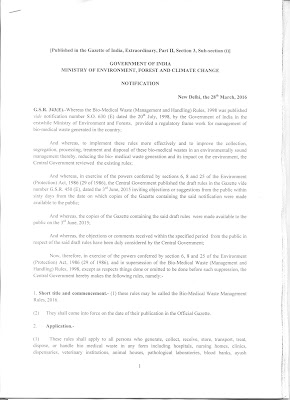
Under the Environment (Protection) Act, 1986, the 37 page long Bio-Medical Waste Management Rules,
2016 came into force from 28th March, 2016 in supersession of the Bio-Medical
Waste (Management and Handling) Rules, 1998.
The rules apply to all persons who
generate, collect, receive, store, transport, treat, dispose, or handle bio medical
waste in any form including hospitals, nursing homes, clinics, dispensaries,
veterinary institutions, animal houses, pathological laboratories, blood banks,
ayush hospitals, clinical establishments, research or educational institutions,
health camps, medical or surgical camps, vaccination camps, blood donation
camps, first aid rooms of schools, forensic laboratories and research labs.
These rules do not apply to radioactive wastes as covered under the
provisions of the Atomic Energy Act, 1962(33 of 1962) and the rules made there
under; hazardous chemicals covered under the Manufacture, Storage and Import of
Hazardous Chemicals Rules, 1989 made under the Act; solid wastes covered under
the Municipal Solid Waste (Management and Handling) Rules, 2000 made under the
Act; the lead acid batteries covered under the Batteries (Management and
Handling) Rules, 2001 made under the Act; hazardous wastes covered under the Hazardous Wastes (Management,
Handling and Transboundary Movement) Rules, 2008 made under the Act; waste
covered under the e-Waste (Management and Handling) Rules, 2011 made under the Act;
and hazardous micro organisms, genetically engineered micro organisms and cells
covered under the Manufacture, Use, Import, Export and Storage of Hazardous Microorganisms,
Genetically Engineered Micro organisms or Cells Rules, 1989 made under the Act.
The reference to the “e-Waste (Management and Handling) Rules, 2011” shows
that e-waste (Management) Rules, 2015 has not been factored in.
As per the Rules the "bio-medical waste" means any waste, which
is generated during the diagnosis, treatment or immunisation of human beings or
animals or research activities pertaining thereto or in the
production or testing of biological or in health camps, including the
categories mentioned in
Schedule I appended to these rules.
The Rules provides for “phase out use of chlorinated plastic bags, gloves
and blood bags within two years from the date of notification of these rules”.
It prohibits mixing of treated bio-medical waste with municipal solid waste.
It provides for ensure treatment and disposal of liquid waste in accordance
with the Water (Prevention and Control of Pollution) Act, 1974.
It provides for maintenance of all record for operation of incineration,
hydro or autoclaving etc., for a period of five years. It provides that existing
incinerators should “achieve the standards for treatment and disposal of
bio-medical waste as specified in Schedule II for retention time in secondary
chamber and Dioxin and Furans within two years from the date of this
notification.”
Clause 7 of the Rules 7 deals with Treatment and disposal of biomedical
waste. Bio-medical waste shall be treated and disposed of in accordance with
Schedule I, and in compliance with the standards provided in Schedule-II by the
health care facilities and common bio-medical waste treatment facility. Occupier
shall hand over segregated waste as per the Schedule-I to common bio-medical
waste treatment facility for treatment, processing and final disposal: Provided
that the lab and highly infectious bio-medical waste generated shall be
pre-treated by equipment like autoclave or microwave. No occupier shall
establish on-site treatment and disposal facility, if a service of ` common
biomedical waste treatment facility is available at a distance of seventy-five
kilometer. In cases where service of the common bio-medical waste treatment
facility is not available, the Occupiers shall set up requisite biomedical
waste treatment equipment like incinerator, autoclave or microwave, shredder
prior to commencement of its operation, as per the authorisation given by the
prescribed authority.
Any person including an occupier or operator of a common bio medical waste
treatment facility, intending to use new technologies for treatment of bio
medical waste other than those listed in Schedule I shall request the Central
Government for laying down the standards or operating parameters. On receipt of
a request referred to in sub-rule (5), the Central Government may determine the
standards and operating parameters for new technology which may be published in
Gazette by the Central Government. Every operator of common bio-medical waste
treatment facility shall set up requisite biomedical waste treatment equipments
like incinerator, autoclave or microwave, shredder and effluent treatment plant
as a part of treatment, prior to commencement of its operation. Every occupier
shall phase out use of non-chlorinated plastic bags within two years from the
date of publication of these rules and after two years from such publication of
these rules, the chlorinated plastic bags shall not be used for storing and
transporting of bio-medical waste and the occupier or operator of a common
bio-medical waste treatment facility shall not dispose of such plastics by
incineration and the bags used for storing and transporting biomedical waste shall
be in compliance with the Bureau of Indian Standards. Till the Standards are
published, the carry bags shall be as per the Plastic Waste Management Rules,
2011. After ensuring treatment by autoclaving or microwaving followed by
mutilation or shredding, whichever is applicable, the recyclables from the
treated bio-medical wastes such as plastics and glass shall be given to such
recyclers having valid authorisation or registration from the respective
prescribed authority. The Occupier or Operator of a common bio-medical waste
treatment facility shall maintain a record of recyclable wastes referred to in
sub-rule (9) which are auctioned or sold and the same shall be submitted to the
prescribed authority as part of its annual report. The record shall be open for
inspection by the prescribed authorities. The handling and disposal of all the mercury
waste and lead waste shall be in accordance with the respective rules and
regulations.
Clause 17
deals with the “Site for common bio-medical waste treatment and disposal
facility”. It provides that Without prejudice to rule 5 of these rules, the
department in the business allocation of land assignment shall be responsible
for providing suitable site for setting up of common biomedical waste treatment
and disposal facility in the State Government or Union territory
Administration. The selection of site for setting up of such facility shall be
made in consultation with the prescribed authority, other stakeholders and in
accordance with guidelines published by the Ministry of Environment, Forest and
Climate Change or Central Pollution Control Board.
Clause 18 of
the Rules deals with ‘Liability of the occupier, operator of a facility’. The
occupier or an operator of a common bio-medical waste treatment facility shall
be liable for all the damages caused to the environment or the public due to
improper handling of bio- medical wastes. The occupier or operator of common
bio-medical waste treatment facility shall be liable for action under section 5
and section 15 of the Act, in case of any violation.
Schedule I
read with rules 3 (e), 4(b), 7(1), 7(2), 7(5), 7 (6) and 8(2) Part-1 deals with
Biomedical wastes
categories
and their segregation, collection, treatment, processing and disposal options.
The Rule
states, “Disposal by deep burial is permitted only in rural or remote areas
where there is no access to common bio-medical waste treatment facility. This
will be carried out with prior approval from the prescribed authority and as
per the Standards specified in Schedule-III. The deep burial facility shall be
located as per the provisions and guidelines issued by Central Pollution
Control Board from time to time.” There is an urgent need to undertake environmental
health impact of such practices undertaken in the past to decide whether such
permissions are reasonable and sane.
Schedule II
read with Rule 4(t), 7(1) and 7(6)] Standards for treatment and disposal of bio-medical
wastes. Among other aspects it provides Standards for Incineration. It provides
that minimum stack height shall be 30 meters above the ground and shall be
attached with the necessary monitoring facilities as per requirement of
monitoring of ‘general parameters’ as notified under the Environment
(Protection) Act, 1986 and in accordance with the Central Pollution Control Board
Guidelines of Emission Regulation Part-III.
At page 19
of the Rules it provides that “The ash or vitrified material generated from the
‘Plasma
Pyrolysis or
Gasification shall be disposed off in accordance with the Hazardous Waste
(Management,
Handling and
Transboundary Movement) Rules 2008 and revisions made thereafter in case the constituents
exceed the limits prescribed under Schedule II of the said Rules or else in
accordance with
the
provisions of the Environment (Protection) Act, 1986, whichever is applicable.”
The Rules
states that “Medical waste shall not be considered as properly treated unless
the time, temperature and pressure indicators indicate that the required time,
temperature and pressure were reached during the autoclave process. If for any
reasons, time temperature or pressure indicator indicates that the required temperature,
pressure or residence time was not reached, the entire load of medical waste
must be autoclaved again until the proper temperature, pressure and residence
time were achieved.”
It states
that microwave treatment shall not be used for cytotoxic, hazardous or radioactive
wastes,
contaminated
animal carcasses, body parts and large metal items.
It provides
that for deep burial “A pit or trench should be dug about two meters deep. It
should be half filled with waste, then covered with lime within 50 cm of the
surface, before filling the rest of the pit with soil.”
Schedule III
read with Rule 6 and 9(3)] provides List of Prescribed Authorities and the
Corresponding Duties.
Besides Union
Ministry of Environment, Forest and Climate Change it provides the authorities and
duties of Central or State Ministry of Health and Family Welfare, Central Ministry
for Animal Husbandry and Veterinary or State Department of Animal Husbandry and
Veterinary, Ministry of Defence, Central Pollution Control Board, “State
Government of Health or Union Territory Government or Administration”, State
Pollution Control Boards or Pollution Control Committees, Municipalities or
Corporations, Urban Local Bodies and Gram Panchayats.
The
reference to “State Government of Health or Union Territory Government or Administration”
shows a proofing error in the drafting.
Schedule IV
read with Rule 8(3) and (5)] Part A provides “Label for bio-medical waste containers
or bags” and Part B deal with “Label for transporting bio-medical waste bags or
containers.” There are five forms dealing with accident reporting, application
for authorisation or renewal of authorization to be submitted by occupier of
health care facility or common bio-medical waste treatment facility, authorisation
for operating a facility for generation, collection, reception, treatment,
storage, transport
and disposal
of biomedical wastes, Annual Report to be submitted to the prescribed authority
on or before 30th June every year for the period from January to December of
the preceding year, by the occupier of health care facility (HCF) or common
bio-medical waste treatment facility (CBWTF) and Application for filing appeal
against order passed by the prescribed authority.