

Massive Legal Win for Kebaowek First Nation And Allies Against Proposed
Nuclear Waste Dump in Canada
-
Federal Court of Appeal Upholds Victory for Kebaowek First Nation
and Allies in “Species at Risk” Case Against Chalk River Nuclear Waste
Project Kebaow...
Latest Post
Jairam Ramesh Visits Okhla’s Hazardous Incinerator Plant Site amidst Agitation, Promises Inquiry
Written By mediavigil on Thursday, March 31, 2011 | 4:24 AM
OKHLA ANTI-INCINERATOR COMMITTEE
PRESS RELEASE
Jairam Ramesh Visits Okhla’s Hazardous Incinerator Plant Site amidst Agitation, Promises Inquiry
31, March, 2011 NEW DELHI: Minister for Environment and Forests, Jairam Ramesh, visited the site of the controversial 2010 tonne-per-day “waste-to-energy” incinerator on Thursday, March. 31, that is fast coming up in Okhla, South Delhi.
Ramesh promised irate residents from nearby colonies, who gathered at the site, that he would inquire into how no resident or civil society people turned up at a public hearing conducted by the Delhi Pollution Control Committee (DPCC) before the construction of the plant was begun, a fact pointed out by ToxicsWatch Alliance an environmental group present there. The proceedings of the public hearing drafted by DPCC were given to the Minister revealed it.
Anant Trivedi, a senior resident representing the Eshwar Nagar colony said there was little point in attending any hearing when the environment impact assessment was not made available to the public until March 2011. Ramesh asked Prof. S.P. Gautam, Chairman, Central Pollution Control Board present at the site to examine the concerns in front of the
DPCC officials present admitted to Ramesh that only two of their own staffers were present for the hearing conducted in 2007.
Residents from several colonies of Okhla area turned up to agitate against the plant which uses technology that is known emit dangerous dioxins, furans and toxic oxides.
Amanatullah Khan, a Congress party leader from the Jamia Nagar area, Okhla pointed out to the minister that the plant was in close proximity to the Jamia Millia Islamia, the Holy Family Hospital and several schools and institutions.
It was pointed out to the Minister that the plant, being built by Jindal Ecopolis, stands in violation of a Supreme Court order in 2005, banning waste-to-energy plants. In 2007, the court partially lifted the ban to allow 5 pilot projects on an experimental basis on biological treatment method but it is not one of those projects and the thermal technology too is non-biological.
The Supreme Court ruling echoed a White Paper produced by the Union Ministry of Environment & Forests (MoEF) stating: “The government claims that this plant will generate electricity, but it will only generate dioxins and other toxic emissions.”
The Comptroller Auditor General of India (CAG) and Delhi High Court have rebuked the concerned ministries for treating Delhi citizens as guinea pigs for experimental technologies that have been tried and have failed.
The residents are demanding that the MoEF cancel the flawed environmental clearance given to the “waste-to-energy” plant on the basis of fake public hearing, violation of Supreme Court rulings, proximity to residences and institutions.
One of the residents, R. K. Goyal told the minister that he should be primarily concerned about the health of the citizens rather than protecting the interest of private corporations that are pursuing unsound technological paths.
Notably, Asian Development Bank (ADB) has withdrawn from the Okhla-Timarpur waste to energy plant which was scheduled to start operations in November 2011 in the midst of bitter resistance of residents, wastepickers and environmental groups since March 2005.
For Details: Anant Trivedi: Resident, Eshwar Nagar, Mb: 9868502292
Asha Arora: 9711408421, Okhlakaghosla@gmailcom
Okhla Anti-Incinerator Committee - E-mail: delhiwasteplant@rediffmail.com
Web: www.facebook.com/ghoslaokhla
Blog: toxicswatch.blogspot.com, Gopal Krishna, Mobile: 9818089660,
E-mail: krishna2777@gmail.com
PRESS RELEASE
Jairam Ramesh Visits Okhla’s Hazardous Incinerator Plant Site amidst Agitation, Promises Inquiry
31, March, 2011 NEW DELHI: Minister for Environment and Forests, Jairam Ramesh, visited the site of the controversial 2010 tonne-per-day “waste-to-energy” incinerator on Thursday, March. 31, that is fast coming up in Okhla, South Delhi.
Ramesh promised irate residents from nearby colonies, who gathered at the site, that he would inquire into how no resident or civil society people turned up at a public hearing conducted by the Delhi Pollution Control Committee (DPCC) before the construction of the plant was begun, a fact pointed out by ToxicsWatch Alliance an environmental group present there. The proceedings of the public hearing drafted by DPCC were given to the Minister revealed it.
Anant Trivedi, a senior resident representing the Eshwar Nagar colony said there was little point in attending any hearing when the environment impact assessment was not made available to the public until March 2011. Ramesh asked Prof. S.P. Gautam, Chairman, Central Pollution Control Board present at the site to examine the concerns in front of the
DPCC officials present admitted to Ramesh that only two of their own staffers were present for the hearing conducted in 2007.
Residents from several colonies of Okhla area turned up to agitate against the plant which uses technology that is known emit dangerous dioxins, furans and toxic oxides.
Amanatullah Khan, a Congress party leader from the Jamia Nagar area, Okhla pointed out to the minister that the plant was in close proximity to the Jamia Millia Islamia, the Holy Family Hospital and several schools and institutions.
It was pointed out to the Minister that the plant, being built by Jindal Ecopolis, stands in violation of a Supreme Court order in 2005, banning waste-to-energy plants. In 2007, the court partially lifted the ban to allow 5 pilot projects on an experimental basis on biological treatment method but it is not one of those projects and the thermal technology too is non-biological.
The Supreme Court ruling echoed a White Paper produced by the Union Ministry of Environment & Forests (MoEF) stating: “The government claims that this plant will generate electricity, but it will only generate dioxins and other toxic emissions.”
The Comptroller Auditor General of India (CAG) and Delhi High Court have rebuked the concerned ministries for treating Delhi citizens as guinea pigs for experimental technologies that have been tried and have failed.
The residents are demanding that the MoEF cancel the flawed environmental clearance given to the “waste-to-energy” plant on the basis of fake public hearing, violation of Supreme Court rulings, proximity to residences and institutions.
One of the residents, R. K. Goyal told the minister that he should be primarily concerned about the health of the citizens rather than protecting the interest of private corporations that are pursuing unsound technological paths.
Notably, Asian Development Bank (ADB) has withdrawn from the Okhla-Timarpur waste to energy plant which was scheduled to start operations in November 2011 in the midst of bitter resistance of residents, wastepickers and environmental groups since March 2005.
For Details: Anant Trivedi: Resident, Eshwar Nagar, Mb: 9868502292
Asha Arora: 9711408421, Okhlakaghosla@gmailcom
Okhla Anti-Incinerator Committee - E-mail: delhiwasteplant@rediffmail.com
Web: www.facebook.com/ghoslaokhla
Blog: toxicswatch.blogspot.com, Gopal Krishna, Mobile: 9818089660,
E-mail: krishna2777@gmail.com
Study to shine new light on mercury
Written By krishna on Sunday, March 27, 2011 | 9:55 PM
Sifting through Delhi’s municipal rubbish every day, Anwarul Shaikh and Rupa Begum often find broken CFL bulbs mixed in kitchen and other domestic waste.
The compact fluorescent lamps have replaced incandescent bulbs in garbage mounds in the past couple of years, Rupa said, picking a few up. The glass tube and plastic end cap of a CFL fetch them up to Rs 3. Of late, Anwarul has been complaining of restricted vision.
Mercury vapour in broken CFLs could be the reason for Anwarul’s condition, said T K Joshi, director, occupational and environmental programmes centre of Maulana Azad Medical College in Delhi. Since mercury is a neurotoxin, it can affect all organs of the body. Its major impact is on the brain, lungs and kidneys, said Joshi. But with growing demand for energy-efficient lighting, the country’s production capacity for CFLs has gone up 25 times—from 19 mn in 2002 to 500 mn in 2010. The Centre’s Bachat Lamp Yojana, a scheme to popularise CFLs alone has pushed 20 million CFLs in the past three years. And all this is without any check on mercury pollution.
The CFLs sold in the country have 3-12 mg of mercury. As per the standards proposed by the International Electrotechnical Commission it should not be more than five mg.
Advanced technologies have even helped manufacturers in USA and Europe produce CFLs with just 1 mg of mercury. “Indian industry does not have any mandatory or voluntary standards for regulating mercury in florescent lights,” said Gopal Krishna of Toxics Watch, a non-profit in Delhi.
The Centre should have promoted energy efficient LED (light emitting diode) lights that do not contain mercury, he added. Assuming that each of the 350 million CFL bulbs produced in 2009 contained 5 mg mercury, 1,750 kg mercury would have been added to the waste in 2010. “There is no recycling unit for fluorescent lamps in India,” said an official at the Central Pollution Control Board (CPCB). In 2008 the board framed guidelines on mercury management in the CFL sector.
It said all mercury-contaminated lamps and cut glass tips “may be treated or recycled” in a recycling unit at production site or at an authorised unit.
The Board’s guideline was based on a task force report commissioned by Union environment ministry in 2007. The task force had recommended the Bureau of Indian Standards (BIS) to draw up standards for the amount of mercury in CFLs. But BIS is yet to draft mandatory standards. “One of the hindrances is the lack of advanced testing facility in the country,” said H C Kandpal of the National Physical Laboratory.
The task force had also called for a tax on CFLs to finance safe disposal of mercury. Its report mentioned industries could buy back CFLs for recycling them. The report did not go down well with the industry, which has commissioned another study.
Ruhi Kandhari,Down To Earth Features
http://www.deccanherald.com/content/147576/study-shine-light-mercury.html
Coal may soon become an essential commodity
New Delhi, March 2, 2011: Coal may become part of the list of essential commodities if the recommendation made by the Parliamentary Standing Committee on Coal and Steel is implemented by the Government.
The Committee has asked the Government to include coal as an essential commodity to help curb pilferage and prevent illegal mining of the commodity. Coal was removed from the category of essential commodities under the Essential Commodity Act.
The Committee, which tabled its report in Parliament recently, suggested that the Coal Ministry should approach the Ministry of Consumer Affairs, Food and Public Distribution for inclusion of coal as an essential commodity to control the production, supply and distribution of the commodity.
Cost of illegal mining
Further it suggested that Coal Ministry ask all coal companies to prepare a comprehensive document including the details of human lives lost, environmental degradation and the resultant loss to the national economy due to illegal mining.
Stating that the natural resources of the country are being plundered at the cost of national economy and destruction of environment, the Committee observed, “officials responsible to curb illegal mining are either indifferent or too scared to stop the menace. In short all responsible officials including State law enforcement officers are not at all interested to prevent illegal coal mining.”
A total of 583 cases of illegal mining have been reported by Coal India Ltd and its subsidiaries between April 2006 and September 2009. Stating that there may be thousands of cases that go unreported, the Committee felt that coal companies should deploy Central Industrial Security Force (CISF) in co-ordination with the State police for maintaining more vigil and curb illegal mining and theft of coal in leasehold areas.
A study done by Indian School of Mines, Dhanbad and Xavier Labour Research Institute, Jamshedpur for Government of Jharkhand estimates losses from coal theft and illegal mining to coal companies at Rs 106 crore and cost to the State Exchequer at Rs 34 crore a year in Jharkhand alone. Further, the panel suggested that Coal Ministry and Coal India should undertake a study to assess the extent of illegal mining.
http://www.thehindubusinessline.com/industry-and-economy/economy/article1503868.ece?
The compact fluorescent lamps have replaced incandescent bulbs in garbage mounds in the past couple of years, Rupa said, picking a few up. The glass tube and plastic end cap of a CFL fetch them up to Rs 3. Of late, Anwarul has been complaining of restricted vision.
Mercury vapour in broken CFLs could be the reason for Anwarul’s condition, said T K Joshi, director, occupational and environmental programmes centre of Maulana Azad Medical College in Delhi. Since mercury is a neurotoxin, it can affect all organs of the body. Its major impact is on the brain, lungs and kidneys, said Joshi. But with growing demand for energy-efficient lighting, the country’s production capacity for CFLs has gone up 25 times—from 19 mn in 2002 to 500 mn in 2010. The Centre’s Bachat Lamp Yojana, a scheme to popularise CFLs alone has pushed 20 million CFLs in the past three years. And all this is without any check on mercury pollution.
The CFLs sold in the country have 3-12 mg of mercury. As per the standards proposed by the International Electrotechnical Commission it should not be more than five mg.
Advanced technologies have even helped manufacturers in USA and Europe produce CFLs with just 1 mg of mercury. “Indian industry does not have any mandatory or voluntary standards for regulating mercury in florescent lights,” said Gopal Krishna of Toxics Watch, a non-profit in Delhi.
The Centre should have promoted energy efficient LED (light emitting diode) lights that do not contain mercury, he added. Assuming that each of the 350 million CFL bulbs produced in 2009 contained 5 mg mercury, 1,750 kg mercury would have been added to the waste in 2010. “There is no recycling unit for fluorescent lamps in India,” said an official at the Central Pollution Control Board (CPCB). In 2008 the board framed guidelines on mercury management in the CFL sector.
It said all mercury-contaminated lamps and cut glass tips “may be treated or recycled” in a recycling unit at production site or at an authorised unit.
The Board’s guideline was based on a task force report commissioned by Union environment ministry in 2007. The task force had recommended the Bureau of Indian Standards (BIS) to draw up standards for the amount of mercury in CFLs. But BIS is yet to draft mandatory standards. “One of the hindrances is the lack of advanced testing facility in the country,” said H C Kandpal of the National Physical Laboratory.
The task force had also called for a tax on CFLs to finance safe disposal of mercury. Its report mentioned industries could buy back CFLs for recycling them. The report did not go down well with the industry, which has commissioned another study.
Ruhi Kandhari,Down To Earth Features
http://www.deccanherald.com/content/147576/study-shine-light-mercury.html
Coal may soon become an essential commodity
New Delhi, March 2, 2011: Coal may become part of the list of essential commodities if the recommendation made by the Parliamentary Standing Committee on Coal and Steel is implemented by the Government.
The Committee has asked the Government to include coal as an essential commodity to help curb pilferage and prevent illegal mining of the commodity. Coal was removed from the category of essential commodities under the Essential Commodity Act.
The Committee, which tabled its report in Parliament recently, suggested that the Coal Ministry should approach the Ministry of Consumer Affairs, Food and Public Distribution for inclusion of coal as an essential commodity to control the production, supply and distribution of the commodity.
Cost of illegal mining
Further it suggested that Coal Ministry ask all coal companies to prepare a comprehensive document including the details of human lives lost, environmental degradation and the resultant loss to the national economy due to illegal mining.
Stating that the natural resources of the country are being plundered at the cost of national economy and destruction of environment, the Committee observed, “officials responsible to curb illegal mining are either indifferent or too scared to stop the menace. In short all responsible officials including State law enforcement officers are not at all interested to prevent illegal coal mining.”
A total of 583 cases of illegal mining have been reported by Coal India Ltd and its subsidiaries between April 2006 and September 2009. Stating that there may be thousands of cases that go unreported, the Committee felt that coal companies should deploy Central Industrial Security Force (CISF) in co-ordination with the State police for maintaining more vigil and curb illegal mining and theft of coal in leasehold areas.
A study done by Indian School of Mines, Dhanbad and Xavier Labour Research Institute, Jamshedpur for Government of Jharkhand estimates losses from coal theft and illegal mining to coal companies at Rs 106 crore and cost to the State Exchequer at Rs 34 crore a year in Jharkhand alone. Further, the panel suggested that Coal Ministry and Coal India should undertake a study to assess the extent of illegal mining.
http://www.thehindubusinessline.com/industry-and-economy/economy/article1503868.ece?
Incinerators Reveal Environmental Lawlessness in Delhi
Note:ToxicsWatch Alliance (TWA)has been raising controversial "waste-to-energy (WTE)" incinerators that are proposed in Delhi since March 2005. Earlier, it has managed to stop at least 7 such hazardous plants in the country. These WTE projects in Delhi are meant for 62.2 MW of power at Okhla, Timarpur, Ghazipur and Narela-Bawana has been proposed. The plants at Okhla and Timarpur will generate 16 MW energy and Gazipur will generate 10 MW. The Narela-Bawana plant will generate 36 MW was mentioned in MCD's Budget of December 2010.
Complete Environment Impact Assessments (EIAs)of these life thretening pojects that reveal environmental lawlessness in Delhi are not available in public domain.
Gopal Krishna
ToxicsWatch Alliance (TWA)
Waste-to-power plants upset MoEF
RASHME SEHGAL
The setting up of three waste-to-power projects in Okhla, Timarpur and Gazipur to generate 41 MW of power in the NCR has raised queries from both the Supreme Court and the ministry of environment and forests (MoEF).
While the Supreme Court, in 2007, had given a ruling permitting the establishing of five pilot plants in the NCR quantifying they be based “only on biological treatment rather than incineration”. The MoEF in a white paper also states, “While the (Delhi) government claims that this plant will generate electricity, it will generate dioxins and other toxic emissions.”
The Delhi government however insists that these projects are registered under the Clean Development Mechanism of the UNFCC and will enable the government to earn credits on saved carbon emissions.
Mr Gopal Krishna, who heads the Toxics Watch Alliance, said while the city generates around 10,000 tonnes of waste per day, from which 50 per cent is organic, 30 per cent is recycable and 20 per cent is inert, “the organic waste is being composted and the recyclable waste is being managed by the city’s five lakh rag picker population.”
"Both the Central and state government should commit to maximising recycling as this helps in climate mitigation. It is also an inclusive planning process because it ensure that the city's five lakh rag picker population do not end up losing their livelihoods," Mr Krishna added.
Three hospitals located near the Okhla plant namely Apollo, Holy Family and Fortis Escorts have expressed their unhappiness at the incinerator unit being located close to their establishments.
A senior doctor in Apollo ssaid, "These plants are known to emit hazardous pollutants which can eventually enter the food chain. The state government must show greater sensitivity to the protests of the local public."
Activists o express apprehension that the setting up of incinerator technologies is a clear attempt to hand over the municipal solid waste management to private players.
"This is a major livelihood concern especially since rag pickers form a sizeable population in every city of the country," Ravi Aggarwal of Toxic Link pointed out.
With residents of the areas where these incinerators are located taking the protest to the street, PM Manmohan Singh has asked Delhi chief minister Shiela Dixit and environment minister Jairam Ramesh to look into this issue.
http://epaper.asianage.com/Asian/AAge/2011/03/26/ArticleHtmls/26_03_2011_008_005.shtml
Hundreds of residents turn up at a rally against Okhla-Timarpur toxic plant
Asad/Sukhdev Vihar
This Sunday when many residents in Okhla were busy shopping or chilling in their homes some 500 residents from different colonies of Okhla assembled outside Sukhdev Vihar D.D.A Flats, Pocket A and B at 11 A.M to protest against a waste-to-energy project coming in the locality. The residents marched from there to Jamia Nagar till Kalindi Kunj to create awareness among others about the danger of such a project.
The convener of Toxics Watch Alliance, Gopal Krishna, told OKHLA TIMES: “We are strongly opposed to this project because of its long-lasting impact on the environment and health. The plant site is close to three major hospitals: Holy Family, Fortis-Escorts and Apollo Indraprastha. How can such a plant come in a residential area?” A local Congress party leader Amanatullah Khan also addressed the gathering.
Residents have been protesting against the plant since Rakesh Mehta, the chief secretary of Delhi government, signed a MOU in March 2005, said Krishna. “Though we are positive with the response we are getting from the residents but the Central and Delhi government are not taking notice of the development. We want this technology to be abandoned. This plant is coming in violation of the Supreme Court order,” he further added.
Earlier, some residents of Sukhdev Vihar, Jamia Nagar, Sarita Vihar, Maharani Bagh, New Friends Colony and Okhla had submitted a memorandum to union environment minister Jairam Ramesh, stating: “While there is overwhelming evidence that plants of these types produce toxic gases, residues and respirable particles, the Okhla plant is being set up barely 150m from the nearest established residences.”
Opposition party leaders of the Bharaitya Janata Party (BJP) are also supporting the residents' concern. In a letter dated June 27, 2008 to the Lt. Governor of Delhi, Tejender Khanna, BJP MP Vijay Kumar Malhotra said: “This plant would release various types of harmful gases which will certainly pose serious helath threat to the lives of surrounding residents.” This has been stated in a press release issued by the Okhla Anti-Incinerator Committee.
Residents want the government to bring an immediate stop to construction of the Rs 200-crore project that is expected to convert more than 1,000 tonnes of solid waste. From July onwards the waste would be converted into electricity. Some 8,000 tonnes of solid waste is produced in Delhi every day. Pressure is being mounted on the government to scrap the project.
Moved by residents' uprising, environment minister Jairam Ramesh had also written a letter to the chief minister Sheila Dikshit. It was after this that the CM had promised to call a meeting with residents and address their concerns.
Dikshit said: “I have received the letter. The government will not set up a hazardous plant, and to the best of my knowledge we have been extremely careful with the project. Since there are so many objections, I will call a meeting with residents as soon as the budget session of the assembly gets over. We can also consider a third party intervention in the matter. I will also write to Ramesh and ask if there are any experts he can recommend to study the proposal and suggest what steps should be taken.”
Mere words will not satisfy the residents, we want action against the plant, according to a local Md Anwar.
http://www.okhlatimes.com/news-details.php?n_id=153
Green Schemes Turn Into White Elephants
BANGALORE, (IPS) - Several incinerator facilities that were supposed to turn waste into energy have proven to be white elephants that are now adding to the country’s pollution woes, instead of alleviating them.
"Massive waste-to-energy plant subsidies are ruining the waste management field in India," said Almitra Patel, a civil engineer from the Massachusetts Institute of Technology in Boston. "Companies are now using these subsidies to set up plants that fail." Solid waste experts are alarmed these facilities - which failed to work in the 1980s and 1990s - continue to exist.
Waste-to-energy (WTE) plants, are releasing toxic fumes because wastes are not being burned properly. Waste incineration technology - controversial in western countries - is even more toxic in India due to mixed, un-segregated wastes, which emit a medley of poisonous gases such as dioxins and furans when burned.
At Timarpur in New Delhi, a WTE incineration plant imported from the Danish firm Volund Milijotecknick in 2003 - which subsequently failed - has been resurrected, and another WTE incinerator is being built in Okhla. Activists are protesting violations of environmental procedures at the Timarpur plant, which is surrounded by a community of about 500,000.
In February 2011, the Asian Development Bank (ADB) withdrew funding to the plant under its Asia Pacific Carbon Fund, but the Timarpur Okhla Waste Management Company claims it will be able to reduce carbon emissions by 262,791 tonnes per year for the next ten years, and has filed for carbon credits. (ToxicsWatch Alliance was in correspondence with ADB and it revealed its decision to media)
WTE "works only on paper", said Mumbai-based Ragini Jain, who works on dry waste policy, explaining how Indian waste will not combust sufficiently to produce adequate electricity. Indian waste is mainly biodegradable compostable waste with high moisture content. When it arrives at the WTEs it is also mixed with non-biodegradable plastics, aluminium and similar substances - the wastes are not separated.
India set up solid waste management rules in 2000, making urban towns responsible for waste segregation and disposal, and recommending composting as the most suitable form of waste disposal after segregation.
The Solid Waste Rules of 2000 were set up after Patel petitioned the supreme court in 1996, claiming that the government was neglecting the responsibility of proper waste management. The court later appointed Patel head of a national committee on solid waste.
In 2005, Patel again filed a public interest lawsuit before the supreme court, petitioning the court to put a stay on government subsidies for all proposed and future WTE projects until the current plants had been adequately reviewed for feasibility.
The court ordered a stay on government subsidies for further WTEs, allowing only five of these projects to proceed for research and development purposes. The Ministry of New and Renewable Energy however says there is no court ban on promoting further WTE projects.
India now has a reported 33 WTE projects in the works, of which several have the makings of financial corruption and administrative malfeasance, say NGO activists and waste management experts in Bangalore, New Delhi and Mumbai. (END)
Jamia students cry foul, protest toxic plant
New Delhi, March 27: Hundreds of citizens and students gathered at Jamia Nagar, opposite the Jamia Millia Islamia, today to register their protest against a giant municipal waste incinerator rapidly coming up in the Okhla area, contravening a Supreme Court order.
Students from Jamia also participated in the rally that followed the protest in Jamia Nagar.
Amanatullah Khan, a local Congress leader, said, "The toxic emissions from the plant of this type have been known to cause birth deformities, respiratory ailments and hormonal problems. However, in spite of representations from people belonging to different political parties, the Delhi government has continued to pursue construction of the plant promoted by Jindal Ecopolis. People are not going to take this quietly and will protest vehemently."
Khan said the whole Okhla area was being turned into a health and environment disaster zone through the misuse of the Okhla sewage treatment plant, the Okhla industrial effluent treatment plant and a common biomedical waste incinerator despite a court order a year ago, calling for its relocation.
Khan said, "There exists a sense of betrayal in the Jamia area because the Delhi government had failed to implement a Delhi High Court order to relocate a common biomedical incinerator which was causing serious health problems to the community. Today's rally is being held to highlight the fact that the residents' grievances are not being addressed."
Asha Arora, a local resident said, "Instead of looking after the welfare of the people, the government was creating problems. All of us will have to unite against this toxic plant till it is closed down." Delegations from Jamia Nagar, Haji colony, Sukhdev Vihar, Zakir Nagar and Gafar Manzil assembled at Batla House and were joined by the residents of nearby colonies before the march terminated at Okhla head.
A letter was also sent today to the minister of environment and forests (MoEF), Jairam Ramesh, protesting against the "highhandedness and environmental lawlessness barely 10 km from the seat of power of the great Indian nation."
Earlier, the residents of the colonies in the Okhla area had met the minister and complained to him that an incinerator was being set up without addressing the existing problems of the area arising out of gross misuse, such as denudation of a green buffer.
On March 23, a rally was held by hundreds of Delhi's waste pickers, demanding the scrapping of the waste-to-energy policy which affected their livelihood.
They had submitted a memorandum to the Lt-Governor.
Complete Environment Impact Assessments (EIAs)of these life thretening pojects that reveal environmental lawlessness in Delhi are not available in public domain.
Gopal Krishna
ToxicsWatch Alliance (TWA)
Waste-to-power plants upset MoEF
RASHME SEHGAL
The setting up of three waste-to-power projects in Okhla, Timarpur and Gazipur to generate 41 MW of power in the NCR has raised queries from both the Supreme Court and the ministry of environment and forests (MoEF).
While the Supreme Court, in 2007, had given a ruling permitting the establishing of five pilot plants in the NCR quantifying they be based “only on biological treatment rather than incineration”. The MoEF in a white paper also states, “While the (Delhi) government claims that this plant will generate electricity, it will generate dioxins and other toxic emissions.”
The Delhi government however insists that these projects are registered under the Clean Development Mechanism of the UNFCC and will enable the government to earn credits on saved carbon emissions.
Mr Gopal Krishna, who heads the Toxics Watch Alliance, said while the city generates around 10,000 tonnes of waste per day, from which 50 per cent is organic, 30 per cent is recycable and 20 per cent is inert, “the organic waste is being composted and the recyclable waste is being managed by the city’s five lakh rag picker population.”
"Both the Central and state government should commit to maximising recycling as this helps in climate mitigation. It is also an inclusive planning process because it ensure that the city's five lakh rag picker population do not end up losing their livelihoods," Mr Krishna added.
Three hospitals located near the Okhla plant namely Apollo, Holy Family and Fortis Escorts have expressed their unhappiness at the incinerator unit being located close to their establishments.
A senior doctor in Apollo ssaid, "These plants are known to emit hazardous pollutants which can eventually enter the food chain. The state government must show greater sensitivity to the protests of the local public."
Activists o express apprehension that the setting up of incinerator technologies is a clear attempt to hand over the municipal solid waste management to private players.
"This is a major livelihood concern especially since rag pickers form a sizeable population in every city of the country," Ravi Aggarwal of Toxic Link pointed out.
With residents of the areas where these incinerators are located taking the protest to the street, PM Manmohan Singh has asked Delhi chief minister Shiela Dixit and environment minister Jairam Ramesh to look into this issue.
http://epaper.asianage.com/Asian/AAge/2011/03/26/ArticleHtmls/26_03_2011_008_005.shtml
Hundreds of residents turn up at a rally against Okhla-Timarpur toxic plant
Asad/Sukhdev Vihar
This Sunday when many residents in Okhla were busy shopping or chilling in their homes some 500 residents from different colonies of Okhla assembled outside Sukhdev Vihar D.D.A Flats, Pocket A and B at 11 A.M to protest against a waste-to-energy project coming in the locality. The residents marched from there to Jamia Nagar till Kalindi Kunj to create awareness among others about the danger of such a project.
The convener of Toxics Watch Alliance, Gopal Krishna, told OKHLA TIMES: “We are strongly opposed to this project because of its long-lasting impact on the environment and health. The plant site is close to three major hospitals: Holy Family, Fortis-Escorts and Apollo Indraprastha. How can such a plant come in a residential area?” A local Congress party leader Amanatullah Khan also addressed the gathering.
Residents have been protesting against the plant since Rakesh Mehta, the chief secretary of Delhi government, signed a MOU in March 2005, said Krishna. “Though we are positive with the response we are getting from the residents but the Central and Delhi government are not taking notice of the development. We want this technology to be abandoned. This plant is coming in violation of the Supreme Court order,” he further added.
Earlier, some residents of Sukhdev Vihar, Jamia Nagar, Sarita Vihar, Maharani Bagh, New Friends Colony and Okhla had submitted a memorandum to union environment minister Jairam Ramesh, stating: “While there is overwhelming evidence that plants of these types produce toxic gases, residues and respirable particles, the Okhla plant is being set up barely 150m from the nearest established residences.”
Opposition party leaders of the Bharaitya Janata Party (BJP) are also supporting the residents' concern. In a letter dated June 27, 2008 to the Lt. Governor of Delhi, Tejender Khanna, BJP MP Vijay Kumar Malhotra said: “This plant would release various types of harmful gases which will certainly pose serious helath threat to the lives of surrounding residents.” This has been stated in a press release issued by the Okhla Anti-Incinerator Committee.
Residents want the government to bring an immediate stop to construction of the Rs 200-crore project that is expected to convert more than 1,000 tonnes of solid waste. From July onwards the waste would be converted into electricity. Some 8,000 tonnes of solid waste is produced in Delhi every day. Pressure is being mounted on the government to scrap the project.
Moved by residents' uprising, environment minister Jairam Ramesh had also written a letter to the chief minister Sheila Dikshit. It was after this that the CM had promised to call a meeting with residents and address their concerns.
Dikshit said: “I have received the letter. The government will not set up a hazardous plant, and to the best of my knowledge we have been extremely careful with the project. Since there are so many objections, I will call a meeting with residents as soon as the budget session of the assembly gets over. We can also consider a third party intervention in the matter. I will also write to Ramesh and ask if there are any experts he can recommend to study the proposal and suggest what steps should be taken.”
Mere words will not satisfy the residents, we want action against the plant, according to a local Md Anwar.
http://www.okhlatimes.com/news-details.php?n_id=153
Green Schemes Turn Into White Elephants
BANGALORE, (IPS) - Several incinerator facilities that were supposed to turn waste into energy have proven to be white elephants that are now adding to the country’s pollution woes, instead of alleviating them.
"Massive waste-to-energy plant subsidies are ruining the waste management field in India," said Almitra Patel, a civil engineer from the Massachusetts Institute of Technology in Boston. "Companies are now using these subsidies to set up plants that fail." Solid waste experts are alarmed these facilities - which failed to work in the 1980s and 1990s - continue to exist.
Waste-to-energy (WTE) plants, are releasing toxic fumes because wastes are not being burned properly. Waste incineration technology - controversial in western countries - is even more toxic in India due to mixed, un-segregated wastes, which emit a medley of poisonous gases such as dioxins and furans when burned.
At Timarpur in New Delhi, a WTE incineration plant imported from the Danish firm Volund Milijotecknick in 2003 - which subsequently failed - has been resurrected, and another WTE incinerator is being built in Okhla. Activists are protesting violations of environmental procedures at the Timarpur plant, which is surrounded by a community of about 500,000.
In February 2011, the Asian Development Bank (ADB) withdrew funding to the plant under its Asia Pacific Carbon Fund, but the Timarpur Okhla Waste Management Company claims it will be able to reduce carbon emissions by 262,791 tonnes per year for the next ten years, and has filed for carbon credits. (ToxicsWatch Alliance was in correspondence with ADB and it revealed its decision to media)
WTE "works only on paper", said Mumbai-based Ragini Jain, who works on dry waste policy, explaining how Indian waste will not combust sufficiently to produce adequate electricity. Indian waste is mainly biodegradable compostable waste with high moisture content. When it arrives at the WTEs it is also mixed with non-biodegradable plastics, aluminium and similar substances - the wastes are not separated.
India set up solid waste management rules in 2000, making urban towns responsible for waste segregation and disposal, and recommending composting as the most suitable form of waste disposal after segregation.
The Solid Waste Rules of 2000 were set up after Patel petitioned the supreme court in 1996, claiming that the government was neglecting the responsibility of proper waste management. The court later appointed Patel head of a national committee on solid waste.
In 2005, Patel again filed a public interest lawsuit before the supreme court, petitioning the court to put a stay on government subsidies for all proposed and future WTE projects until the current plants had been adequately reviewed for feasibility.
The court ordered a stay on government subsidies for further WTEs, allowing only five of these projects to proceed for research and development purposes. The Ministry of New and Renewable Energy however says there is no court ban on promoting further WTE projects.
India now has a reported 33 WTE projects in the works, of which several have the makings of financial corruption and administrative malfeasance, say NGO activists and waste management experts in Bangalore, New Delhi and Mumbai. (END)
Jamia students cry foul, protest toxic plant
New Delhi, March 27: Hundreds of citizens and students gathered at Jamia Nagar, opposite the Jamia Millia Islamia, today to register their protest against a giant municipal waste incinerator rapidly coming up in the Okhla area, contravening a Supreme Court order.
Students from Jamia also participated in the rally that followed the protest in Jamia Nagar.
Amanatullah Khan, a local Congress leader, said, "The toxic emissions from the plant of this type have been known to cause birth deformities, respiratory ailments and hormonal problems. However, in spite of representations from people belonging to different political parties, the Delhi government has continued to pursue construction of the plant promoted by Jindal Ecopolis. People are not going to take this quietly and will protest vehemently."
Khan said the whole Okhla area was being turned into a health and environment disaster zone through the misuse of the Okhla sewage treatment plant, the Okhla industrial effluent treatment plant and a common biomedical waste incinerator despite a court order a year ago, calling for its relocation.
Khan said, "There exists a sense of betrayal in the Jamia area because the Delhi government had failed to implement a Delhi High Court order to relocate a common biomedical incinerator which was causing serious health problems to the community. Today's rally is being held to highlight the fact that the residents' grievances are not being addressed."
Asha Arora, a local resident said, "Instead of looking after the welfare of the people, the government was creating problems. All of us will have to unite against this toxic plant till it is closed down." Delegations from Jamia Nagar, Haji colony, Sukhdev Vihar, Zakir Nagar and Gafar Manzil assembled at Batla House and were joined by the residents of nearby colonies before the march terminated at Okhla head.
A letter was also sent today to the minister of environment and forests (MoEF), Jairam Ramesh, protesting against the "highhandedness and environmental lawlessness barely 10 km from the seat of power of the great Indian nation."
Earlier, the residents of the colonies in the Okhla area had met the minister and complained to him that an incinerator was being set up without addressing the existing problems of the area arising out of gross misuse, such as denudation of a green buffer.
On March 23, a rally was held by hundreds of Delhi's waste pickers, demanding the scrapping of the waste-to-energy policy which affected their livelihood.
They had submitted a memorandum to the Lt-Governor.
March Against Toxic waste- to- energy incinerator & environmental lawlessness in Okhla
PRESS NOTE
March Against Toxic waste- to- energy incinerator & environmental lawlessness in Okhla
27 March, 2011 NEW DELHI: Hundreds of people gathered at Jamia Nagar, Opposite the Jamia Millia University today to protest against a giant municipal waste incinerator rapidly coming up in the Okhla area, contravening a Supreme Court order banning the technology.
Amanatullah Khan, a local Congress party leader, told the gathering that the toxic emissions from plants of this type have been known to cause birth deformities, caners, respiratory ailments and hormonal problems. Khan said in spite of representations from people belonging to different political parties, the Delhi government has continued to pursue construction of the plant promoted by Jindal Ecopolis.
Khan said the whole Okhla area was being turned into a health and environment disaster zone through misuse of and mishandling of the Okhla sewage treatment plant, the Okhla industrial effluent treatment plant and a common biomedical waste incinerator despite a Delhi High Court order, a year ago, calling for its relocation.
He said there already existed a sense of betrayal in the Jamia area because the Delhi government had failed to implement a Delhi High Court order to relocate a common biomedical incinerator which was already causing serious health problems to the community. “Today’s rally is being held to highlight the fact that the residents’ serious grievances are not being addressed.”
Asha Arora, a local resident said instead of looking after the welfare of the people the government was causing problems for them. “All of us will have to unite against this toxic plant till it is closed down.”
Delegations from Haji colony, Sukhdev Vihar, Zakir Nagar, Gafar Manzil and Jamia Nagar assembled at Batla House and were joined by residents of nearby colonies before the march terminated at Okhla head (near Kalindi Kunj).
Today (Sunday) a letter was sent to the Minister for Environment and Forests (MoEF), Jairam Ramesh protesting against “high handedness and environmental lawlessness barely 10 kms away from the seat of power of the great Indian nation.”
On March 17, the residents of colonies in the Okhla area had met the minister and complained to him that the new waste-to-energy incinerator was being set up without addressing existing problems in the area arising out of gross misuse, such as denudation of a green buffer.
On 23rd March, a rally was held by hundreds of Delhi’s waste pickers demanding the scrapping of the waste-to-energy policy which was not only polluting but also affected their livelihoods. They had submitted a memorandum to the Lt Governor.
Earlier opposition party leaders of the Bharaitya Janata Party (BJP) had also expressed apprehension over the location of such a plant in a densely populated area of South Delhi.
“This plant would release various types of harmful gases which will certainly pose serious helath threat to the lives of surrounding residents,” said Vijay Kumar Malhotra, BJP M.P. in a letter dated June 27, 2008 to the Lt. Governor of Delhi, Tejender Khanna.
For Details: Contact: Asha Arora 9711408421, Okhlakaghosla@gmailcom
Okhla Anti-Incinerator Committee - E-mail: delhiwasteplant@rediffmail.com
Web: www.facebook.com/ghoslaokhla
Blog: toxicswatch.blogspot.com, Gopal Krishna, Mobile : 9818089660, E-mail: krishna2777@gmail.com
March Against Toxic waste- to- energy incinerator & environmental lawlessness in Okhla
27 March, 2011 NEW DELHI: Hundreds of people gathered at Jamia Nagar, Opposite the Jamia Millia University today to protest against a giant municipal waste incinerator rapidly coming up in the Okhla area, contravening a Supreme Court order banning the technology.
Amanatullah Khan, a local Congress party leader, told the gathering that the toxic emissions from plants of this type have been known to cause birth deformities, caners, respiratory ailments and hormonal problems. Khan said in spite of representations from people belonging to different political parties, the Delhi government has continued to pursue construction of the plant promoted by Jindal Ecopolis.
Khan said the whole Okhla area was being turned into a health and environment disaster zone through misuse of and mishandling of the Okhla sewage treatment plant, the Okhla industrial effluent treatment plant and a common biomedical waste incinerator despite a Delhi High Court order, a year ago, calling for its relocation.
He said there already existed a sense of betrayal in the Jamia area because the Delhi government had failed to implement a Delhi High Court order to relocate a common biomedical incinerator which was already causing serious health problems to the community. “Today’s rally is being held to highlight the fact that the residents’ serious grievances are not being addressed.”
Asha Arora, a local resident said instead of looking after the welfare of the people the government was causing problems for them. “All of us will have to unite against this toxic plant till it is closed down.”
Delegations from Haji colony, Sukhdev Vihar, Zakir Nagar, Gafar Manzil and Jamia Nagar assembled at Batla House and were joined by residents of nearby colonies before the march terminated at Okhla head (near Kalindi Kunj).
Today (Sunday) a letter was sent to the Minister for Environment and Forests (MoEF), Jairam Ramesh protesting against “high handedness and environmental lawlessness barely 10 kms away from the seat of power of the great Indian nation.”
On March 17, the residents of colonies in the Okhla area had met the minister and complained to him that the new waste-to-energy incinerator was being set up without addressing existing problems in the area arising out of gross misuse, such as denudation of a green buffer.
On 23rd March, a rally was held by hundreds of Delhi’s waste pickers demanding the scrapping of the waste-to-energy policy which was not only polluting but also affected their livelihoods. They had submitted a memorandum to the Lt Governor.
Earlier opposition party leaders of the Bharaitya Janata Party (BJP) had also expressed apprehension over the location of such a plant in a densely populated area of South Delhi.
“This plant would release various types of harmful gases which will certainly pose serious helath threat to the lives of surrounding residents,” said Vijay Kumar Malhotra, BJP M.P. in a letter dated June 27, 2008 to the Lt. Governor of Delhi, Tejender Khanna.
For Details: Contact: Asha Arora 9711408421, Okhlakaghosla@gmailcom
Okhla Anti-Incinerator Committee - E-mail: delhiwasteplant@rediffmail.com
Web: www.facebook.com/ghoslaokhla
Blog: toxicswatch.blogspot.com, Gopal Krishna, Mobile : 9818089660, E-mail: krishna2777@gmail.com
Rally on 27th March Against Delhi's Okhla-Timarpur Incinerator Plant
Written By krishna on Saturday, March 26, 2011 | 11:39 AM
Rally on Sunday at 11:00 am
Dear all,As all of you would know that our visit/dharna at Ministry of Environment & Forests i.e. outside Jairam Ramesh's office was quite a success as an event but still lot more to be done. It gave a very high visibility to the problem almost all the leading media houses covered the issue. In our continued effort to ensure that this plant doesnt see light of the day, there is a rally on 27th March 2011 i.e. Sunday at 11:00 a.m.
We thank all those who have been regularly participating in the campaign and would continue to request others to please come out this time. Every additional participant makes a difference.
We are doing our bit for the cause and requesting you to come and join this campaign.
Assembling point : Outside Sukhdev Vihar D.D.A Flats, Pkt A & B
Best Regards,
On behalf of all the aggrieved residents
E-mail: delhiwasteplant@rediffmail.com
Okhla Anti-Incinerator Committee
Asha Arora, Member, Mb: 9711408421
E-mail: okhlakaghosla@gmail.com
For further details visit: toxicswatch.blogspot.com or call Gopal Krishna, ToxicsWatch Alliance,
Mb: 9818089660, E-mail: krishna2777@gmail.com
P.S: There was a angry rally against incinerator based waste to energy projects in Delhi on 23rd March since these hazardous projects are a threat to livelihood and health. A petition was submitted to the Lt Governor.

Delhi’s bid to earn money through waste-to-power projects has been opposed by residents of neighbourhoods where the plants are coming up. Ragpickers, who believe the projects will cost them their livelihoods, are up in arms too. The Delhi government has planned three projects — one each in Okhla, Ti mparpur and Ghazipur — to generate over 41 MW. The projects are registered under the Clean Development Mechanism (CDM) of the United National Framework Convention of Climate Change (UNFCCC) to earn credits on the carbon emissions saved to generate power.
“We earn Rs 50 to Rs 100 per day by lifting recyclable articles from garbage dumps,” said Raju Rajasthani, a ragpicker at the Bhalswa dump in north Delhi. “As the entire garbage would be treated in the plants, we will become redundant.” Ragpickers have some support from the residents of Okhla, Jamia Nagar, Ghaffar Manzil, Abul Fazl Enclave and Noor Nagar, but for a different reason. They are protesting against the location of the Okhla plant; it’s too close to their homes, they say. “The plant will kill the environment,” said Jamia Nagar resident KS Ahmed.
Union Environment Minister Jairam Ramesh has asked Chief Minister Sheila Dikshit to look into the objections. “If people are against them, their apprehensions should be dealt with,” he said. A ministry white paper said the plants will generate dioxins and other toxic emissions, which could harm public health.
“People’s concerns have been looked into. Some non-governmental organisations are creating problems,” said a civic official on condition of anonymity as he is not authorised to speak to the media.
HT
Waste pickers along with environmentalists and civil society groups staged a march from Kudeshiya Park to the Lieutenant-Governor's office here protesting against the setting up of three waste-to-energy plants in the city.

The protesters said the three incinerator plants at Okhla, Timarpur and Gazipur were being built with complete disregard to the public health concerns of the area residents.
They said the livelihood of rag-pickers would be severely impacted as recyclable waste will be burnt. Also, the plant will emit hazardous pollutants, they alleged.
Residents of Batla House, Jamia Nagar, Ghaffar Manzil, Abul Fazl Enclave and Noor Nagar have been protesting against the plant in Okhla.
The Hindu
Waste to Energy Facility in Delhi Causing Controversy with Residents
The Okhla-Timarpur thermal Waste to Energy plant in Delhi, India will no longer be associated with the Asian Development Bank (ADB) according to a report in The Times of India. ToxicsWatch Alliance (TWA) had shared its correspondence with ADB. The incineration-based plant in Okhla is under construction and is scheduled to start operations in November 2011.
Asia Pacific Carbon Fund (APCF) had agreed to co-finance the project which, the parent company says, will reduce almost 263,000 tonnes of carbon dioxide emissions annually. The plant will incinerate 643,000 tonnes of Delhi's waste, generating 16 MW power plant. The initial investment in the project is about Rs 1.74 billion ($38 million)
The plant had initially been due to enter service in October 2009, but has been delayed primarily due to environment related objection from local residents. D Nayantara, a local resident told The Times of India: "An incineration plant in the middle of a residential area is really a poor idea. The government has still not given answers on how the waste will be carted to this site or how and where it will be segregated."
"There are several studies, including a white paper by the ministry of environment and forests, to show that composting is the best solution for Indian waste." Nayantara added. Initial assessment of the project was conducted based on the CDM-Project Design Document (PDD).
One senior representative told The Times of India that the nature of the project when assessed was an integrated waste to energy project as mentioned in the PDD. An agreement with the project developer was signed to provide carbon co-financing from APCF, which was subjected to fulfilment of certain condition precedence in the given time frame, including ADB due-diligence of the project.
"Conditions were not satisfied by the project developer, and, therefore, the agreement has expired. APCF is no longer associated with Timarpur-Okhla Waste Management Company Pvt Ltd's integrated waste to energy project in Delhi and no funds were released for this project," said the APCF representative.
Residents of areas near the project site have been protesting against the incineration plant saying that it will lead to pollution in the area, and the matter has been taken to court. At a meeting of the chief minister and representatives of the power company the issue of foul smells emanating from the existing Timarpur plant was discussed. According to The Times of India, sources said that officials seemed confident of addressing the issue once the entire plant was ready.
The two plants under this project are slated to produce around 2.23 tonnes of refuse derived fuel annually while the biomethanation plant will use 100 tonnes of waste to churn out 5000 cubic metres of biogas daily. The fuel will be used to produce 16 MW of power. BSES Rajdhani Power Ltd will purchase half of the power that is produced. Power regulator, DERC, meanwhile recently passed an order on the tariff of the power produced by the plant at Rs 2.49/kWh (5.5 cents/kWh) for the first year and specified that any surplus power from the plant should be sold to a third party.
TWA has been raising the adverse environmental health consequences of such technologies since 2000 and the issue of these projects since March 2005.
Angry Rally Against Incinerator based Waste to Energy Projects
Mere shifting of location of the hazardous technology based plant not enough, such technologies should be abandoned
On the 23rd of March 2011 waste pickers marched from Delhi’s Kudeshiya Park (near ISBT) to Lt. Governor Office to demand the immediate stoppage of the waste-to-energy plants in Delhi at Okhla- Timarpur (16 MW) and Gazipur (10 MW). Notably, a US Environmental Protection Agency (USEPA) report availvle on its website observes that the energy generated from municipal waste is costlier than nuclear energy.
The rally was planned today to celebrate the martyardom of Shahid Bhagat Singh, the tallest revolutionary freedom fighter of the country.
Environmental and labour groups have been protesting against these plants since March 2005 and have been joined in by the affected local residents. The plants which got environmental clearance during the tenure of A Raja as Environment Minister are highly suspect and deserve to be reviewed and cancelled.
The proposed polluting technology to deal with the waste from South Delhi, North West Delhi and East Delhi is fraught with disastrous public health consequences for which two companies namely, Timarpur-Okhla Waste Management Company (TOWMCL) and the Unique Waste Processing Company (subsidiary of IL&FS Infrastructure Development Corporation Limited) have been set up. The Timarpur-Okhla carbon credit project was registered on 10th November, 2007 with a claim to reduce greenhouse gases to the tune of 262,791 metric tonnes CO2 equivalent per annum. Unique Waste Processing Company, a subsidiary of Infrastructure Leasing and Financial Services (IL&FS) and Andhra Pradesh Technology Development Centre (APTDC) has incorporated Timarpur-Okhla Waste Management Company for developing the project for processing municipal waste and also to produce electricity at two locations namely Timarpur and Okhla, at the site at Okhla that is adjacent to defunct Okhla Sewage Treatment Plant (STP).
TOWMCL is working with New Delhi Municipal Council (NDMC) and MCD. The Timarpur and Okhla plant will together be processing 650 tonnes per day of MSW at Timarpur site and 1300 tonnes per day of MSW at Okhla and claims to generate 16 MW of electricity. The Gazipur plant will process 1300 tonnes per day of MSW and claims to generate 10 MW of electricity.
It is scientifically established that the plants will emit hazardous pollutants, such as dioxins, which will eventually enter the food chain. Government cannot be allowed to experiment with Delhi’s health. These incinerators are coming up in clear violation of Supreme Court rulings on such plants. “In 2007 the Supreme Court allowed five pilot plants on an experimental basis and that too based only on biological treatment rather than incineration.”
The Supreme Court’s ruling is supported by the White Paper produced by the Ministry of Environment and Forests, stating, “The government claims that this plant will generate electricity, but it will only generate dioxins and other toxic emissions.” Comtroller Auditor General of India (CAG) and Delhi High Court have rebuked the concerned ministries for treating Delhi citizens as guinea pig for experimental technologies that have been tried and have failed.
In such a backdrop, Waste pickers have marched along with Residents, Citizens, Civil society groups, Human rights associations, Environmentalists, Students, Social Activists, NGOs, Trade Unions demanding stoppage of toxic waste to energy plants in Okhla, Timarpur and Gazipur.
THEIR DEMANDS ARE AS UNDER
* Union Government should remove incinerator technologies from its waste to energy policy being bulldozed by the Ministry of New & Renewable Energy down the throat of State Governments
* Delhi Government Should Desist from violating Supreme Court’s Order and endangering the public health of Delhi residents
* Mere shifting of the location of the hazardous technology based plant is insufficient, such technologies must be abandoned
* Central and State Government should stop with immediate effect the proposed waste to energy plants in Timarpur, Sukhdev Vihar (Okhla) and Gazipur and high cost routes for waste management must be avoided, instead only appropriate methods such as small-scale bio-methanation, composting and proper recycling be propagated.
* Central and State Government should give legal recognition to wastepickers and their role in the collection, segregation and recycling of waste. About 3.5 lakhs of urban poor, mostly migrated from rural areas in search of livelihood, are involved in the waste management informal sector. Wastepickers should be given legal entitlement for the access to and management of waste.
* Central and State Government must take cognizance of the threat to waste pickers’ livelihood. Therefore, municipal waste should not be handed over to private companies. Privatization of the municipal solid waste management should be halted immediately.
* Central and State Government should adopt policies which explicitly aim to reduce resource consumption and associated waste generation. Delhi generates approximately 10.000 Tonnes of waste per day, of which 50% is organic, 30% is recyclable and 20% inert. Both organic waste can be composted and recyclable materials can be managed by wastepickers. Therefore only the inert fraction should be diverted in the sanitation landfills in order to face Delhi’s problem of landfill locations.
* Central and State Government should commit to maximizing recycling, minimizing landfilling, and eliminating incineration altogether. Recycling (including composting and other appropriate systems for managing organics) is strongly preferable to waste disposal on virtually every criterion: greenhouse gas emissions, the release of toxins, employment, social inclusion, sustainability, and public expenditure.
* Central and State Government should recognize the informal recycling sector’s contribution to climate change mitigation; and, when undertaking initiatives in the waste sector, should adopt inclusive and comprehensive planning processes that give wastepickers a voice and vote at every stage of project and policy design.
* Central and State Government should build upon the strengths of existing wastepicker networks with investments and technical support to increase recycling while ensuring decent livelihoods for all workers and traders in the recycling economy.
A delgation of wastepickers went to meet the Lt Governor who had deputed Ms Padmini Singhla, Additional Secretary to LG for recieving the petition from the waste pickers. She heard the gnawing concerns of a Dioxins emitting technology and informed the delegation comprising of TOXICSWATCH ALLIANCE, All India Kabadi Mazdoor Mahasangh and other partcipating organisations that Mr Sanjiv Mittal, OSD to LG will look into the matter and apprise the LG. It has reliably been learnt that Prime Minister has asked the LG to look into the matter and Union Environment Minister has asked Delhi Chief Minister to attend to the concerns of the residents against the toxic plants.
Web: http://toxicswatch.blogspot.com/2011/01/toxic-municipal-waste-to-energy-wte.html
http://www.facebook.com/#!/pages/Okhla-ka-Ghosla/112310532173391
Anti-nuclear March to Parliament


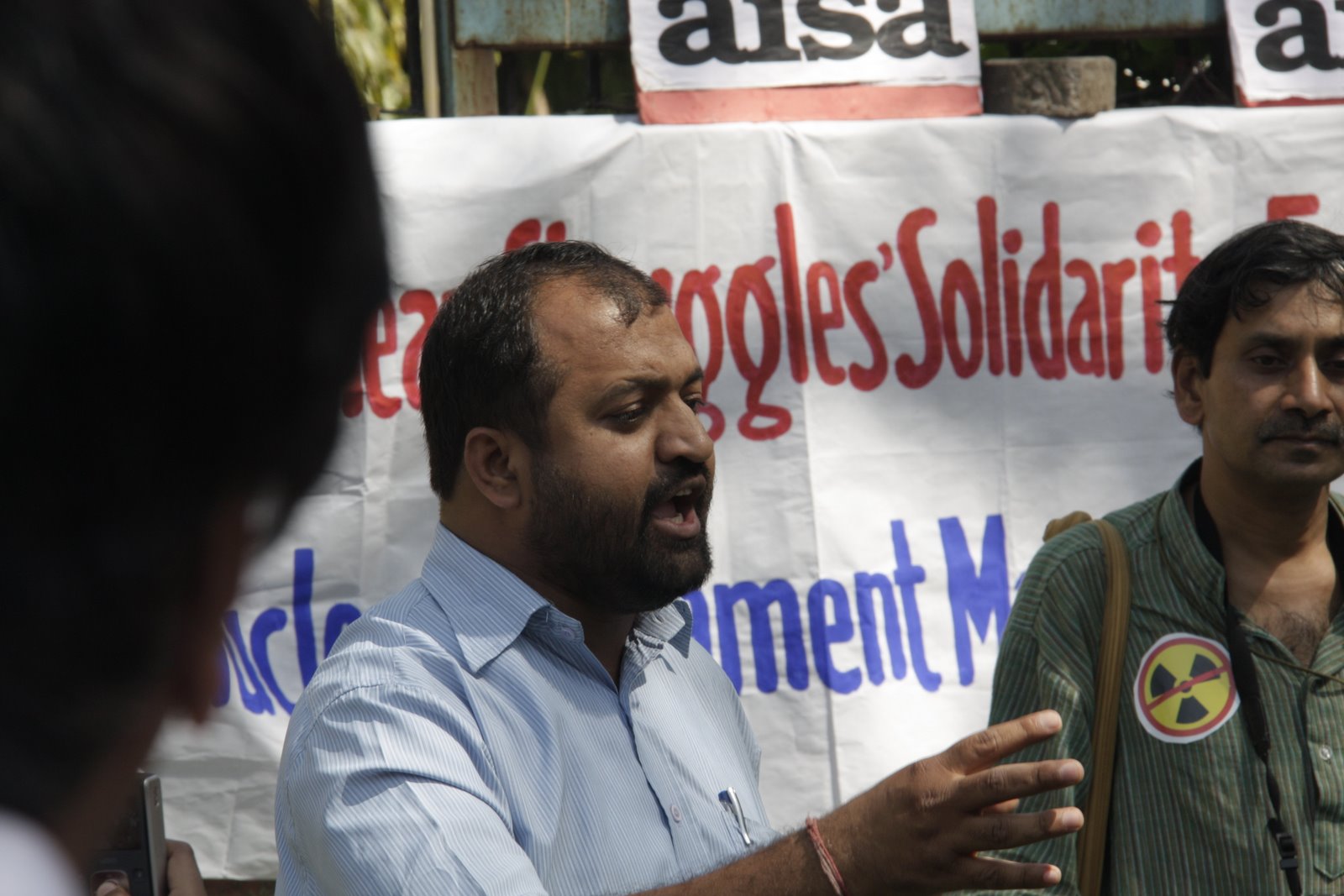

Source: http://www.flickr.com/photos/joeathialy/5559159368/in/set-72157626224553815/
Civil Society Seeks Scrapping of WHO-IAEA Treaty on Nuclear Hazards
Press Statement
Civil Society Seeks Scrapping of WHO-IAEA Treaty on Nuclear HazardsNon-nuclear Energy Options Demanded
"Choice is Clear- No Nuclear"
New Delhi 26/3/2011: No to Nuclear Energy Forum (NNEF), a forum of concerned citizens that tracks information on atomic issues states that at present, International Atomic Energy Agency (IAEA), World Health Organisation (WHO) cannot be trusted with sharing truth about the nuclear catastrophe in Japan and such imminent disasters India because of a 52 years old treaty between WHO and IAEA, which is heavily influenced by Nuclear Suppliers Group (NSG), established in 1975.
NSG comprises of 46 nuclear supplier states including China, Russia, and the US, that have voluntarily agreed to coordinate their export controls governing transfers of civilian nuclear material and nuclear-related equipment and technology to non-nuclear-weapon states. In 2008, the NSG agreed to exempt India from its requirement that recipient countries have in place comprehensive IAEA safeguards covering all nuclear activities. US got exemption from NSG for three years to undertake nuclear trade with India. India is pursuing its nuclear energy path under the overarching guidelines of this very IAEA.
ToxicsWatch Alliance (TWA), a member of the NNEF participated in a joint rally organised by Anti-Nuclear Struggles’ Solidarity Forum on 25th March at Jantar Mantar, New Delhi demanding moratorium on new nuclear projects and an independent review of the existing plants.
The banners at the rally read: Choice is Clear- No Nuclear. The speakers at the rally included Ashok Chaudhury, Praful Bidwai, Gopal Krishna, Soumya Dutta, Bhupindar Singh Rawat, Vinuta Gopal, a student leader from All India Students Association (AISA) among others.
Wikileaks expose has revealed that India's nuclear program is not in the interest of Indian citizens even as the government has been compelled by the tranational nuclear companies to unleash a propaganda about how no disaster will ever happen in India.
Indian government remains callous towards the recent recommendations of a fact finding team led by former Union Finance Secretary which says, "There are plenty of credible and scientific studies by pioneering institutions and experts who have developed convincing models of a comprehensive "carbon- free, nuclear- free" energy policy with a mix of energy conservation, efficiency, R & D on renewable sources, and larger social social-political changes ensuring greater community and public use of resources" referring to report of Union of Concerned Scientists.
TWA opposes nuclear energy and weaponisation plans and programmes in the light of what happened in Three Mile Island, Chernobyl, Fukushima, Hiroshima and Nagasaki.
In such a context, Indian Prime Minister, Dr Manmohan Singh's "statement in Parliament on the Earthquake and Tsunami in Japan" on March 14, 2011 reads: As Honourable Members are aware, the north eastern part of Japan was hit by a massive earthquake and tsunami on the 11th of March." He underplayed the nuclear catastrophe saying, "The disaster has affected some of the nuclear power plants in Japan. The Government of India is in constant touch with the International Atomic Energy Agency, the Japanese Atomic Industrial Forum, and the World Association of Nuclear Operators. In India, we are currently operating 20 nuclear power reactors. 18 of these are the indigenous Pressurised Heavy Water Reactors. Two reactors at Tarapur, TAPS-1& TAPS-2 are Boiling Water Reactors of the type being operated in Japan. A safety audit of these reactors has been completed recently. Indian nuclear plants have in the past met their safety standards. Following the earthquake in Bhuj on 26 January 2002 the Kakrapar Atomic Power Station continued to operate safely without interruption. Following the 2004 tsunami, the Madras Atomic Power Station was safely shutdown without any radiological consequences. It was possible to restart the plant in a few days after regulatory review."
NNEF demands that such claims of Prime Minister must be verified and cross-checked by a high powered committee of Independent experts given the fact that Mamohan Singh who is in-charge of Department of Atomic Energy appears to be guilty of dereliction of duty because he chose to ignore what Union Secretary, Ministry of Health and Family Welfare testified while deposing before the Parliamentary Standing Committee on Science & Technology, Environment & Forests. The Committee's report mentioned that “while drafting the Bill the Dept. of Atomic Energy did not consult them. Since the response system to deal with any kind of emergency of such type, the hospitals are not well-equipped, it is natural that mortality and morbidity due to multiple burn, blasts, radiation injuries and psycho-social impact could be on very high scale and medical tackling of such a large emergency could have enough repercussions in the nearby areas of radioactive fallout."
Union Health Secretary mentioned that in the entire Civil Liability for Nuclear Damage Bill, there is not a single clause which speaks about taking health care during radiological emergencies. It reflects only about payment of compensation due to health impacts of such radiation. She suggested while setting up nuclear plants consideration may also be given to the fact that there should be hospital having trained doctors near such establishments and arrangements should also be made for free treatment of people who are affected by serious nuclear fallout.” Union Health Secretary confessed that her Ministry is nowhere to meet an eventuality that may arise out of nuclear and radiological emergencies.
Observations of G K Pillai, Secretary, Ministry of Home Affairs illustrate how Department of Atomic Energy has not been rigorous in the drafting of the Bill. While commenting on the conditions in which the operator of a nuclear power plant, who could be made liable for nuclear damage, Pillai stated that the Bill contains such terms as armed conflict, hostilities, civil war, insurrection or an act of terrorism that have wide meanings but have not been defined in the present Bill. Therefore there is a need for inserting meanings of these terms from other laws, in Section 2 of this Bill. Such vagueness in connotations can make the operators negligent in observing security procedures and can create situations of disputes between the operator and the central government.
Dr Singh must be deemed responsible for unpardonable negligence for having ignored the suggestions of Union Secretary, Ministry of Labour and Employment who pointed out that grave natural disaster should not include earthquakes or floods while referring to Clause 5 (1) (i) which provided for non-liability of operator for any nuclear damage arising out of a grave natural disaster of an exceptional character.
Dr Singh pretended ignorance about the prventive actions taken by French and German Governments and averred, "I would like to assure Honourable Members of the House that the Government attaches the highest importance to nuclear safety. The Department of Atomic Energy and its agencies including the Nuclear Power Corporation of India have been instructed to undertake an immediate technical review of all safety systems of our nuclear power plants particularly with a view to ensuring that they would be able to withstand the impact of large natural disasters such as tsunamis and earthquakes. I would also like to inform the House that work is underway in the Department of Atomic Energy towards further strengthening India’s national nuclear safety regulatory authority."
Prime Minister's statement and assurance feigns ignorance about how testimony after testimony before the Parliamentary Committee had asked for deletion of the word terrorism from the Bill but the same is not reflected in the Committee’ s report despite the fact that Union Defence Secretary, who also appeared before the Committee categorically stated, “under different layers of protection, nuclear assets including nuclear installations are being protected through Defence. However he admitted that absolute and fool proof protection cannot be guaranteed for any nuclear or other assets in the country during peace or war.” Exceptions for acts of terrorism and natural disasters can easily be used by the supplier and the operator to wash their hands off any nuclear disaster.
Its high time Indian government gave up its Ostirch policy and the nuclear energy path for energy security.
Notably, on 28th May 1959, the WHO 's assembly voted into force an obscure but important agreement with the IAEA founded just two years before in 1957. This agreement has given the IAEA an effective veto on any actions by the WHO that relate in any way to nuclear energy. This prevents the WHO from playing its proper role.
The WHO's objective is to promote "the attainment by all peoples of the highest possible level of health".
The IAEA's mission is to "accelerate and enlarge the contribution of atomic energy to peace, health and prosperity throughout the world".
Since the 21st anniversary of the Chernobyl disaster in April 2007 efforts are on to persuade the WHO to abandon its the WHO-IAEA Agreement. The protest has continued through the WHO's 62nd World Health Assembly.
The scientific case against the agreement is building up, most recently when the European Committee on Radiation Risk (ECRR) called for its abandonment at its conference held in May 2009 in Lesvos, Greece.
NNEF has taken congnisance of the IAEA's Fukushima Nuclear Accident Update, it urges both the corporate media and the non-corporate media besides the world citizens to take such updates with a pinch of salt given the fact that IAEA is both the promoter and regulator of nuclear commerce. Thus, this agency is conflict of interest ridden and does not inspire even an iota of confidence.
WHO's Situation Report titled "Japan Earthquake and Tsunami" dated 25th March, 2011 notes that "A 9.0 magnitude earthquake (updated from the 8.8 magnitude, by Japan Meteorological Agency on 13 March) occurred 11 March 2011 in Japan at 05:46:23 GMT, hitting the northeast coast of Honshu, Japan. The worst affected area is the east coast of Tohoku region. Tsunamis have caused devastation in the coastal areas of Tohoku and southern Hokkaido. Based on official Japanese government figures (15:30 hrs, Tokyo time 25 March), 9 811 people are confirmed dead, 2 779 injured with more than 17 541 missing. There are now 245 394 evacuees." Clearly, WHO is just reproducing Government of Japan's version.
The "Working together to support Japan and the global community:Joint FAO-IAEA-WHO statement on food safety issues following the Fukushima Daiichi nuclear emergency" dated 23rd March, 2011 says, "Since the events of 11 March, thousands of lives have been lost, and many homes and buildings have been damaged or destroyed by the earthquake and tsunami. Japan's transportation infrastructure has also suffered, and cropland and aquaculture installations have been degraded or wiped out. In this situation, damage to the reactors of a nuclear power plant, the resulting risk of direct human exposure to radiation, and efforts to bring the involved installations under control have also received priority attention. Food safety issues are an additional dimension of the emergency. Some food products sampled at sites both within the Fukushima Prefecture and in adjacent areas have been contaminated by radioactive materials." It appears to be underplaying and underestimating the catastrophe due to nuclear energy facility.
The question which remains unanswered is: Isn't India's Department of Atomic Energy (DAE) both the promoter and regulator of nuclear energy facilities on the lines of IAEA? Is it sane to ask the possible perpetrators of acts of ommission and commission to regulate themselves? This is what both DAE and IAEA do.
In such a backdrop, NNEF seeks abandonment of proposed nuclear plants at Koodankulam, Tamil Nadu, Jaitapur, Maharastra, Chutka in Madhya Pradesh, Fatehabad in Haryana, Mithivirdi in Gujarat, Kovvada and Kadapa in Andhra Pradesh and Haripur in West Bengal. It alsoseeks cancellation of new uranium mining sites proposed in Domiasiat in Meghalaya and Nalgonda in Andhra Pradesh. NNEF seeks a white paper from an independent team on existing nuclear power plants and uranium mining sites like the one in Jadugoda in Jharkhand.
TWA has been drawing the attention of the concrned agencies and media towards the testimonies of several Union Secretaries on the matter of liability for nuclear damage Bill given to the Parliamentary Standing Committee on Environment, Forests, Science & Technology wherein they had expressed grave reservations about the Bill and non-existence of health infrastructure to deal with a nuclear emergency. These Secretaries were not consulted while preparing the Bill and their gnawing concerns were disregarded so much so that the Committee recommended that in future they should be consulted.
TWA wonders as to when will such time in future come when public health concerns of the present and future generations and their human rights will be considered which creates a compelling logic against nuclear energy and in favour of non-nuclear energy options. Will it be after a nuclear catastrophe?
TWA demands that in the aftermath of the Fukushima nuclear catastrophe, President of India should send back the Liability for Nuclear Damage Bill to Parliament without giving her assent to it.
For Details: Gopal Krishna, ToxicsWatch Alliance, Member, No to Nuclear Energy Forum (NNEF)
New Delhi, Mb: 07739308480, 09818089660, E-mail: krishna2777@gmail.com
Civil Society Seeks Scrapping of WHO-IAEA Treaty on Nuclear HazardsNon-nuclear Energy Options Demanded
"Choice is Clear- No Nuclear"
New Delhi 26/3/2011: No to Nuclear Energy Forum (NNEF), a forum of concerned citizens that tracks information on atomic issues states that at present, International Atomic Energy Agency (IAEA), World Health Organisation (WHO) cannot be trusted with sharing truth about the nuclear catastrophe in Japan and such imminent disasters India because of a 52 years old treaty between WHO and IAEA, which is heavily influenced by Nuclear Suppliers Group (NSG), established in 1975.
NSG comprises of 46 nuclear supplier states including China, Russia, and the US, that have voluntarily agreed to coordinate their export controls governing transfers of civilian nuclear material and nuclear-related equipment and technology to non-nuclear-weapon states. In 2008, the NSG agreed to exempt India from its requirement that recipient countries have in place comprehensive IAEA safeguards covering all nuclear activities. US got exemption from NSG for three years to undertake nuclear trade with India. India is pursuing its nuclear energy path under the overarching guidelines of this very IAEA.
ToxicsWatch Alliance (TWA), a member of the NNEF participated in a joint rally organised by Anti-Nuclear Struggles’ Solidarity Forum on 25th March at Jantar Mantar, New Delhi demanding moratorium on new nuclear projects and an independent review of the existing plants.
The banners at the rally read: Choice is Clear- No Nuclear. The speakers at the rally included Ashok Chaudhury, Praful Bidwai, Gopal Krishna, Soumya Dutta, Bhupindar Singh Rawat, Vinuta Gopal, a student leader from All India Students Association (AISA) among others.
Wikileaks expose has revealed that India's nuclear program is not in the interest of Indian citizens even as the government has been compelled by the tranational nuclear companies to unleash a propaganda about how no disaster will ever happen in India.
Indian government remains callous towards the recent recommendations of a fact finding team led by former Union Finance Secretary which says, "There are plenty of credible and scientific studies by pioneering institutions and experts who have developed convincing models of a comprehensive "carbon- free, nuclear- free" energy policy with a mix of energy conservation, efficiency, R & D on renewable sources, and larger social social-political changes ensuring greater community and public use of resources" referring to report of Union of Concerned Scientists.
TWA opposes nuclear energy and weaponisation plans and programmes in the light of what happened in Three Mile Island, Chernobyl, Fukushima, Hiroshima and Nagasaki.
In such a context, Indian Prime Minister, Dr Manmohan Singh's "statement in Parliament on the Earthquake and Tsunami in Japan" on March 14, 2011 reads: As Honourable Members are aware, the north eastern part of Japan was hit by a massive earthquake and tsunami on the 11th of March." He underplayed the nuclear catastrophe saying, "The disaster has affected some of the nuclear power plants in Japan. The Government of India is in constant touch with the International Atomic Energy Agency, the Japanese Atomic Industrial Forum, and the World Association of Nuclear Operators. In India, we are currently operating 20 nuclear power reactors. 18 of these are the indigenous Pressurised Heavy Water Reactors. Two reactors at Tarapur, TAPS-1& TAPS-2 are Boiling Water Reactors of the type being operated in Japan. A safety audit of these reactors has been completed recently. Indian nuclear plants have in the past met their safety standards. Following the earthquake in Bhuj on 26 January 2002 the Kakrapar Atomic Power Station continued to operate safely without interruption. Following the 2004 tsunami, the Madras Atomic Power Station was safely shutdown without any radiological consequences. It was possible to restart the plant in a few days after regulatory review."
NNEF demands that such claims of Prime Minister must be verified and cross-checked by a high powered committee of Independent experts given the fact that Mamohan Singh who is in-charge of Department of Atomic Energy appears to be guilty of dereliction of duty because he chose to ignore what Union Secretary, Ministry of Health and Family Welfare testified while deposing before the Parliamentary Standing Committee on Science & Technology, Environment & Forests. The Committee's report mentioned that “while drafting the Bill the Dept. of Atomic Energy did not consult them. Since the response system to deal with any kind of emergency of such type, the hospitals are not well-equipped, it is natural that mortality and morbidity due to multiple burn, blasts, radiation injuries and psycho-social impact could be on very high scale and medical tackling of such a large emergency could have enough repercussions in the nearby areas of radioactive fallout."
Union Health Secretary mentioned that in the entire Civil Liability for Nuclear Damage Bill, there is not a single clause which speaks about taking health care during radiological emergencies. It reflects only about payment of compensation due to health impacts of such radiation. She suggested while setting up nuclear plants consideration may also be given to the fact that there should be hospital having trained doctors near such establishments and arrangements should also be made for free treatment of people who are affected by serious nuclear fallout.” Union Health Secretary confessed that her Ministry is nowhere to meet an eventuality that may arise out of nuclear and radiological emergencies.
Observations of G K Pillai, Secretary, Ministry of Home Affairs illustrate how Department of Atomic Energy has not been rigorous in the drafting of the Bill. While commenting on the conditions in which the operator of a nuclear power plant, who could be made liable for nuclear damage, Pillai stated that the Bill contains such terms as armed conflict, hostilities, civil war, insurrection or an act of terrorism that have wide meanings but have not been defined in the present Bill. Therefore there is a need for inserting meanings of these terms from other laws, in Section 2 of this Bill. Such vagueness in connotations can make the operators negligent in observing security procedures and can create situations of disputes between the operator and the central government.
Dr Singh must be deemed responsible for unpardonable negligence for having ignored the suggestions of Union Secretary, Ministry of Labour and Employment who pointed out that grave natural disaster should not include earthquakes or floods while referring to Clause 5 (1) (i) which provided for non-liability of operator for any nuclear damage arising out of a grave natural disaster of an exceptional character.
Dr Singh pretended ignorance about the prventive actions taken by French and German Governments and averred, "I would like to assure Honourable Members of the House that the Government attaches the highest importance to nuclear safety. The Department of Atomic Energy and its agencies including the Nuclear Power Corporation of India have been instructed to undertake an immediate technical review of all safety systems of our nuclear power plants particularly with a view to ensuring that they would be able to withstand the impact of large natural disasters such as tsunamis and earthquakes. I would also like to inform the House that work is underway in the Department of Atomic Energy towards further strengthening India’s national nuclear safety regulatory authority."
Prime Minister's statement and assurance feigns ignorance about how testimony after testimony before the Parliamentary Committee had asked for deletion of the word terrorism from the Bill but the same is not reflected in the Committee’ s report despite the fact that Union Defence Secretary, who also appeared before the Committee categorically stated, “under different layers of protection, nuclear assets including nuclear installations are being protected through Defence. However he admitted that absolute and fool proof protection cannot be guaranteed for any nuclear or other assets in the country during peace or war.” Exceptions for acts of terrorism and natural disasters can easily be used by the supplier and the operator to wash their hands off any nuclear disaster.
Its high time Indian government gave up its Ostirch policy and the nuclear energy path for energy security.
Notably, on 28th May 1959, the WHO 's assembly voted into force an obscure but important agreement with the IAEA founded just two years before in 1957. This agreement has given the IAEA an effective veto on any actions by the WHO that relate in any way to nuclear energy. This prevents the WHO from playing its proper role.
The WHO's objective is to promote "the attainment by all peoples of the highest possible level of health".
The IAEA's mission is to "accelerate and enlarge the contribution of atomic energy to peace, health and prosperity throughout the world".
Since the 21st anniversary of the Chernobyl disaster in April 2007 efforts are on to persuade the WHO to abandon its the WHO-IAEA Agreement. The protest has continued through the WHO's 62nd World Health Assembly.
The scientific case against the agreement is building up, most recently when the European Committee on Radiation Risk (ECRR) called for its abandonment at its conference held in May 2009 in Lesvos, Greece.
NNEF has taken congnisance of the IAEA's Fukushima Nuclear Accident Update, it urges both the corporate media and the non-corporate media besides the world citizens to take such updates with a pinch of salt given the fact that IAEA is both the promoter and regulator of nuclear commerce. Thus, this agency is conflict of interest ridden and does not inspire even an iota of confidence.
WHO's Situation Report titled "Japan Earthquake and Tsunami" dated 25th March, 2011 notes that "A 9.0 magnitude earthquake (updated from the 8.8 magnitude, by Japan Meteorological Agency on 13 March) occurred 11 March 2011 in Japan at 05:46:23 GMT, hitting the northeast coast of Honshu, Japan. The worst affected area is the east coast of Tohoku region. Tsunamis have caused devastation in the coastal areas of Tohoku and southern Hokkaido. Based on official Japanese government figures (15:30 hrs, Tokyo time 25 March), 9 811 people are confirmed dead, 2 779 injured with more than 17 541 missing. There are now 245 394 evacuees." Clearly, WHO is just reproducing Government of Japan's version.
The "Working together to support Japan and the global community:Joint FAO-IAEA-WHO statement on food safety issues following the Fukushima Daiichi nuclear emergency" dated 23rd March, 2011 says, "Since the events of 11 March, thousands of lives have been lost, and many homes and buildings have been damaged or destroyed by the earthquake and tsunami. Japan's transportation infrastructure has also suffered, and cropland and aquaculture installations have been degraded or wiped out. In this situation, damage to the reactors of a nuclear power plant, the resulting risk of direct human exposure to radiation, and efforts to bring the involved installations under control have also received priority attention. Food safety issues are an additional dimension of the emergency. Some food products sampled at sites both within the Fukushima Prefecture and in adjacent areas have been contaminated by radioactive materials." It appears to be underplaying and underestimating the catastrophe due to nuclear energy facility.
The question which remains unanswered is: Isn't India's Department of Atomic Energy (DAE) both the promoter and regulator of nuclear energy facilities on the lines of IAEA? Is it sane to ask the possible perpetrators of acts of ommission and commission to regulate themselves? This is what both DAE and IAEA do.
In such a backdrop, NNEF seeks abandonment of proposed nuclear plants at Koodankulam, Tamil Nadu, Jaitapur, Maharastra, Chutka in Madhya Pradesh, Fatehabad in Haryana, Mithivirdi in Gujarat, Kovvada and Kadapa in Andhra Pradesh and Haripur in West Bengal. It alsoseeks cancellation of new uranium mining sites proposed in Domiasiat in Meghalaya and Nalgonda in Andhra Pradesh. NNEF seeks a white paper from an independent team on existing nuclear power plants and uranium mining sites like the one in Jadugoda in Jharkhand.
TWA has been drawing the attention of the concrned agencies and media towards the testimonies of several Union Secretaries on the matter of liability for nuclear damage Bill given to the Parliamentary Standing Committee on Environment, Forests, Science & Technology wherein they had expressed grave reservations about the Bill and non-existence of health infrastructure to deal with a nuclear emergency. These Secretaries were not consulted while preparing the Bill and their gnawing concerns were disregarded so much so that the Committee recommended that in future they should be consulted.
TWA wonders as to when will such time in future come when public health concerns of the present and future generations and their human rights will be considered which creates a compelling logic against nuclear energy and in favour of non-nuclear energy options. Will it be after a nuclear catastrophe?
TWA demands that in the aftermath of the Fukushima nuclear catastrophe, President of India should send back the Liability for Nuclear Damage Bill to Parliament without giving her assent to it.
For Details: Gopal Krishna, ToxicsWatch Alliance, Member, No to Nuclear Energy Forum (NNEF)
New Delhi, Mb: 07739308480, 09818089660, E-mail: krishna2777@gmail.com
Blog:toxicswatch.blogspot.com
Narela-Bawana Waste to Energy Plant is anti environment, anti-workers & anti-people
Written By mediavigil on Thursday, March 24, 2011 | 9:15 PM
Note: Delhi must find long-term solutions to its growing waste problem. The landfills have a huge potential to contaminate groundwater, destroy the surrounding environments owing to toxicity and defile the forest. Such landfills will kill the nascent forest. The pits proposed for land filling are green with vegetation. The deep pits in the Bhatti area are ideal rainwater harvesting areas. Delhi's waste, hazardous waste characteristics that will contaminate the groundwater. The pits proposed for land filling are currently green and lush with vegetation. It is a forest in the making.
The pits in the Bhatti mines area are an ideal rainwater harvesting area. It is ironical that Delhi Government is proposing to turn it into a garbage dump. Delhi's waste has hazardous waste characteristics that will contaminate the groundwater. The idea of waste to energy plants based on a tried, tested and failed incineration technology in Okhla, Timarpur, Gazipur and Narela-Bawana is anti environment, anti-workers and anti-people faces bitter opposition. The construction of these plants are in violation of Supreme Court's order.
As to Narela- Bawana waste to energy plant, 4000 TPD of municipal solid waste will be treated in two phases; Phase-I which will process 1000 TPD of waste will compose of a material recovery Facility (MRF) to reclaim metals and recyclables, and sort out organic and combustible material for composting and RDF facilities. Phase-II will compose of a power plant based on Mass-burn technology, which will process 3000 TPD of waste. It is claimed that a total of approximately 12, 86,260 tonnes of solid waste shall be disposed off in this facility up to closure of the facility that has been planned for 25 years. The total project cost is Rs. 70 Crores for Phase – I and Rs. 378 Crore for Phase – II. The project area is 100 acres.
The Narela-Bawan waste to energy plant site is site is accessible through Narela Bawana Road. Old Delhi Railway Station is about 14 km away from the site. Bawana reserve forest is within 2.5 km radius, Sri Krishna Sultanpur reserve forest is within 4.5 km radius and Haryana state boundary is within 5 km radius. The current proposal is to establish a waste to energy plant based on incineration of Refuse-derived fuel (RDF) for generating 36 MW using MSW processing capacity of 3000 TPD. The EIA report of the proposed plant claims that fly ash (that will be generated) will be sent to Landfill which be less than 20% of input waste.
A 40 page report titled "An Industry Blowing Smoke" released by eight national environmental groups saying, the core impacts of all types of incinerators remain the same: They are toxic to public health, harmful to the economy, environment and climate, and undermine recycling and waste reduction programs. It has rightly been argued that "Incinerating the nation's trash is a dirty, damaging and short-sighted non solution to the waste management problem". Its a robust report with 216 references.
The report recommends Zero Waste approach which ToxicsWatch Alliance (TWA) strongly endorses. Zero Waste means striving to reduce waste disposal in landfills and incinerators to zero, iIvesting in reuse, recycling and composting jobs and infrastructure requiring that products are made to be non-toxic and recyclable, ensuring that manufacturers of products assume the full social and environmental costs of what they produce,
ensuring that industries reuse materials and respect worker and community rights, preventing waste and reducing unnecessary consumption.
The report was co-released by Blue Ridge Environmental Defense League www.bredl.org, California Communities Against Toxics www.stoptoxics.org, Clean Water Action www.cleanwateraction.org, Energy Justice Network www.energyjustice.net, Connecticut Coalition for Environmental Justice www.environmental-justice.org, Global Alliance for Incinerator Alternatives
www.no-burn.org, Greenaction for Health and Environmental Justice www.greenaction.org, Toxics Action Center, www.toxicsaction.org
Gopal KrishnaThe pits in the Bhatti mines area are an ideal rainwater harvesting area. It is ironical that Delhi Government is proposing to turn it into a garbage dump. Delhi's waste has hazardous waste characteristics that will contaminate the groundwater. The idea of waste to energy plants based on a tried, tested and failed incineration technology in Okhla, Timarpur, Gazipur and Narela-Bawana is anti environment, anti-workers and anti-people faces bitter opposition. The construction of these plants are in violation of Supreme Court's order.
As to Narela- Bawana waste to energy plant, 4000 TPD of municipal solid waste will be treated in two phases; Phase-I which will process 1000 TPD of waste will compose of a material recovery Facility (MRF) to reclaim metals and recyclables, and sort out organic and combustible material for composting and RDF facilities. Phase-II will compose of a power plant based on Mass-burn technology, which will process 3000 TPD of waste. It is claimed that a total of approximately 12, 86,260 tonnes of solid waste shall be disposed off in this facility up to closure of the facility that has been planned for 25 years. The total project cost is Rs. 70 Crores for Phase – I and Rs. 378 Crore for Phase – II. The project area is 100 acres.
The Narela-Bawan waste to energy plant site is site is accessible through Narela Bawana Road. Old Delhi Railway Station is about 14 km away from the site. Bawana reserve forest is within 2.5 km radius, Sri Krishna Sultanpur reserve forest is within 4.5 km radius and Haryana state boundary is within 5 km radius. The current proposal is to establish a waste to energy plant based on incineration of Refuse-derived fuel (RDF) for generating 36 MW using MSW processing capacity of 3000 TPD. The EIA report of the proposed plant claims that fly ash (that will be generated) will be sent to Landfill which be less than 20% of input waste.
A 40 page report titled "An Industry Blowing Smoke" released by eight national environmental groups saying, the core impacts of all types of incinerators remain the same: They are toxic to public health, harmful to the economy, environment and climate, and undermine recycling and waste reduction programs. It has rightly been argued that "Incinerating the nation's trash is a dirty, damaging and short-sighted non solution to the waste management problem". Its a robust report with 216 references.
The report recommends Zero Waste approach which ToxicsWatch Alliance (TWA) strongly endorses. Zero Waste means striving to reduce waste disposal in landfills and incinerators to zero, iIvesting in reuse, recycling and composting jobs and infrastructure requiring that products are made to be non-toxic and recyclable, ensuring that manufacturers of products assume the full social and environmental costs of what they produce,
ensuring that industries reuse materials and respect worker and community rights, preventing waste and reducing unnecessary consumption.
The report was co-released by Blue Ridge Environmental Defense League www.bredl.org, California Communities Against Toxics www.stoptoxics.org, Clean Water Action www.cleanwateraction.org, Energy Justice Network www.energyjustice.net, Connecticut Coalition for Environmental Justice www.environmental-justice.org, Global Alliance for Incinerator Alternatives
www.no-burn.org, Greenaction for Health and Environmental Justice www.greenaction.org, Toxics Action Center, www.toxicsaction.org
ToxicsWatch Alliance
NEW DELHI: Delhi government has denied permission to the Municipal Corporation of Delhi to use part of the Bhatti mine area as a landfill site since the earmarked portions fell within the boundary of the wildlife sanctuary.
The affidavit filed by the government in the high court states that in light of the provisions of the Wildlife Protection Act, 1972 and the Environment Protection Act, 1986 "MCD should revisit its proposal and explore the feasibility of segregation of the municipal solid wastes for disposal in a suitable area outside the wildlife sanctuary".
The proposal to use abandoned mining pits in Bhatti as landfill was discussed in 2002 and the municipal corporation had been asked to have an environment impact assessment done of the proposed activity. An in-principal approval had also been accorded to the civic agency to use four pits for dumping waste. However, after a survey of the area and a site inspection led by chief secretary Rakesh Mehta it was found that the proposed pits were part of the Bhatti wildlife sanctuary, reserved forest and southern Ridge.
Delhi produces about 8,500 MT of waste per day of which only about 20% is recycled mainly through the unorganized sector of ragpickers. The rest finds its way into three landfill sites the capacity of which has long been exhausted. An MCD official said that according to a Supreme Court order, MCD was to have been allotted 1,500 acres to use as landfill sites but so far they only had 150 acres.
"We will have to assess the implication of this development but it doesn't bode too well for us. Apart from the three existing landfill sites, an integrated one will be coming up in Narela/Bawana in the next three to four months where waste of Civil Lines and Rohini will be taken. We are also looking at other technology like waste to energy and recycling to deal with our waste problem. Two plants, one each in Okhla and Ghazipur, are in an advanced stage of construction and work will soon begin on another one in Narela/Bawana. We also have to focus strongly on recycling," said the official.
The agency has come under severe criticism from several agencies in its inability to manage waste. The overflowing landfill sites also receive construction waste and hazardous waste and have been found to contaminate soil and groundwater.
The Times of India
CBI was always for Anderson's extradition in Bhopal case
Written By krishna on Wednesday, March 23, 2011 | 7:35 PM
Note:I strongly disagree with the mispalced opinion of K K Venugopal in the matter of Anderson's extradition who has opined that "we have missed the bus". It is quite clear by now that while CBI was on its toes, it was not allowed to pursue the case by Rajiv Gandhi and PV Narshimha Rao. One can have a public testimony of ex-CBI Directors to unearth the acoountability of Gandhi and Rao. The myopic surrender of our Ministry of External Affairs (MEA) appears anti-national and against India's supreme public interest.
Gopal Krishna
Court backs CBI plea for Anderson's extradition in Bhopal case
New Delhi, Mar 23 (PTI) A Delhi court today allowed the CBI''s plea for extradition of former Union Carbide Corporation chairman Warren M Anderson, an accused in the 1984 Bhopal Gas Tragedy case, from the United States, saying that "sentiments of the disaster-hit people" is linked to it.
"Considering the entire gamut of facts in its holistic perspective and the sentiments of disaster-hit people, I deem it expedient and in the interest of justice that there is no bar in law in seeking extradition of Warren Anderson from the corresponding US authorities," Chief Metropolitan Magistrate Vinod Yadav said.
The court also said that there is no reason that the US authorities will not heed to the extradition plea.
"I see no ground or reason that why the US authorities would not cooperate with the CBI in extraditing Anderson. The request of the CBI for extradition of Anderson stands allowed," the CMM said.
"Let extradition request to the corresponding US authorities be sent through appropriate ministry for compliance," the court said.
The court''s order came on a CBI plea seeking permission to get 90-year-old Anderson extradited to stand trial in a Bhopal court on charges of culpable homicide not amounting to murder in connection with the world''s worst industrial disaster that left over 15,000 people dead and maimed over five lakh besides killing thousands of animals.
The CBI argued before the court about the seriousness in getting Anderson extradited which it had been trying since 1987 when the charge sheet was filed in the case in the court of Chief Judicial Magistrate in Bhopal.
"A chronology of steps taken by the CBI, right from 1992 till July 2010 in the case would reveal that the CBI was not sleeping over the matter and was conscious about its duties to bring Warren Anderson to book," the judge noted.
PTI
CBI moves court to seek Anderson's extradition
Jiby Kattakayam
NEW DELHI: Laying the groundwork for fresh extradition proceedings against the former Union Carbide Corporation (UCC) chairman, Warren Anderson, to face trial in the Bhopal gas tragedy case, the CBI on Tuesday (23rd March) filed an affidavit in a Tis Hazari court here on Tuesday listing various charges against him.
The world's worst industrial disaster left over 15,000 people dead and over 5 lakh injured or disabled when toxic Methyl Isocyanate gas leaked from the plant owned by the UCC's subsidiary Union Carbide India Limited (UCIL) on the night of December 2/3, 1984. In its affidavit filed before Chief Metropolitan Magistrate Vinod Yadav, the CBI said it was necessary in the interest of justice to extradite Mr. Anderson to face trial in the case pending against him in the court of the CJM, Bhopal. The affidavit is an integral part of the extradition request that will be made by India.
“Mr. Anderson had full knowledge of the defective design and structure of the plant and of the poor safety measures adopted at the UCIL, Bhopal, the consequences of which were bound to occur and did occur when the poisonous gas leaked,” the affidavit said.
The CBI, in its affidavit, listed the facts of the case; the investigations conducted by it, the provisions of the Design Transfer and Technical Service Agreement concluded between the UCC and the UCIL in 1973 for setting up the Bhopal plant; and the results of a 1982 Operational Safety Survey by a U.S.-based team of the UCC which pointed to dangerous shortcomings in the Bhopal plant.
The CBI also attached a report of the Expert Group constituted by the Government of India which studied all the scientific and man-made aspects of the disaster; deposition by various prosecution witnesses and relevant paragraphs of the Bhopal trial court's judgment on June 7, 2010, which had mention of the culpability of the UCC in the disaster. The CBI stated that the Supreme Court order of September 13, 1996, quashing charges under Sections 304-Part II of the IPC against Keshub Mahindra and other eight accused, instead holding that they be charged under Section 304-A did not apply to Mr. Anderson as his trial was separated in 1992 from the remaining accused because of his failure to appear before the court.
The Hindu
Gopal Krishna
Court backs CBI plea for Anderson's extradition in Bhopal case
New Delhi, Mar 23 (PTI) A Delhi court today allowed the CBI''s plea for extradition of former Union Carbide Corporation chairman Warren M Anderson, an accused in the 1984 Bhopal Gas Tragedy case, from the United States, saying that "sentiments of the disaster-hit people" is linked to it.
"Considering the entire gamut of facts in its holistic perspective and the sentiments of disaster-hit people, I deem it expedient and in the interest of justice that there is no bar in law in seeking extradition of Warren Anderson from the corresponding US authorities," Chief Metropolitan Magistrate Vinod Yadav said.
The court also said that there is no reason that the US authorities will not heed to the extradition plea.
"I see no ground or reason that why the US authorities would not cooperate with the CBI in extraditing Anderson. The request of the CBI for extradition of Anderson stands allowed," the CMM said.
"Let extradition request to the corresponding US authorities be sent through appropriate ministry for compliance," the court said.
The court''s order came on a CBI plea seeking permission to get 90-year-old Anderson extradited to stand trial in a Bhopal court on charges of culpable homicide not amounting to murder in connection with the world''s worst industrial disaster that left over 15,000 people dead and maimed over five lakh besides killing thousands of animals.
The CBI argued before the court about the seriousness in getting Anderson extradited which it had been trying since 1987 when the charge sheet was filed in the case in the court of Chief Judicial Magistrate in Bhopal.
"A chronology of steps taken by the CBI, right from 1992 till July 2010 in the case would reveal that the CBI was not sleeping over the matter and was conscious about its duties to bring Warren Anderson to book," the judge noted.
PTI
CBI moves court to seek Anderson's extradition
Jiby Kattakayam
NEW DELHI: Laying the groundwork for fresh extradition proceedings against the former Union Carbide Corporation (UCC) chairman, Warren Anderson, to face trial in the Bhopal gas tragedy case, the CBI on Tuesday (23rd March) filed an affidavit in a Tis Hazari court here on Tuesday listing various charges against him.
The world's worst industrial disaster left over 15,000 people dead and over 5 lakh injured or disabled when toxic Methyl Isocyanate gas leaked from the plant owned by the UCC's subsidiary Union Carbide India Limited (UCIL) on the night of December 2/3, 1984. In its affidavit filed before Chief Metropolitan Magistrate Vinod Yadav, the CBI said it was necessary in the interest of justice to extradite Mr. Anderson to face trial in the case pending against him in the court of the CJM, Bhopal. The affidavit is an integral part of the extradition request that will be made by India.
“Mr. Anderson had full knowledge of the defective design and structure of the plant and of the poor safety measures adopted at the UCIL, Bhopal, the consequences of which were bound to occur and did occur when the poisonous gas leaked,” the affidavit said.
The CBI, in its affidavit, listed the facts of the case; the investigations conducted by it, the provisions of the Design Transfer and Technical Service Agreement concluded between the UCC and the UCIL in 1973 for setting up the Bhopal plant; and the results of a 1982 Operational Safety Survey by a U.S.-based team of the UCC which pointed to dangerous shortcomings in the Bhopal plant.
The CBI also attached a report of the Expert Group constituted by the Government of India which studied all the scientific and man-made aspects of the disaster; deposition by various prosecution witnesses and relevant paragraphs of the Bhopal trial court's judgment on June 7, 2010, which had mention of the culpability of the UCC in the disaster. The CBI stated that the Supreme Court order of September 13, 1996, quashing charges under Sections 304-Part II of the IPC against Keshub Mahindra and other eight accused, instead holding that they be charged under Section 304-A did not apply to Mr. Anderson as his trial was separated in 1992 from the remaining accused because of his failure to appear before the court.
The Hindu
Angry Rally Against Incinerator based Waste to Energy Projects
PRESS STATEMENT

Angry Rally Against Incinerator based Waste to Energy Projects
Such Hazardous Technologies, a Threat to Livelihood & Health
Nuclear Energy Cheaper Than Waste to Energy says, USEPA
Mere shifting of location of the hazardous technology based plant not enough, such technologies should be abandoned
New Delhi, 23 March, 2011: On the 23rd of March 2011 waste pickers marched from Delhi's Kudeshiya Park (near ISBT) to Lt. Governor Office to demand the immediate stoppage of the waste-to-energy plants in Delhi at Okhla- Timarpur (16 MW) and Gazipur (10 MW). Notably, a US Environmental Protection Agency (USEPA) report available on its website observes that the energy generated from municipal waste is costlier than nuclear energy.
The rally was planned today to celebrate the martyardom of Shahid Bhagat Singh, the tallest revolutionary freedom fighter of the country.
Environmental and labour groups have been protesting against these plants since March 2005 and have been joined in by the affected local residents. The plants which got environmental clearance during the tenure of A Raja as Environment Minister are highly suspect and deserve to be reviewed and cancelled.
The proposed polluting technology to deal with the waste from South Delhi, North West Delhi and East Delhi is fraught with disastrous public health consequences for which two companies namely, Timarpur-Okhla Waste Management Company (TOWMCL) and the Unique Waste Processing Company (subsidiary of IL&FS Infrastructure Development Corporation Limited) have been set up. The Timarpur-Okhla carbon credit project was registered on 10th November, 2007 with a claim to reduce greenhouse gases to the tune of 262,791 metric tonnes CO2 equivalent per annum. Unique Waste Processing Company, a subsidiary of Infrastructure Leasing and Financial Services (IL&FS) and Andhra Pradesh Technology Development Centre (APTDC) has incorporated Timarpur-Okhla Waste Management Company for developing the project for processing municipal waste and also to produce electricity at two locations namely Timarpur and Okhla, at the site at Okhla that is adjacent to defunct Okhla Sewage Treatment Plant (STP).
TOWMCL is working with New Delhi Municipal Council (NDMC) and MCD. The Timarpur and Okhla plant will together be processing 650 tonnes per day of MSW at Timarpur site and 1300 tonnes per day of MSW at Okhla and claims to generate 16 MW of electricity. The Gazipur plant will process 1300 tonnes per day of MSW and claims to generate 10 MW of electricity.
It is scientifically established that the plants will emit hazardous pollutants, such as dioxins, which will eventually enter the food chain. Government cannot be allowed to experiment with Delhi’s health. These incinerators are coming up in clear violation of Supreme Court rulings on such plants. “In 2007 the Supreme Court allowed five pilot plants on an experimental basis and that too based only on biological treatment rather than incineration.”
The Supreme Court’s ruling is supported by the White Paper produced by the Ministry of Environment and Forests, stating, “The government claims that this plant will generate electricity, but it will only generate dioxins and other toxic emissions.” Comtroller Auditor General of India (CAG) and Delhi High Court have rebuked the concerned ministries for treating Delhi citizens as guinea pig for experimental technologies that have been tried and have failed.
In such a backdrop, Waste pickers have marched along with Residents, Citizens, Civil society groups, Human rights associations, Environmentalists, Students, Social Activists, NGOs, Trade Unions demanding stoppage of toxic waste to energy plants in Okhla, Timarpur and Gazipur.THEIR DEMANDS ARE AS UNDER

The Supreme Court’s ruling is supported by the White Paper produced by the Ministry of Environment and Forests, stating, “The government claims that this plant will generate electricity, but it will only generate dioxins and other toxic emissions.” Comtroller Auditor General of India (CAG) and Delhi High Court have rebuked the concerned ministries for treating Delhi citizens as guinea pig for experimental technologies that have been tried and have failed.
In such a backdrop, Waste pickers have marched along with Residents, Citizens, Civil society groups, Human rights associations, Environmentalists, Students, Social Activists, NGOs, Trade Unions demanding stoppage of toxic waste to energy plants in Okhla, Timarpur and Gazipur.THEIR DEMANDS ARE AS UNDER

- Union Government should remove incinerator technologies from its waste to energy policy being bulldozed by the Ministry of New & Renewable Energy down the throat of State Governments
- Delhi Government Should Desist from violating Supreme Court's Order and endangering the public health of Delhi residents
- Mere shifting of the location of the hazardous technology based plant is insufficient, such technologies must be abandoned
- Central and State Government should stop with immediate effect the proposed waste to energy plants in Timarpur, Sukhdev Vihar (Okhla) and Gazipur and high cost routes for waste management must be avoided, instead only appropriate methods such as small-scale bio-methanation, composting and proper recycling be propagated.
- Central and State Government should give legal recognition to wastepickers and their role in the collection, segregation and recycling of waste. About 3.5 lakhs of urban poor, mostly migrated from rural areas in search of livelihood, are involved in the waste management informal sector. Wastepickers should be given legal entitlement for the access to and management of waste.
- Central and State Government must take cognizance of the threat to waste pickers’ livelihood. Therefore, municipal waste should not be handed over to private companies. Privatization of the municipal solid waste management should be halted immediately.
- Central and State Government should adopt policies which explicitly aim to reduce resource consumption and associated waste generation. Delhi generates approximately 10.000 Tonnes of waste per day, of which 50% is organic, 30% is recyclable and 20% inert. Both organic waste can be composted and recyclable materials can be managed by wastepickers. Therefore only the inert fraction should be diverted in the sanitation landfills in order to face Delhi’s problem of landfill locations.
- Central and State Government should commit to maximizing recycling, minimizing landfilling, and eliminating incineration altogether. Recycling (including composting and other appropriate systems for managing organics) is strongly preferable to waste disposal on virtually every criterion: greenhouse gas emissions, the release of toxins, employment, social inclusion, sustainability, and public expenditure.
- Central and State Government should recognize the informal recycling sector’s contribution to climate change mitigation; and, when undertaking initiatives in the waste sector, should adopt inclusive and comprehensive planning processes that give wastepickers a voice and vote at every stage of project and policy design.
- Central and State Government should build upon the strengths of existing wastepicker networks with investments and technical support to increase recycling while ensuring decent livelihoods for all workers and traders in the recycling economy.
 A delgation of wastepickers went to meet the Lt Governor who had deputed Ms Padmini Singhla, Additional Secretary to LG for recieving the petition from the waste pickers. She heard the gnawing concerns of a Dioxins emitting technology and informed the delegation comprising of TOXICSWATCH ALLIANCE, All India Kabadi Mazdoor Mahasangh and other partcipating organisations that Mr Sanjiv Mittal, OSD to LG will look into the matter and apprise the LG. It has reliably been learnt that Prime Minister has asked the LG to look into the matter and Union Environment Minister has asked Delhi Chief Minister to attend to the concerns of the residents against the toxic plants.
 For any enquiries call: Shashi Bhushan Pandit, Secretary, All India Kabadi Mazdoor Mahasangh (AIKMM), Mb: 9968413109, Gopal Krishna, Convener, TOXICSWATCH ALLIANCE, Mb: 9818089660, E-mail: krishna2777@gmail.com, Asha Arora, Member, OKHLA ANTI-INCINERATOR CAMPAIGN COMMITTEE, Mb: 9711408421, E-mail: okhlakaghosla@gmail.com, Anant Trivedi, Resident, Eshwar Nagar, Mb: 9868502292, Arif Khan, Resident, Hazi Colony, Mb: 9891519844,
Web:http://toxicswatch.blogspot.com/2011/01/toxic-municipal-waste-to-energy-wte.html
PRESS INVITE: Rally Against Carbon Credit Projects in Delhi
Written By mediavigil on Tuesday, March 22, 2011 | 4:20 AM
PRESS INVITE
Rally Against Carbon Credit Projects in Delhi
Waste pickers protest against privatization and waste-to-energy projects
*Carbon Credit Projects Threaten Livelihood & Cause Pollution*
Delhi, 22nd of March 2011
On the 23rd of March 2011 waste pickers will march from Kudeshiya Park (near ISBT) to Lt. Governor Office to demand the immediate stop of the waste-to-energy plants in Delhi. In complete disregard to the established public health concerns of residents of Delhi, three hazardous incinerator plants are under construction to generate power from waste at Okhla and Timarpur (16 MW) and Gazipur (10 MW). The matter came up for hearing on 14th March in the Delhi High Court. Environmental groups have been protesting against these plants since March 2005.
There is massive opposition to these Waste to Energy projects that has met with protest rally from both the residents of the adjacent colonies and from the waste pickers. The first complain about the contamination that these plants will cause. The second argue that their livelihood will be severely impacted as the recyclable waste, a source of livelihood will be burnt.
A bitter campaign against waste incinerators has brought the residents and waste puckers together. In South Delhi’s Okhla area residents of Batla House, Jamia Nagar, Ghaffar Manzil, Abul Fazl Enclave and Noor Nagar have joined hands. Protests have also been coming up against the incinerator from the major hospitals and health care institutions in the vicinity, the Fortis-Escort Heart Institute, Apollo Indraprastha, Cheshire Homes and the Holy Family Hospital. The Holy Family Hospital management too has joined saying: “Setting up a massive plant of his type without consulting major stakeholders like the nearby hospitals, Apollo, Holy Family and Fortis Escorts, the Jamia University and the residents is nothing short of total disregard for the health of the people of Delhi.”
It is scientifically established that the plant will emit hazardous pollutants which will eventually enter the food chain. Government cannot be allowed to experiment with Delhi’s health. These incinerators are coming up in clear violation of Supreme Court rulings on such plants. “In 2007 the Supreme Court allowed five pilot plants on an experimental basis and that too based only on biological treatment rather than incineration.”
The Supreme Court’s ruling is supported by the White Paper produced by the Ministry of Environment and Forests, stating, “The government claims that this plant will generate electricity, but it will only generate dioxins and other toxic emissions.”
In such a backdrop, Waste pickers will march along with Residents, Citizens, Civil society groups, Human rights associations, Environmentalists, Students, Social Activists, NGOs, Trade Unions demanding stoppage of toxic waste to energy plants in Okhla, Timarpur and Gazipur.
Date: 23rd of March 2011
Time: 12.00
Venue: Kudeshiya Park (near ISBT) to Lt Governor House
For any enquiries call: Shashi Bhushan Pandit, Secretary, All India Kabadi Mazdoor Mahasangh (AIKMM),Mb: 9968413109, Gopal Krishna, Convener, TOXICSWATCH ALLIANCE, Mb: 9818089660, E-mail: krishna2777@gmail.com, Asha Arora, Member, OKHLA ANTI-INCINERATOR CAMPAIGN COMMITTEE, Mb: 9711408421, E-mail: okhlakaghosla@gmail.com, Anant Trivedi, Resident, Eshwar Nagar, Mb: 9868502292, Arif Khan, Resident, Hazi Colony, Mb: 9891519844,
Web: toxicswatch.blogspot.com
http://www.facebook.com/#!/pages/Okhla-ka-Ghosla/112310532173391
Rally Against Carbon Credit Projects in Delhi
Waste pickers protest against privatization and waste-to-energy projects
*Carbon Credit Projects Threaten Livelihood & Cause Pollution*
Delhi, 22nd of March 2011
On the 23rd of March 2011 waste pickers will march from Kudeshiya Park (near ISBT) to Lt. Governor Office to demand the immediate stop of the waste-to-energy plants in Delhi. In complete disregard to the established public health concerns of residents of Delhi, three hazardous incinerator plants are under construction to generate power from waste at Okhla and Timarpur (16 MW) and Gazipur (10 MW). The matter came up for hearing on 14th March in the Delhi High Court. Environmental groups have been protesting against these plants since March 2005.
There is massive opposition to these Waste to Energy projects that has met with protest rally from both the residents of the adjacent colonies and from the waste pickers. The first complain about the contamination that these plants will cause. The second argue that their livelihood will be severely impacted as the recyclable waste, a source of livelihood will be burnt.
A bitter campaign against waste incinerators has brought the residents and waste puckers together. In South Delhi’s Okhla area residents of Batla House, Jamia Nagar, Ghaffar Manzil, Abul Fazl Enclave and Noor Nagar have joined hands. Protests have also been coming up against the incinerator from the major hospitals and health care institutions in the vicinity, the Fortis-Escort Heart Institute, Apollo Indraprastha, Cheshire Homes and the Holy Family Hospital. The Holy Family Hospital management too has joined saying: “Setting up a massive plant of his type without consulting major stakeholders like the nearby hospitals, Apollo, Holy Family and Fortis Escorts, the Jamia University and the residents is nothing short of total disregard for the health of the people of Delhi.”
It is scientifically established that the plant will emit hazardous pollutants which will eventually enter the food chain. Government cannot be allowed to experiment with Delhi’s health. These incinerators are coming up in clear violation of Supreme Court rulings on such plants. “In 2007 the Supreme Court allowed five pilot plants on an experimental basis and that too based only on biological treatment rather than incineration.”
The Supreme Court’s ruling is supported by the White Paper produced by the Ministry of Environment and Forests, stating, “The government claims that this plant will generate electricity, but it will only generate dioxins and other toxic emissions.”
In such a backdrop, Waste pickers will march along with Residents, Citizens, Civil society groups, Human rights associations, Environmentalists, Students, Social Activists, NGOs, Trade Unions demanding stoppage of toxic waste to energy plants in Okhla, Timarpur and Gazipur.
Date: 23rd of March 2011
Time: 12.00
Venue: Kudeshiya Park (near ISBT) to Lt Governor House
For any enquiries call: Shashi Bhushan Pandit, Secretary, All India Kabadi Mazdoor Mahasangh (AIKMM),Mb: 9968413109, Gopal Krishna, Convener, TOXICSWATCH ALLIANCE, Mb: 9818089660, E-mail: krishna2777@gmail.com, Asha Arora, Member, OKHLA ANTI-INCINERATOR CAMPAIGN COMMITTEE, Mb: 9711408421, E-mail: okhlakaghosla@gmail.com, Anant Trivedi, Resident, Eshwar Nagar, Mb: 9868502292, Arif Khan, Resident, Hazi Colony, Mb: 9891519844,
Web: toxicswatch.blogspot.com
http://www.facebook.com/#!/pages/Okhla-ka-Ghosla/112310532173391
Environment Minister Must Reject Incinerator Technology: TWA
Note: Jairam Ramesh has responded to a letter from Toxics Watch Alliance (TWA). Other organisations and RWAs had also written to him. He has asked the Delhi Chief Minister to reconsider the location of the proposed Timarpur-Okhla waste-to-energy plant. Following complaints from several organisations and individuals, He has conveyed the concerns that residents have over the presence of the plant in an area that has residential colonies, hospitals and a green buffer.
He has urged the Delhi Government to re-examine the project and find another location for the project that proposes to convert the waste generated in the city to power. The project is being opposed by residents on the grounds that the plant will produce toxic ash and hazardous residues.
TWA disagrees with the Minister's response becasue the technology which is being used is itself hazardous. Therefore, its shifting alone is not a solution.
TWA
Rethink on waste plant in residential area
Waste-to-energy plant at Okhla: Sheila to review
NEW DELHI: Reacting to a letter written by environment minister Jairam Ramesh to reconsider location of the Timarpur-Okhla waste-to-energy plant, chief minister Sheila Dikshit on Friday (18th March) said she would call a meeting with residents and if there were any serious concerns, the government would take another look at the project.
"I have received the letter this morning. The government will not set up a hazardous plant, and to the best of my knowledge we have been extremely careful with the project. Since there are so many objections, I will call a meeting with residents as soon as the budget session of the assembly gets over. We can also consider a third party intervention in the matter. I will also write to Ramesh and ask if there are any experts he can recommend to study the proposal and suggest what steps should be taken," said Dikshit.
This was extremely important as the government was also planning to set up similar plants at Ghazipur and Mukarba Chowk, the CM said. "If there are any issues with the technology we need to address them before work on the other two commences," said Dikshit.
Ramesh, who had been approached by residents, had written to the CM saying that while residents did not seem opposed to the plant, they had serious "objections to its location near residential colonies, hospitals and a green buffer." He said: "The project is needed, but surely some other location can be found which does not evoke such wide protests."
Dikshit said that the technology had been very tempting since it would address two major issues for the city – power shortage and waste management. "Delhi has a serious waste crisis, and so far we have not managed to identify any additional waste disposal facility. This proposal sounded perfect for our problem and I had been informed that all possible precautions had been taken care of to prevent any health or environmental damage," she said.
The project has met stiff resistance from residents and environment groups. According to sources, none of the similar plants set up in India, including the one in Delhi, have worked due to the composition of waste. "To increase calorific value of the waste, elements like plastic will have to be added but its burning is extremely hazardous to health. Secondly, nobody has been able to tell us how so much waste is going to be transported to the plant. There are several issues which the government has not been able to address so far," said a resident.
TOI
Delhi has failed to handle its hazardous waste: Jairam
The Hindu
Appalled by a report filed on the functioning and the efficiency of the Common Effluent Treatment Plant (CETP) in Okhla, Union Environment Minister Jairam Ramesh has shot off a letter to Delhi Chief Minister Sheila Dikshit instructing her to make amends.
The report that was commissioned by the Minister himself has pointed out that the CETP is not functioning to its full capacity and the city has failed to handle its hazardous waste.
Describing the findings of the report as “damaging” and the situation “unacceptable” both for the Delhi Government as well as the citizens, Mr. Ramesh has called for the Chief Minieter's intervention in taking corrective measures. The Minister has also regretted that a Treatment Storage and Disposal Facility (TSDF) for hazardous wastes in and around the city has not been established so far.
According to the report filed by engineers from the Odisha Pollution Control Board, the CETP in Okhla has an installed capacity of 24 MLD, but is treating only 4 MLD of effluents. Designed for treatment of industrial effluents, the CETP receives 95 per cent domestic effluents for treatment, the report claims. It says, the CETP receives 4 MLD effluents, which includes 95 per cent sewage and 5 per cent industrial effluents.
It further says the treated effluent is discharged to domestic waste water drain which again goes to the CETP for treatment. “This causes unnecessary load on the CETP. Such disposal of treated waste water into raw effluent without recycle or reuse makes no sense,” the report says.
The engineers from OPCB have suggested using treated waste water for plantation purposes instead of discharging it into any water body.
“Till date the generated sludge, which is hazardous in nature is being stored in a shed inside the premises. No scientific disposal of the waste is being carried out, which indicates non-compliance,” the report points out, adding the sludge generated should be sent to TSDF for further disposal.
The Minister has also asked the Chief Minister to reconsider the location of the proposed Timarpur-Okhla waste-to-energy plant. Following complaints from several organisations and individuals, Mr. Ramesh has conveyed the concerns that residents have over the presence of the plant in an area that has residential colonies, hospitals and a green buffer.
He has urged the Delhi Government to re-examine the project and find another location for the project that proposes to convert the waste generated in the city to power. The project is being opposed by residents on the grounds that the plant will produce toxic ash and hazardous residues.
--------------------------------------------------------------------------------
‘Common Effluent Treatment Plant at Okhla not functioning to its full capacity'
‘No Treatment Storage and Disposal Facility (TSDF) for hazardous wastes in the city so far'
---------------------------------------------------------------------------------
The Hindu
Going for the burn
Environment minister Jairam Ramesh doesn’t think it should come up in the present location of a densely populated residential area. The Asian Development Bank’s Asian Pacific Carbon Fund has dropped it from its aid portfolio.
Also, the residents of 15 south Delhi colonies (numbering nearly 500,000 people) are dead against it. Yet, for some unfathomable reasons, the Delhi government is pushing the Rs 200-crore Timarpur-Okhla waste-to-energy project that is coming up on a 15-acre Municipal Corporation of Delhi plot, a few hundred metres from south Delhi colonies like Sukhdev Vihar, Maharani Bagh and New Friends Colony, near three premier hospitals (Holy Family, Fortis-Escorts and Apollo Indraprastha) and an old age home.
It is being built on land that was seen as a green buffer between the residential areas and a biomedical waste plant set up years ago.
Like many other projects in India, this too began with a public hearing — an eyewash, really — in 2006 when the DMK’s A Raja was the Union environment minister.
The Delhi government claims that it had given a newspaper notice for the public hearing (a legal requirement for projects of this size) on December 17, 2006, but no resident of the area attended the meeting. Residents, however, tell a different story. They allege that the public notice was drafted in a manner as to conceal the fact that 2,050 tonnes of municipal solid waste would be burnt everyday to generate 16 MW of electricity.
Later a Right to Information (RTI) petition found that only a few people attended the hearing: an engineer from the project proponents, the Delhi Pollution Control Committee, and a department clerk.
Alarmingly, the Environment Impact Assessment Report of the project, which formed the basis of the clearance, has since gone missing. Today, the case is in the Delhi High Court and will come up for hearing on March 14.
Interestingly, there’s a Supreme Court ban on such waste-to-energy plants and the court has allowed only five pilot projects to test their viability. The one under construction in south Delhi, a private-public partnership between the Delhi government and Jindal Ecopolis, is not one of those pilot plants.
Yet, at the Delhi High Court, the state government touted this project as one. But replying to an RTI question, the Union ministry for renewable energy replied that it’s not one of the five pilot projects okayed by the apex court.
While the government and the company say that there are no health hazards from the project, it is well known that all municipal waste combustors, regardless of what technology they use, release a number of pollutants including cadmium, lead, dioxin, sulfur dioxide, hydrogen chloride and nitrogen dioxide.
Dioxin and furans are toxic and they tend to persist in the environment for generations. Studies of human populations living near incinerators and of compounds released indicate that incinerators are associated with numerous health problems, especially in children and other vulnerable populations. These health problems include nerve damage, delayed development, birth defects, brain damage, respiratory and cardiovascular ailments, and cancer.
Then there’s the issue of plastics: the residents feel that complete elimination of plastics is impossible and they would be burnt as part of fuel to attain the desirable calorific value for the project during operations. This, they feel, will directly expose the communities to highly toxic pollutants. In fact, the Municipal Solid Waste Rules, 2000, rules say it’s illegal to incinerate chlorinated plastics (like PVC) and wastes chemically treated with any chlorinated disinfectant.
Cleverly, the government has used the climate change shield as a cover for the project and termed it as a renewable project. But annexure A of the Kyoto Protocol says that waste incineration is a greenhouse gas-emitter!
These are some of the serious questions that need to be answered. But as things stand now, the government refuses to remove its earplugs as residents run pillar to post for a fair hearing.
HT
He has urged the Delhi Government to re-examine the project and find another location for the project that proposes to convert the waste generated in the city to power. The project is being opposed by residents on the grounds that the plant will produce toxic ash and hazardous residues.
TWA disagrees with the Minister's response becasue the technology which is being used is itself hazardous. Therefore, its shifting alone is not a solution.
White Paper produced by his Ministry has already recommended against such dioxins and other toxic emissions.generating technology. The Minister must take note of it and reject this technology is which is a POPs and GHGs emitter.
Gopal KrishnaTWA
Rethink on waste plant in residential area
Waste-to-energy plant at Okhla: Sheila to review
NEW DELHI: Reacting to a letter written by environment minister Jairam Ramesh to reconsider location of the Timarpur-Okhla waste-to-energy plant, chief minister Sheila Dikshit on Friday (18th March) said she would call a meeting with residents and if there were any serious concerns, the government would take another look at the project.
"I have received the letter this morning. The government will not set up a hazardous plant, and to the best of my knowledge we have been extremely careful with the project. Since there are so many objections, I will call a meeting with residents as soon as the budget session of the assembly gets over. We can also consider a third party intervention in the matter. I will also write to Ramesh and ask if there are any experts he can recommend to study the proposal and suggest what steps should be taken," said Dikshit.
This was extremely important as the government was also planning to set up similar plants at Ghazipur and Mukarba Chowk, the CM said. "If there are any issues with the technology we need to address them before work on the other two commences," said Dikshit.
Ramesh, who had been approached by residents, had written to the CM saying that while residents did not seem opposed to the plant, they had serious "objections to its location near residential colonies, hospitals and a green buffer." He said: "The project is needed, but surely some other location can be found which does not evoke such wide protests."
Dikshit said that the technology had been very tempting since it would address two major issues for the city – power shortage and waste management. "Delhi has a serious waste crisis, and so far we have not managed to identify any additional waste disposal facility. This proposal sounded perfect for our problem and I had been informed that all possible precautions had been taken care of to prevent any health or environmental damage," she said.
The project has met stiff resistance from residents and environment groups. According to sources, none of the similar plants set up in India, including the one in Delhi, have worked due to the composition of waste. "To increase calorific value of the waste, elements like plastic will have to be added but its burning is extremely hazardous to health. Secondly, nobody has been able to tell us how so much waste is going to be transported to the plant. There are several issues which the government has not been able to address so far," said a resident.
TOI
Delhi has failed to handle its hazardous waste: Jairam
The Hindu
Appalled by a report filed on the functioning and the efficiency of the Common Effluent Treatment Plant (CETP) in Okhla, Union Environment Minister Jairam Ramesh has shot off a letter to Delhi Chief Minister Sheila Dikshit instructing her to make amends.
The report that was commissioned by the Minister himself has pointed out that the CETP is not functioning to its full capacity and the city has failed to handle its hazardous waste.
Describing the findings of the report as “damaging” and the situation “unacceptable” both for the Delhi Government as well as the citizens, Mr. Ramesh has called for the Chief Minieter's intervention in taking corrective measures. The Minister has also regretted that a Treatment Storage and Disposal Facility (TSDF) for hazardous wastes in and around the city has not been established so far.
According to the report filed by engineers from the Odisha Pollution Control Board, the CETP in Okhla has an installed capacity of 24 MLD, but is treating only 4 MLD of effluents. Designed for treatment of industrial effluents, the CETP receives 95 per cent domestic effluents for treatment, the report claims. It says, the CETP receives 4 MLD effluents, which includes 95 per cent sewage and 5 per cent industrial effluents.
It further says the treated effluent is discharged to domestic waste water drain which again goes to the CETP for treatment. “This causes unnecessary load on the CETP. Such disposal of treated waste water into raw effluent without recycle or reuse makes no sense,” the report says.
The engineers from OPCB have suggested using treated waste water for plantation purposes instead of discharging it into any water body.
“Till date the generated sludge, which is hazardous in nature is being stored in a shed inside the premises. No scientific disposal of the waste is being carried out, which indicates non-compliance,” the report points out, adding the sludge generated should be sent to TSDF for further disposal.
The Minister has also asked the Chief Minister to reconsider the location of the proposed Timarpur-Okhla waste-to-energy plant. Following complaints from several organisations and individuals, Mr. Ramesh has conveyed the concerns that residents have over the presence of the plant in an area that has residential colonies, hospitals and a green buffer.
He has urged the Delhi Government to re-examine the project and find another location for the project that proposes to convert the waste generated in the city to power. The project is being opposed by residents on the grounds that the plant will produce toxic ash and hazardous residues.
--------------------------------------------------------------------------------
‘Common Effluent Treatment Plant at Okhla not functioning to its full capacity'
‘No Treatment Storage and Disposal Facility (TSDF) for hazardous wastes in the city so far'
---------------------------------------------------------------------------------
The Hindu
Going for the burn
Environment minister Jairam Ramesh doesn’t think it should come up in the present location of a densely populated residential area. The Asian Development Bank’s Asian Pacific Carbon Fund has dropped it from its aid portfolio.
Also, the residents of 15 south Delhi colonies (numbering nearly 500,000 people) are dead against it. Yet, for some unfathomable reasons, the Delhi government is pushing the Rs 200-crore Timarpur-Okhla waste-to-energy project that is coming up on a 15-acre Municipal Corporation of Delhi plot, a few hundred metres from south Delhi colonies like Sukhdev Vihar, Maharani Bagh and New Friends Colony, near three premier hospitals (Holy Family, Fortis-Escorts and Apollo Indraprastha) and an old age home.
It is being built on land that was seen as a green buffer between the residential areas and a biomedical waste plant set up years ago.
Like many other projects in India, this too began with a public hearing — an eyewash, really — in 2006 when the DMK’s A Raja was the Union environment minister.
The Delhi government claims that it had given a newspaper notice for the public hearing (a legal requirement for projects of this size) on December 17, 2006, but no resident of the area attended the meeting. Residents, however, tell a different story. They allege that the public notice was drafted in a manner as to conceal the fact that 2,050 tonnes of municipal solid waste would be burnt everyday to generate 16 MW of electricity.
Later a Right to Information (RTI) petition found that only a few people attended the hearing: an engineer from the project proponents, the Delhi Pollution Control Committee, and a department clerk.
Alarmingly, the Environment Impact Assessment Report of the project, which formed the basis of the clearance, has since gone missing. Today, the case is in the Delhi High Court and will come up for hearing on March 14.
Interestingly, there’s a Supreme Court ban on such waste-to-energy plants and the court has allowed only five pilot projects to test their viability. The one under construction in south Delhi, a private-public partnership between the Delhi government and Jindal Ecopolis, is not one of those pilot plants.
Yet, at the Delhi High Court, the state government touted this project as one. But replying to an RTI question, the Union ministry for renewable energy replied that it’s not one of the five pilot projects okayed by the apex court.
While the government and the company say that there are no health hazards from the project, it is well known that all municipal waste combustors, regardless of what technology they use, release a number of pollutants including cadmium, lead, dioxin, sulfur dioxide, hydrogen chloride and nitrogen dioxide.
Dioxin and furans are toxic and they tend to persist in the environment for generations. Studies of human populations living near incinerators and of compounds released indicate that incinerators are associated with numerous health problems, especially in children and other vulnerable populations. These health problems include nerve damage, delayed development, birth defects, brain damage, respiratory and cardiovascular ailments, and cancer.
Then there’s the issue of plastics: the residents feel that complete elimination of plastics is impossible and they would be burnt as part of fuel to attain the desirable calorific value for the project during operations. This, they feel, will directly expose the communities to highly toxic pollutants. In fact, the Municipal Solid Waste Rules, 2000, rules say it’s illegal to incinerate chlorinated plastics (like PVC) and wastes chemically treated with any chlorinated disinfectant.
Cleverly, the government has used the climate change shield as a cover for the project and termed it as a renewable project. But annexure A of the Kyoto Protocol says that waste incineration is a greenhouse gas-emitter!
These are some of the serious questions that need to be answered. But as things stand now, the government refuses to remove its earplugs as residents run pillar to post for a fair hearing.
HT